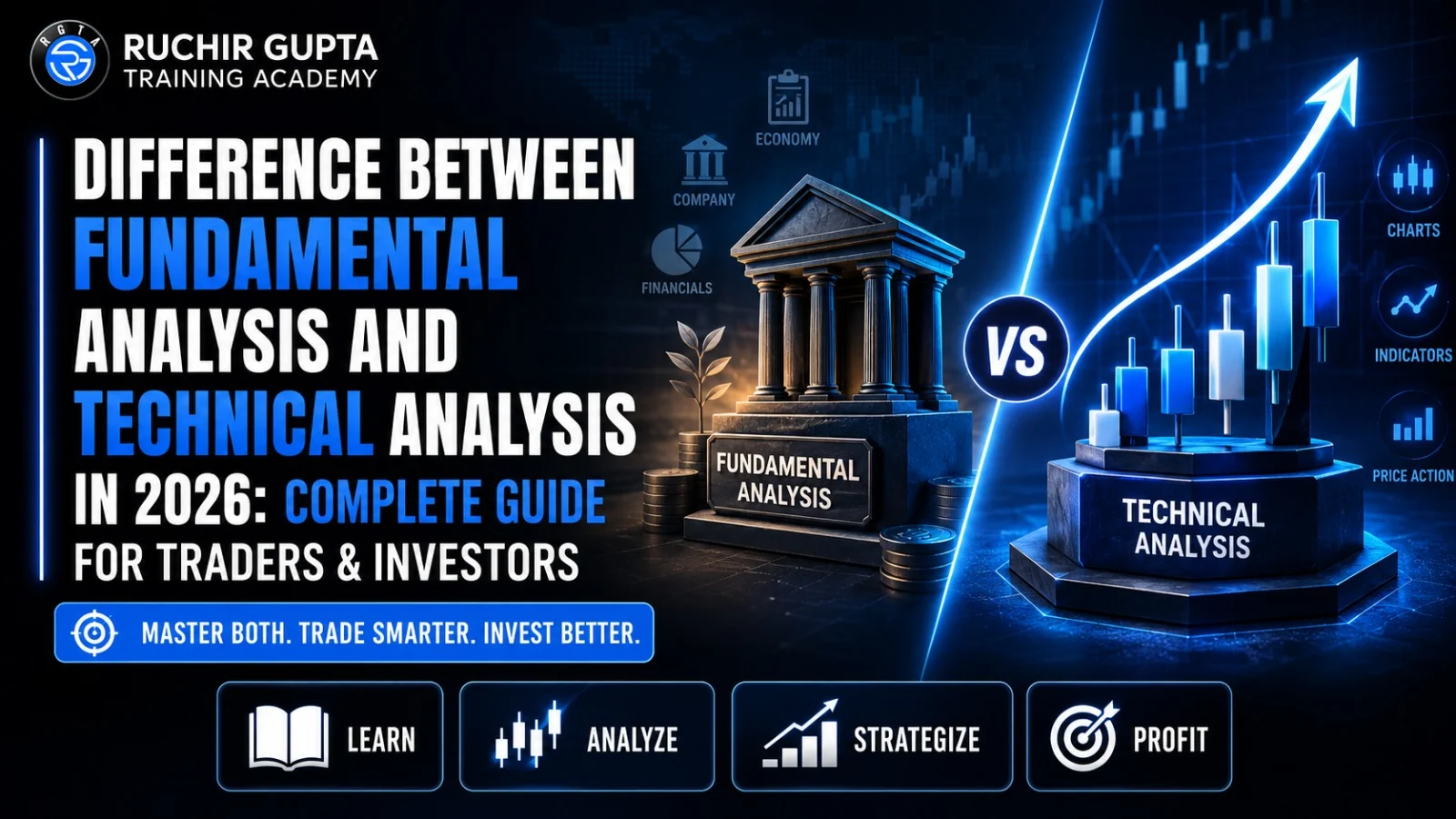
Difference Between Fundamental Analysis and Technical Analysis in 2026: Complete Guide for Traders & Investors
The difference between fundamental analysis and technical analysis is one of the most searched topics in the financial world today. Whether someone is learning fundamental analysis of stocks for long-term investing or studying technical analysis of stocks for intraday trading, understanding both approaches is essential in 2026.
The stock market has changed dramatically. AI-driven trading systems, high-frequency algorithms, options trading growth, and retail trader participation have made technical analysis in stock market trading more important than ever. At the same time, long-term investors still rely heavily on stock fundamental analysis to identify strong businesses and wealth-building opportunities.
This is why smart traders now combine:
- fundamental analysis of stocks
- technical analysis of stocks market
- price action trading
- support and resistance trading
- stock market chart analysis
- moving average trading strategy
- candlestick pattern analysis
to improve decision-making.
If you want to become a better trader or investor, this complete guide will help you understand:
- the real difference between fundamental analysis and technical analysis
- how technical analysis of stocks works
- how fundamental analysis of stocks works
- which strategy is better in 2026
- how professional traders combine both methods
Quick Answer: Difference Between Fundamental Analysis and Technical Analysis
Feature | Fundamental Analysis of Stocks | Technical Analysis of Stocks |
Focus | Business Value | Price Movement |
Used By | Investors | Traders |
Goal | Long-Term Growth | Short-Term Profit |
Main Tools | PE Ratio Analysis, EPS | |
Timeframe | Months to Years | Minutes to Months |
Market Psychology | Less Important | Very Important |
Best For | Investing | Trading |
Popular Methods | Stock Fundamental Analysis | Stock Market Chart Analysis |
What is Fundamental Analysis of Stocks?
Fundamental analysis of stocks means evaluating the financial strength and future growth potential of a company.
In stock fundamental analysis, investors study:
- Revenue growth
- Earnings growth
- PE ratio analysis
- Debt levels
- Business expansion
- Industry growth
- Cash flow
- Management quality
The purpose of fundamental analysis of stocks is to identify companies that may grow significantly over the long term.
Example of Fundamental Analysis of Stocks
Suppose a company:
- increases profits consistently
- expands globally
- maintains low debt
- generates strong cash flow
A long-term investor using stock fundamental analysis may consider that company a strong investment opportunity.
This is why fundamental analysis of stocks is popular among:
- value investors
- mutual funds
- portfolio managers
- retirement investors
What is Technical Analysis of Stocks?
Technical analysis of stocks studies:
- price movement
- volume
- market trends
- candlestick patterns
- support and resistance trading zones
Unlike fundamental analysis of stocks, technical analysis of stocks market strategies focus on charts instead of company financials.
The core belief behind technical analysis in stock market trading is:
“Price already reflects all available information.”
Why Technical Analysis of Stocks Market is Growing Rapidly
The popularity of technical analysis of stocks market trading has increased massively because:
- retail trading is growing globally
- intraday trading is becoming more common
- options trading volume is rising
- AI scanners identify opportunities faster
- traders prefer chart-based execution
This has increased demand for:
- candlestick pattern analysis
- support and resistance trading
- stock market chart analysis
- moving average trading strategy
- price action trading
Fundamental vs Technical Analysis: Core Differences
1. Objective
Fundamental Analysis of Stocks
The goal is to identify undervalued businesses.
Technical Analysis of Stocks
The goal is to predict future price movement.
2. Time Horizon
Analysis Type | Best Timeframe |
Fundamental Analysis of Stocks | Long-Term |
Technical Analysis of Stocks | Short-Term |
3. Data Used
Fundamental Analysis | Technical Analysis |
PE Ratio Analysis | Candlestick Pattern Analysis |
Revenue | Stock Market Chart Analysis |
Profit Growth | Moving Average Trading Strategy |
Balance Sheet | Support and Resistance Trading |
Cash Flow | Price Action Trading |
Key Components of Fundamental Analysis of Stocks
1. PE Ratio Analysis
PE ratio analysis is one of the most important parts of fundamental analysis of stocks.
Formula:
PE Ratio=Market Price Per ShareEarnings Per SharePE\ Ratio = \frac{Market\ Price\ Per\ Share}{Earnings\ Per\ Share}PE Ratio=Earnings Per ShareMarket Price Per Share
Why PE Ratio Analysis Matters
PE ratio analysis helps investors determine:
whether a stock is expensive
whether a stock is undervalued
market expectations
2. Earnings Per Share (EPS)
EPS helps evaluate profitability.
EPS=Net Profit−Preferred DividendsOutstanding SharesEPS = \frac{Net\ Profit – Preferred\ Dividends}{Outstanding\ Shares}EPS=Outstanding SharesNet Profit−Preferred Dividends
3. Revenue Growth
Strong revenue growth is a major factor in stock fundamental analysis.
4. Debt-to-Equity Ratio
Debt analysis helps investors avoid financially weak companies.
5. Return on Equity (ROE)
ROE measures business efficiency.
Key Components of Technical Analysis of Stocks
1. Candlestick Pattern Analysis
Candlestick pattern analysis is one of the most widely used methods in technical analysis of stocks market trading.
Popular patterns:
- Hammer
- Doji
- Bullish engulfing
- Morning star
- Shooting star
Professional traders use candlestick pattern analysis to understand:
- buyer strength
- seller pressure
- market psychology
2. Support and Resistance Trading
Support and resistance trading helps identify:
- buying zones
- selling zones
- breakout areas
- reversal zones
This is one of the most important concepts in technical analysis in stock market trading.
3. Moving Average Trading Strategy
A moving average trading strategy helps traders identify trends.
Most popular moving averages:
- 20 EMA
- 50 EMA
- 200 DMA
Formula:
SMA=P1+P2+P3+…+PnnSMA = \frac{P_1 + P_2 + P_3 + … + P_n}{n}SMA=nP1+P2+P3+…+Pn
4. Price Action Trading
Price action trading focuses on raw market movement without relying heavily on indicators.
Many professional traders prefer price action trading because:
- it reduces confusion
- improves chart reading
- improves execution quality
5. Stock Market Chart Analysis
Stock market chart analysis helps traders identify:
- trends
- breakouts
- reversals
- momentum
This is why technical analysis of stocks market methods continue to dominate intraday and swing trading.
Which is Better: Fundamental Analysis or Technical Analysis?
The answer depends on your goal.
Goal | Better Strategy |
Long-Term Investing | Fundamental Analysis of Stocks |
Intraday Trading | Technical Analysis of Stocks |
Swing Trading | Technical Analysis in Stock Market |
Portfolio Building | Stock Fundamental Analysis |
Options Trading | Technical Analysis of Stocks Market |
Best Strategy in 2026
The smartest traders combine:
- fundamental analysis of stocks
- technical analysis of stocks
- candlestick pattern analysis
- support and resistance trading
- moving average trading strategy
- price action trading
This improves:
- accuracy
- timing
- risk management
- trade quality
Real-World Example
Investor Using Fundamental Analysis of Stocks
Studies:
- PE ratio analysis
- revenue growth
- earnings
- balance sheet
Conclusion:
“This company can grow over 5 years.”
Trader Using Technical Analysis of Stocks
Studies:
- stock market chart analysis
- support and resistance trading
- candlestick pattern analysis
- moving average trading strategy
Conclusion:
“This stock can move 10% this week.”
Why Technical Analysis in Stock Market is Dominating in 2026
The rise of:
- algorithmic trading
- AI scanners
- options trading
- mobile trading apps
has increased the importance of:
- technical analysis of stocks market
- price action trading
- support and resistance trading
- stock market chart analysis
Common Beginner Mistakes
1. Using Too Many Indicators
Many traders overload charts.
Instead, focus on:
moving average trading strategy
support and resistance trading
candlestick pattern analysis
2. Ignoring Risk Management
Risk management matters more than prediction accuracy.
3. Trading Emotionally
Emotional trading destroys discipline.
Best Way to Learn Technical Analysis of Stocks
Most traders fail because they:
- learn random strategies
- follow social media tips
- lack mentorship
This is why many beginners now join structured online stock market courses.
According to academy information, Ruchir Gupta Training Academy teaches:
- technical analysis of stocks
- price action trading
- support and resistance trading
- moving average trading strategy
- stock market chart analysis
- options trading
- scanner-based trading
- risk management
The academy states that over 3 lakh students have been trained globally.
Best Stock Market Course Online – Ruchir Gupta
If you want to learn:
- technical analysis in stock market
- fundamental analysis of stocks
- intraday trading
- options trading
- candlestick pattern analysis
- support and resistance trading
- stock market chart analysis
many traders now explore structured learning programs by Ruchir Gupta Training Academy.
According to the academy profile:
- Ruchir Gupta has 20+ years of market experience
- He is recognized as a stock market mentor and trading educator
- He focuses on disciplined and rule-based trading systems
Join stock market course by Ruchir Guptha. Learn intraday, options trading & technical analysis with live training and mentorship from one of the trusted stock market mentors and trading experts in India.
Final Thoughts
The difference between fundamental analysis and technical analysis is not about which method is right or wrong.
It is about:
- your goals
- your trading style
- your timeframe
If you want:
- long-term wealth → focus on fundamental analysis of stocks
- short-term trading → focus on technical analysis of stocks
- consistent market growth → combine both
In 2026, traders who understand:
- technical analysis of stocks market
- stock market chart analysis
- candlestick pattern analysis
- support and resistance trading
- moving average trading strategy
- price action trading
- stock fundamental analysis
will have a much stronger edge in the financial markets.
Forex Trading vs Stock Trading
Common Forex Trading Mistakes
Forex Trading Scam Awareness
Common Forex Scams in India
❌ Guaranteed returns
❌ Telegram VIP groups
❌ Fake forex robots
❌ Offshore withdrawal traps
❌ “Double your money” schemes
Always verify:
broker regulation
mentor credibility
trading transparency
Future of Forex Trading in India (2026–2027)
The Indian currency market is expanding rapidly due to:
- digital trading adoption
- retail investor participation
- fintech innovation
- financial literacy growth
However, regulations are also becoming stricter to protect investors.
Final Verdict
Forex trading in India is completely legal when traders follow:
- RBI guidelines
- FEMA regulations
- SEBI rules
The biggest mistake beginners make is chasing shortcuts instead of learning structured trading methods.
Professional traders focus on:
- discipline
- consistency
- risk management
- systematic analysis
This is why structured learning programs are becoming increasingly popular among serious traders.
The Best Forex Trading Course | Learn With Ruchir Gupta focuses on practical market understanding, scanner-based trade filtering, risk management, and disciplined forex trading systems designed for long-term consistency instead of emotional speculation.
Also read : Highest Dividend Paying Stocks in India
People Also Ask
What is the difference between fundamental analysis and technical analysis?
The difference between fundamental analysis and technical analysis is that fundamental analysis studies company financials, while technical analysis studies charts and price movement.
Which is better fundamental analysis or technical analysis?
Fundamental analysis is better for investing, while technical analysis is better for trading.
What is technical analysis in stock market?
Technical analysis in stock market trading studies price charts, indicators, and trends.
What is stock fundamental analysis?
Stock fundamental analysis evaluates company performance and valuation.
FAQs
What is fundamental analysis of stocks?
Fundamental analysis of stocks evaluates company financials and growth potential.
What is technical analysis of stocks?
Technical analysis of stocks studies chart patterns and price trends.
What is technical analysis of stocks market?
Technical analysis of stocks market methods use charts, indicators, and volume analysis to identify opportunities.
What is the difference between fundamental analysis and technical analysis?
Fundamental analysis focuses on business value, while technical analysis focuses on market behavior.
What is stock market chart analysis?
Stock market chart analysis studies price patterns and trend movement.
What is candlestick pattern analysis?
Candlestick pattern analysis identifies buyer and seller behavior using chart formations.
What is support and resistance trading?
Support and resistance trading identifies major buying and selling levels.
What is moving average trading strategy?
It carries high risk.
A moving average trading strategy identifies trends using average prices.
RBI regulates foreign exchange.
What is price action trading?
India’s foreign exchange regulation act.
Price action trading studies raw chart movement without excessive indicators.
Price action trading studies raw chart movement without excessive indicators.
Which is better technical analysis or fundamental analysis?
It depends on whether you are trading or investing.
Is technical analysis accurate?
Technical analysis improves probability but cannot guarantee profits.
Is technical analysis useful in 2026?
Yes. Technical analysis in stock market trading remains highly effective.
What is PE ratio analysis?
PE ratio analysis compares stock price with earnings.
How do traders use technical analysis of stocks?
Traders use charts, indicators, and patterns for decision-making.
Why is stock fundamental analysis important?
Stock fundamental analysis helps identify quality companies.
What is the best stock market course online?
Courses with live mentorship and practical training are generally preferred.
Who is Ruchir Gupta?
Ruchir Gupta is a stock market mentor and trading educator with 20+ years of experience.
Can beginners learn technical analysis of stocks?
Yes. Beginners can learn technical analysis of stocks through structured training and practice.
External References