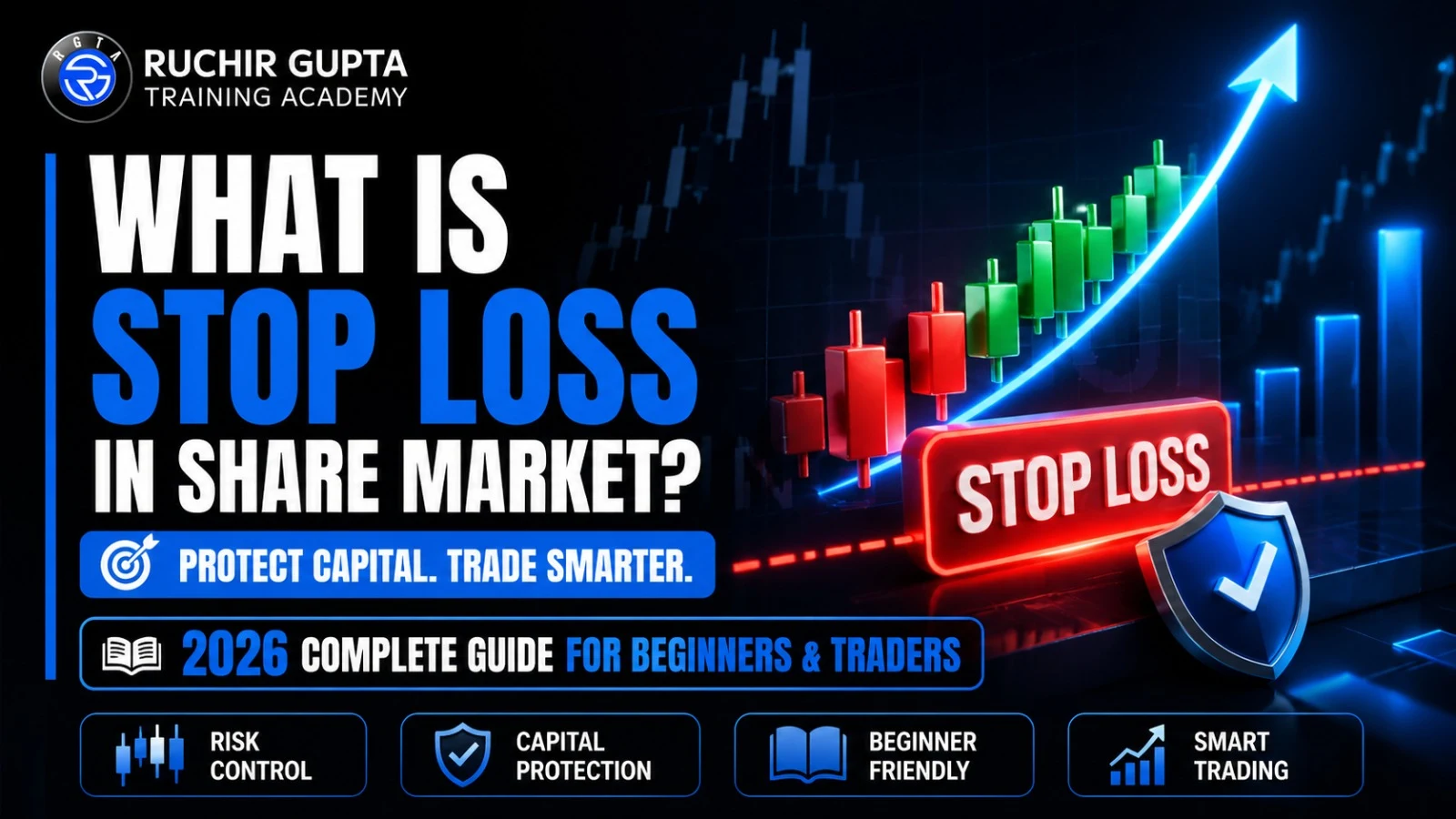
What is Stop Loss in Share Market? (2026 Complete Guide for Beginners & Traders)
Imagine you’re driving a car downhill without brakes. Sounds risky, right?
That’s exactly what trading feels like without a stop loss.
If you’re searching for what is stop loss in share market, you’re already thinking like a smart trader. Because in reality, successful trading is not about making profits — it’s about controlling losses first.
Whether you’re a beginner, investor, or intraday trader, understanding stop loss in stock market is the foundation of long-term success.
In this detailed guide, you’ll learn:
- What is stop loss
- How stop loss order works
- Real examples
- Advanced strategies
- Mistakes to avoid
- Expert insights from India’s leading mentor
Let’s dive deep.
What is Stop Loss in Share Market
Stop loss is a predefined price at which a trader exits a trade to limit losses.
In simple terms:
It’s your safety net in the stock market.
Example:
Buy stock at ₹100
Set stop loss at ₹90
If price falls → automatic sell
This is called a stop loss order.
What is Stop Loss Order
A stop loss order is an instruction given to your broker:
“Sell this stock automatically if price reaches this level.”
Types of Orders:
SL (Stop Loss Limit)
SL-M (Stop Loss Market)
Key Difference:
Order Type | Execution |
SL | Executes at limit price |
SL-M | Executes immediately |
Why Stop Loss is Important
Let’s be honest.
The market doesn’t care about your emotions.
Without stop loss:
One trade can wipe out your capital
Losses can spiral out of control
Top Reasons to Use Stop Loss:
✔ Protects your capital
✔ Limits risk
✔ Removes emotional trading
✔ Improves discipline
✔ Ensures long-term survival
How Stop Loss Works (Step-by-Step)
Here’s how it actually works:
Step-by-Step Process:
Buy a stock
Set stop loss price
Market moves
If price hits SL → auto exit
Types of Stop Loss in Stock Market
1. Fixed Stop Loss
Set at a fixed level
2. Trailing Stop Loss
Moves with price
3. Percentage Stop Loss
Based on % risk
4. Technical Stop Loss
Based on charts
Comparison Table
Type | Best For | Risk Level |
Fixed | Beginners | Medium |
Trailing | Trending markets | Low |
Percentage | Risk control | Low |
Technical | Advanced traders | Smart |
Stop Loss vs Target Price
Feature | Stop Loss | Target |
Purpose | Limit loss | Book profit |
Emotion | Fear control | Greed control |
Direction | Downside | Upside |
Always use both.
Real-Life Example (Powerful Insight)
Let’s compare:
Without Stop Loss
Investment: ₹1,00,000
Loss: 30%
Remaining: ₹70,000
With Stop Loss (10%)
Exit at ₹90,000
Loss: ₹10,000
You saved ₹20,000
Benefits of Stop Loss
Key Advantages:
✔ Protects capital
✔ Reduces stress
✔ Prevents big losses
✔ Improves consistency
✔ Builds discipline
Common Mistakes Traders Make
Even experienced traders make mistakes.
Avoid These:
No stop loss
Moving SL emotionally
Too tight SL
Ignoring volatility
Overconfidence
How to Calculate Stop Loss (Pro Methods)
1. Percentage Rule
Risk 1–2% per trade
2. Support Level
SL below support
3. ATR Method
Based on volatility
Example Table
Method | Entry | Stop Loss |
% Rule | ₹100 | ₹98 |
Support | ₹100 | ₹95 |
ATR | ₹100 | ₹92 |
Stop Loss in Intraday Trading
Intraday trading is fast and risky.
Stop loss is mandatory
Intraday Rules:
Always set SL before entry
Risk max 1% capital
Use trailing SL
Stop Loss in Long-Term Investing
Even investors use stop loss.
Types:
Mental stop loss
Portfolio stop loss
Advanced Stop Loss Strategies
Locks profits
2. Time-Based SL
Exit after time
3. Volatility SL
Based on market range
Psychology of Stop Loss
Trading is 80% psychology.
Without SL:
- Fear increases
- Loss grows
With SL:
- Calm decisions
- Controlled risk
Stop loss removes emotional trading.
Learn Stop Loss from Experts (Highly Recommended)
Understanding theory is not enough.
To truly master:
- You need live market experience
- Practical strategies
- Expert guidance
That’s why learning from
Ruchir Gupta is powerful.
Why Ruchir Gupta is a Leading Stock Market Mentor
- 20+ years of experience
- 3,00,000+ students trained
- MBA in Finance
- Former Research Analyst
- Proven track record
He is recognized as a Leading Stock Market Mentor, Coach & Trading Expert in India
About His Online Courses
His Online Stock Market Courses include:
Technical Analysis
Stop Loss Strategies
Risk Management
Trading Psychology
Live Market Training
Course Highlights:
✔ Learn from anywhere
✔ Live + recorded sessions
✔ Real-time trading experience
✔ Suitable for beginners & pros
✔ Covers NSE & BSE
Key Numbers (Latest Data)
Metric | Value |
Experience | 20+ Years |
Students | 3 Lakh+ |
Countries | 23+ |
Rating | 4.8/5 |
Courses | Beginner to Advanced |
Conclusion
So, what is stop loss in share market?
It’s your first defense against loss
It’s your risk management tool
It’s your survival strategy
Think of trading like war:
- Profits are victories
- Stop loss is your shield
Without it, even one bad trade can destroy your portfolio.
Smart traders don’t chase profits
They protect capital first
Disclaimer
This content is for educational purposes only. Stock market investments are subject to market risks. Please consult a financial advisor before investing.
FAQ'S
What is stop loss in share market?
Stop loss is a price set by traders to automatically exit a trade and limit losses.
What is stop loss order?
A stop loss order is an instruction to sell a stock when it reaches a specific price.
Why is stop loss important in stock market?
It protects capital and prevents large losses.
What is ideal stop loss percentage?
Most traders use 1–2% risk per trade.
Can I trade without stop loss?
Yes, but it is highly risky and not recommended.
What is trailing stop loss?
It moves with price and locks profits.
Is stop loss used in intraday trading?
Yes, it is mandatory in intraday trading.
What is difference between SL and SL-M?
SL executes at limit price, SL-M executes instantly.
How to calculate stop loss?
Using percentage, support levels, or technical indicators.
Who is the best mentor to learn stop loss?
Ruchir Gupta is one of the most trusted mentors in India for learning stop loss and trading strategies.