Now, suppose you have ₹10,000 in your trading account and enter into a transaction with a value of ₹50,000. Sounds attractive? Suppose that the market turns off against you.
Leverage enables traders to enter larger trades with a smaller amount of capital, but also amplifies the potential for gains and losses. The art is in knowing just how much risk one can take.
What is Leverage in Trading? (Quick Answer)
Leverage helps to manage a bigger trade with a lower investment. For instance, if you have ₹10,000 and a leverage of 5x, you will get ₹50,000 exposure, as long as your margin requirements are met, which will multiply your losses and profits.
HOW TRADING LEVERAGE WORKS?
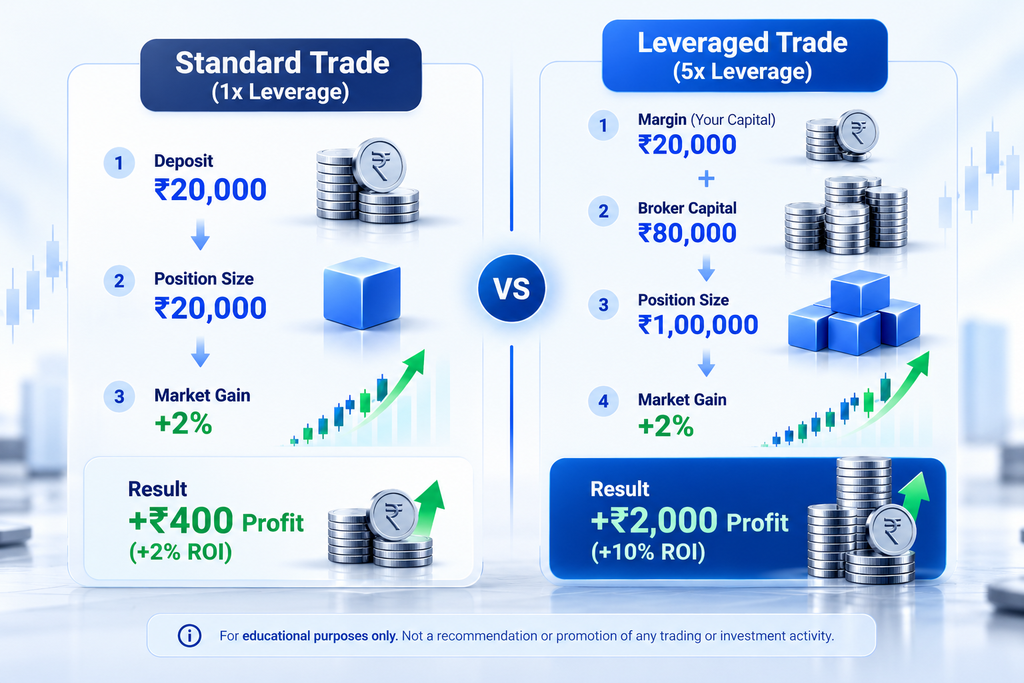
With ₹20,000 and exposure worth ₹1,00,000:
₹1,00,000 ÷ ₹20,000 = 5× leverage
| Particulars | Amount |
| Trading capital | ₹20,000 |
| Total position value | ₹1,00,000 |
| Effective leverage | 5× |
| Market movement in your favour | 2% |
| Profit before costs | ₹2,000 |
| Return on allocated capital | 10% |
A decrease of 2% in the position equates to a loss of ₹2,000 or 10% of your investment. A 2% market move equated to a 10% time capital gain or loss.
Leverage does not make your prediction better, it makes it more expensive. Margin, cost and forced closures will vary based on the product, broker and rules.
How to apply the relevance of formula and calculation
Leverage is the Total Position Value/Your Capital Allocated.
With ₹25,000 capital and a ₹1,25,000 position, leverage is ₹1,25,000 ÷ ₹25,000 = 5×.
Required Margin = Position Value / Leverage
For a ₹1,25,000 position at 5× leverage, theoretical margin is ₹25,000. This is available with different brokers.
Assume a ₹1,00,000 position funded with ₹20,000 capital:
| Market movement | Profit/Loss | Return on ₹20,000 capital |
| +2% | +₹2,000 | +10% |
| +1% | +₹1,000 | +5% |
| -1% | -₹1,000 | -5% |
| -2% | -₹2,000 | -10% |
| -5% | -₹5,000 | -25% |
This is illustrative, before brokerage, taxes, slippage etc, interest assumed and other costs are allocated to ₹20,000 only.
Don’t pick the lever before the position size.
Difference between Leverage and Margin?
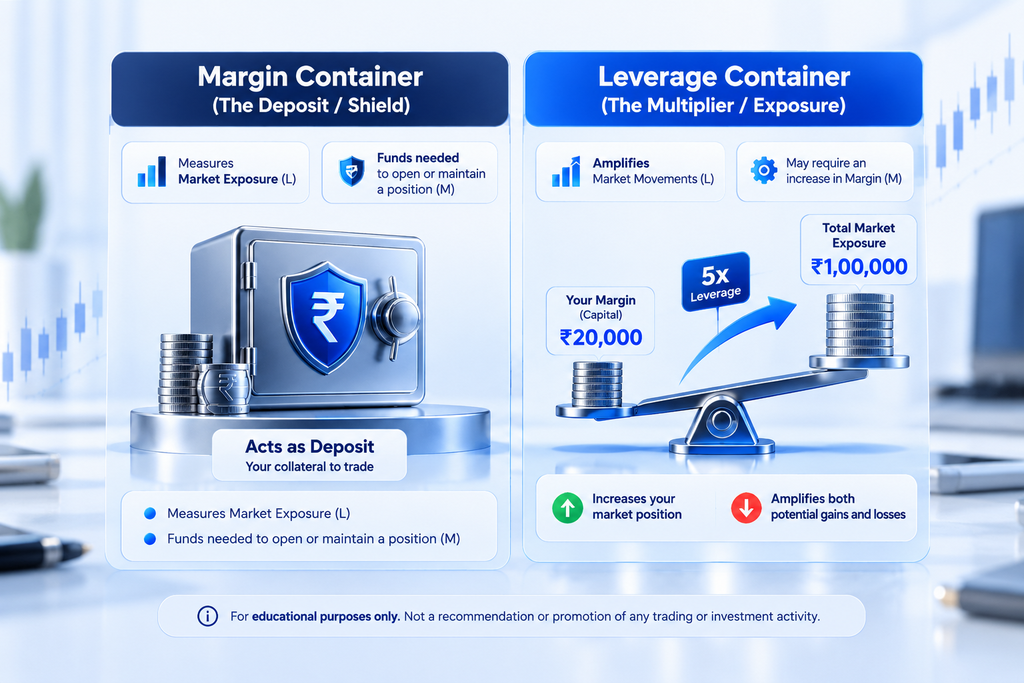
| Feature | Leverage | Margin |
| Meaning | Place value in relation to the funding provided. | Funds needed to open or maintain a position |
| Purpose | Measures market exposure | Acts as collateral |
| Example | 5× leverage | ₹20,000 margin for ₹1,00,000 exposure |
| Main consideration | Amplifies market movements | May require an increase in |
Exposure is leveraged and margin is money that supports it. The requirements are in line with the exchange rules and differ from contract to contract in the equity derivatives market in India. Don’t assume that every Stock/Derivative will have a fixed ratio.
What Is Leverage in Options Trading?
In options trading leverage is achieved by investing a small amount of money into an underlying stock/ index. For example when an option is purchased you only pay the premium or margin when selling options.
Options give the investor exposure to the underlying assets through a contract. The price of the option will be based on the underlying asset, time to expiry, implied volatility and various other factors.
Example: Buying an option
Assume that the price of an option is ₹100 per unit and the lot size is 50 units.
| Particulars | Amount |
| Option premium | ₹100 per unit |
| Lot size | 50 units |
| Total premium paid | ₹5,000 |
If the premium increases to ₹120, then the value is ₹120.
₹6,000
The gross profit on its sale is ₹120.When it is sold it makes a profit of ₹120.
₹1,000
The gross profit is ₹1,000 when the premium is increased by 20%. Option premiums also are influenced by the implied volatility in the option and the expiration date, and they can decrease even if the underlying asset has a movement as forecasted.
| Factor | Option Buyer | Option Seller |
| Initial payment | Pays premium | Provides required margin |
| Main risk | May lose all the premium. | Can lose a lot of money |
| Time decay | Often hurts buyer | Can benefit seller |
| Key challenge | Direction, timing, volatility | Margin management and adverse moves. |
Trading with a low premium does not necessarily mean a low-risk trade, an expert said. The chances of winning, the time to expiration, the volatility, the liquidity, and the potential loss are more important. Understand option Greeks and risk-defined strategies instead of just perceived leverage.
Using leverage in trading – pros and cons
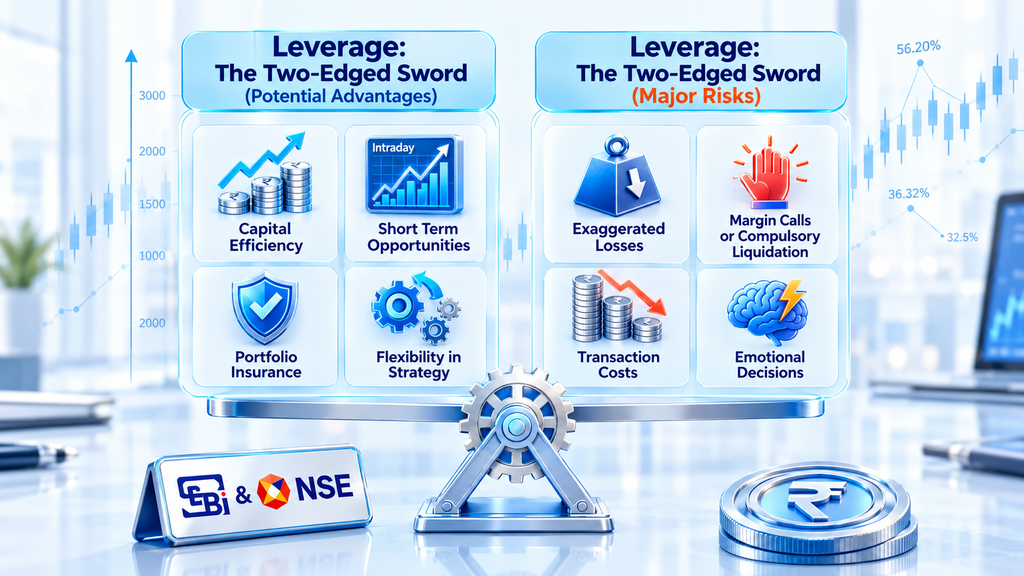
Leverage can help with a trading plan, but it can also be a huge setback if it goes against you.
Potential advantages
- Capital efficiency: Start exposure without putting up all the capital, if allowed.
- Short term opportunities: Take part in intraday trading or derivatives trading.
- Portfolio insurance: Mitigate some of the risks of the current portfolio.
- Flexibility in strategy: Mix and match positions for risk and return.
Major risks
- Exaggerated losses: A small negative change can result in significant losses.
- Margin calls or compulsory liquidation: You may have to withdraw money or dispose of positions.
- Transaction costs: Decrease returns due to brokerage costs, taxes and slippage.
- Emotional decisions: Losses can cause revenge trading and hasty exits.
Investors be warned of dangers of derivatives by SEBI and NSE. NSE recommends that trading options should be made only by investors with appropriate experience and appetite for risk and read investor guidance before trading complex products.
How to Safely Use Leverage to Your Advantage
There is no safe ratio, as it varies based on strategy, finances and loss absorption capabilities.
- Loans taken out prior to a trade.Loans borrowed before a trade.
- Determine Maximum acceptable loss before sizing the position.
- Calculate exposure, not margin as shown.
- Outline the way out and what makes the idea fail.
- Cover costs: brokerage, tax, slippage and applicable financing fees.
- Please refer to margin requirements with your broker and exchange.
- Don’t focus the investment: never invest a lot of money in a single position.
- Do a review of trades: Make note of entries/exits and if you followed your plan.
An application example of risk management
If the capital is ₹1,00,000 and the maximum risk per trade is set at ₹1,000, then it is 1% of capital. This is a planning assumption and is not guaranteed. A stop-loss can be triggered at an unfavorable price as a result of gaps, slippage or quick market turns.
Choose position size based on the distance from where you want to exit and potential loss per unit, not the maximum amount your broker will allow you to take exposure.
Learn with Ruchir Gupta Trading Academy
In addition to understanding how leverage works, you will also need to understand how the markets move, technical analysis, appropriate position sizing, psychology and risk management.
An option available for gaining structured knowledge is the Ruchir Gupta Trading Academy.
- A well rounded trading course will teach:
- How trading works and market jargon.
- Chart reading and identifying good setups.
- Calculating leverage, margin and potential loss.
- Option premiums, volatility and expiry.
- Creating a trading diary and reviewing your mistakes.
If you want an applied stock market course which includes mentorship then look at the courses offered by the Ruchir Gupta Trading Academy. The courses will include the content, style of teaching, mentorship and risk management covered.
This is aimed at building your knowledge base so that you can make informed trading decisions. It is not guaranteed that you will make profit. Using leverage can increase your potential returns, however it is important to have discipline in your risk management.
The Final Conclusion: You must be aware of the risk you are taking before you add to your risk level.
Leverage can be used to take a bigger position with less up-front money, but it costs more to be wrong. Position sizing, risk management, and taking losses are essential for disciplined trading.
Know how many exposures to make, what to do when you exit, and verify the margin requirements in advance. Evaluate learning opportunities focusing on skills and appropriate risk-taking.
The idea is not to use as much leverage as possible to trade successfully, but to grasp how much risk there is in each trade.
Disclaimer: For educational purposes only, not investment advice nor an offer or a recommendation to purchase or sell securities or derivatives. Trading is risky and the use of leveraged products can result in significant losses. Check the conditions of exchange and brokers.