Sometimes a trade can become risky due to unexpected news, a gap down open on the futures, or just a sudden change in sentiment. Hedging can be implemented using options to help limit losses on a trade. However, a hedge will cost and will not make it completely risk free.
Understanding futures and options can improve decisions during volatile conditions.
Quick Answer: What Are Hedges?
Hedges are used to reduce any potential losses in a certain investment or trade. Using options can help reduce potential adverse price movements. An example would be if you have a long position in futures you could buy a put option to help limit your losses. This would cost you the premium amount.
What Is Hedging in Trading?
Hedging is when you take a further position to potentially reduce any losses from your position. It is not a guaranteed profit but will offer protection. For example, if you have index futures you could buy a put ahead of an economic announcement to reduce some losses if the price falls.
Individuals and portfolio investors all make use of hedging to reduce their exposure to the market. Companies also use them to reduce their exposure to currencies, commodities and interest rates.
How Do Options Hedge Futures Positions?
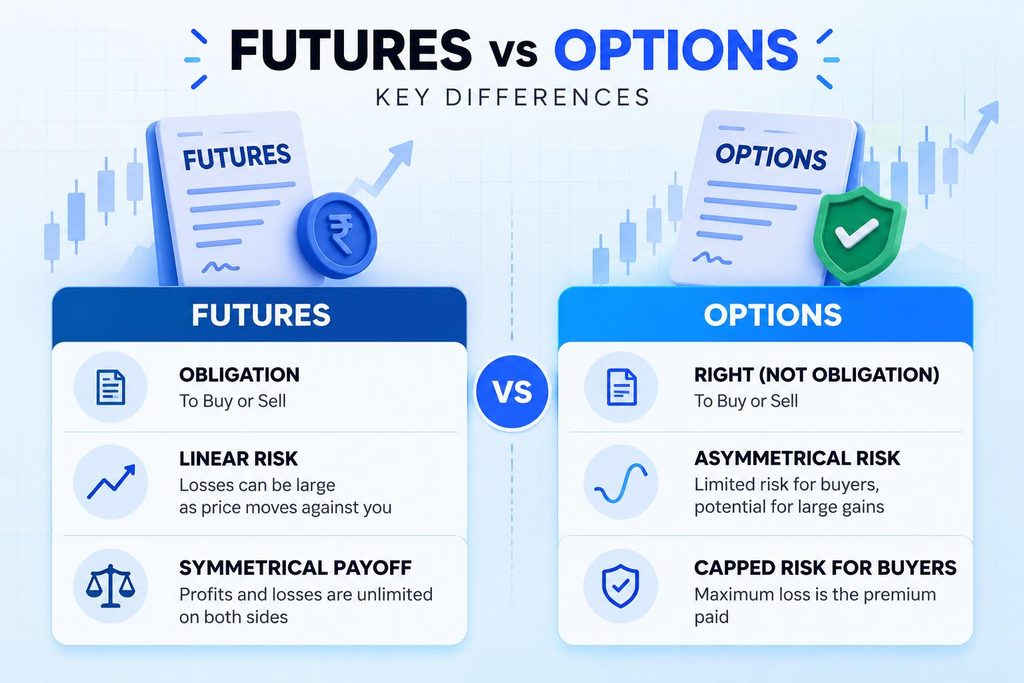
Options and futures are both derivatives. They differ with how they pay out. Futures mean there is an obligation for both parties involved where options give the buyer the right but not obligation to buy/sell based on certain terms. This makes options great to reduce risk.
You can find more info here on the CME Groups options education.
The two basic hedging approaches
1. Put to Long Futures
If you have long futures and think the price could drop then purchase a put option on the same or a suitable underlying. This may increase in value helping to reduce some of your losses on the futures.
2. Call to Short Futures
If you have short futures and are concerned about the price rising then purchase a call option on a suitable underlying. This may reduce some of your losses on the futures.
The best way to hedge would be if they have the same contract specification. So if you have an index option it may not fully hedge your losses if you have a different stock future.
Example – Hedging a Long Future Position
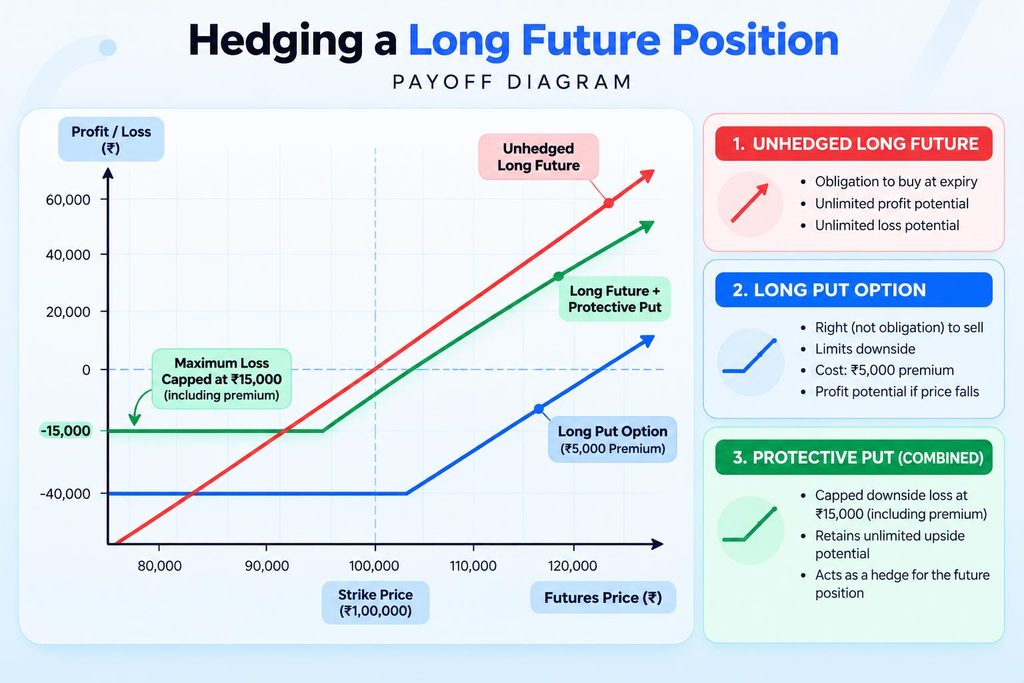
A trader has gone long on index futures and wishes to protect their position prior to an economic announcement. These figures are hypothetical.
Long Future Details
| Particulars | Value |
| Futures Price | 25,000 |
| Units | 50 |
| Strike Price (Put) | 24,800 |
| Put Premium | 100 points |
| Cost of Premium | ₹5,000 |
Premium = 100 × 50 = ₹5,000 (excluding transaction costs)
Profit/Loss at Different Futures Prices
| Futures price at expiry | Futures P/L | Put payoff before premium | Combined P/L before costs | Net P/L after premium |
| 25,400 | +₹20,000 | ₹0 | +₹20,000 | +₹15,000 |
| 25,000 | ₹0 | ₹0 | ₹0 | −₹5,000 |
| 24,500 | −₹25,000 | +₹15,000 | −₹10,000 | −₹15,000 |
What Can We Learn?
- If the market goes up then the future position will be profitable, however we will have a cost of the premium.
- If the market stays the same then you lose out on the cost of the premium.
- If the market goes down then the put will help offset some of the loss from the future.
The intrinsic value of the put will be the difference between the strike price and the underlying price, multiplied by the number of units.
This assumes that you are hedging against the same amount of exposure, expiry date and 1:1 ratio.
The actual outcome will depend on the specific details of the contracts, settlement, option pricing, basis, liquidity and transaction costs. This is not a guaranteed maximum loss for all combinations.
Futures Hedging Strategies
| Strategy | Existing Position | New Position | Purpose | Cost / Trade-off |
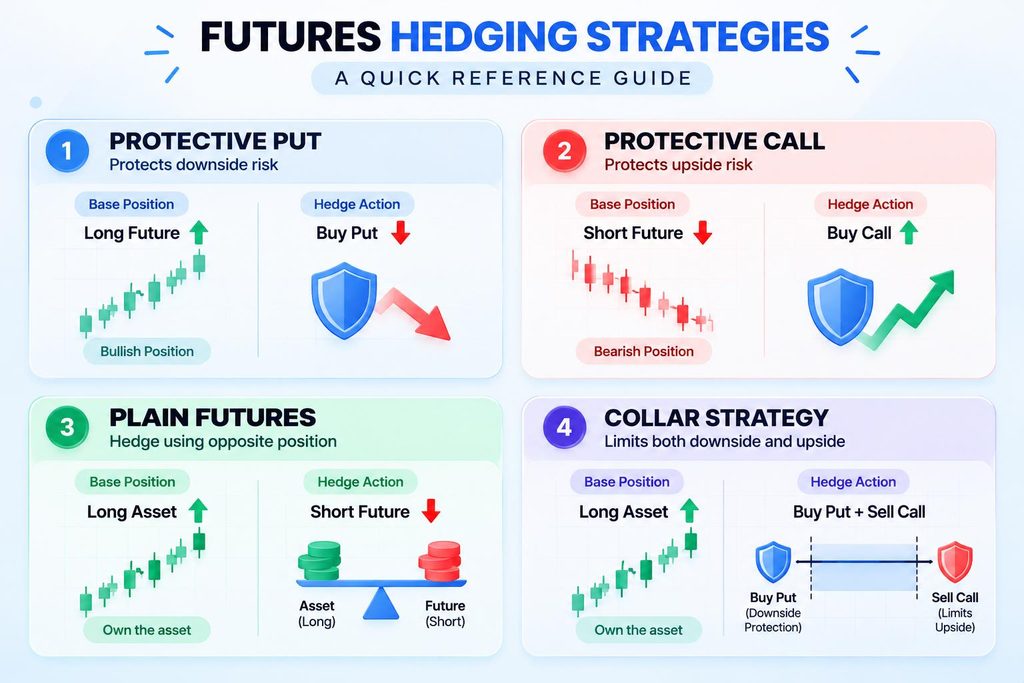
| Protective Put | Futures long | Buy put | Floors your downside, keeps upside | Premium paid; upside reduced by premium academic.oup |
| Protective Call | Futures short | Buy call | Caps your upside risk (protects against a price rise) | Premium paid; gain reduced by premium |
| Plain Futures Hedge | Existing exposure (cash/physical) | Offset with futures counter-position | Locks in a price, removes price risk | No premium; margin and no upside |
| Collar | Long exposure (or short, mirrored) | Buy protective option + sell OTM option | Cuts the cost of protection by funding it with the sold option | Low or zero net premium, but upside capped aqr+1 |
A collar may lower the cost, however you now have an obligation from selling an option. You may also restrict your potential gains.
Which Strategies Should Beginners Understand?
A Protective Put is a good place to start, you have a maximum loss on the put, however you are still exposed to losses on the futures. A Protective Call provides the upside protection on a short futures position. There is no guarantee of making any profit.
Advantages, Disadvantages and Common Errors
Advantages
- Provides downside protection: An option can be used to counteract an adverse price movement.
- You know the cost of the option: You can choose any strike and expiration.
- Provides structure: By having a planned hedge, you may reduce your tendency to exit positions.
Disadvantages
- May be expensive: If the market is volatile it can be an expensive way to hedge. As the options get closer to expiration they may lose time value.
- Not perfect: If the underlying, expiration or amount isn’t matching you will still be exposed.
- Large spreads can increase your costs: You may need more money if the futures move adversely.
Common Errors
Remember to consider how the hedge affects your overall risk. Common errors:
- Not considering the cost: Consider how much the premium is compared to what you want to control.
- Strike too far out: A cheap option that is far out of the money may not provide much protection if there is a moderate price fall.
- Expiration and correlation: The hedge may expire before you want it to. Correlated instruments may not always move in the same direction.
- Emotional: Continually buying options due to fear can eat into your returns.
- Underestimating risks and costs of shorting options: Writers can make large losses. Brokerage costs, tax, exchange fees and spreads will impact on your net returns.
The NSE recommend investors are cautious with derivatives. Buyers can lose the whole premium.
How to Formulate the Right Strategy
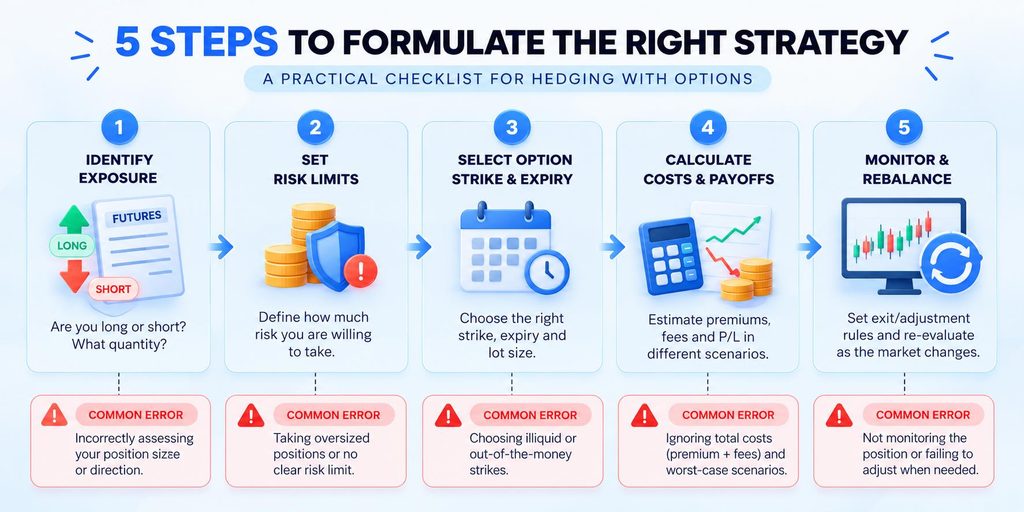
Ensure you have:
- Identified your exposure – Are you long/short? What quantity?
- Defined how much risk you are willing to take.
- Chosen the correct option – Underlying, Strike, Expiry, Lot Size and Liquidity.
- Estimated any fees and results – Premiums and fees. P/L in rising, falling and flat markets.
- Set your parameters and re-evaluate – When will you exit/modify the hedge? Re-evaluate when market changes.
This is a strategy to manage risk rather than assuming that the market will go against you.
Learn About Hedging and Derivatives with Ruchir Gupta Trading Academy
Once you know what hedges are its important to know how to apply them. You need to know how futures are priced, premium prices, strike prices, volatility, expiry and sizing.
Ruchir Gupta Trading Academy offer courses on intraday, options and technical analysis. If you want to improve your fundamentals we recommend taking a stock market course with Ruchir Gupta. Ensure you know what the risks are with each strategy before risking any real money.
Conclusion: Managing Risk
Knowing what hedges are will help you understand that trading is all about risk management. Futures can be protected using options, however there will be costs associated with hedging. Work out the total payoffs and understand the risks involved.
Ruchir Gupta Trading Academy teach intraday trading, options trading and technical analysis.
Disclaimer – This article is for educational purposes only. It should not be used as an investment recommendation. Derivatives carry a high level of risk. Always check the contract specifications and exchange rules applicable at the time of trading.