Trading Psychology Secrets: Why 90% of Traders Still Lose Money in 2026 (And How Smart Traders Win)
The biggest reason traders lose money in 2026 is no longer lack of indicators, AI tools, or market access.
It’s psychology.
Today, almost everyone has:
- TradingView
- AI-powered scanners
- Telegram signals
- YouTube strategies
- Cheap brokerage access
- Advanced charting tools
Yet most traders still blow up accounts.
Why?
Because the real battle is not on the chart.
It is inside the trader’s mind.
Fear.
Greed.
Revenge trading.
Overconfidence.
FOMO.
Impatience.
Dopamine addiction.
The psychology of trading has become even more dangerous in 2026 because markets move faster, information spreads instantly, and retail traders are emotionally overloaded every single day.
Professional traders understand something beginners ignore:
“Trading success depends more on emotional discipline than strategy accuracy.”
A mediocre strategy with strong psychology can survive.
A great strategy with poor psychology eventually fails.
This article will bring to the surface the true trading psychology advantages of disciplined traders, hedge fund professionals and seasoned trading mentors. You will discover how traders make money mistakes, how emotions impact your decisions and just what makes a successful trader from an emotional gambler.
We will also be talking about the mindset and frameworks that have been developed by the top traders such as Ruchir Gupta, who has a systematic trading approach where discipline, risk management and rule-based trading strategies are of central importance.
Quick Answer
What is trading psychology?
Trading psychology refers to the emotional and mental state that influences a trader’s decisions in financial markets. It includes fear, greed, confidence, discipline, patience, and emotional control. Strong trading psychology helps traders follow strategies consistently, manage risk properly, and avoid impulsive decisions that lead to losses.
What Is Trading Psychology?
Definition
Trading psychology is the study of how emotions, thoughts, biases, and mental behavior influence trading decisions.
It affects:
Entry timing
Exit timing
Risk management
Position sizing
Confidence
Patience
Decision-making consistency
The psychology in trading often matters more than technical knowledge.
Many traders know:
Support & resistance
Candlestick patterns
Indicators
Chart setups
But they still fail because emotions override logic.
Why Most Traders Lose Money in 2026
The market environment in 2026 is psychologically brutal.
Major Reasons Traders Keep Losing
Problem | Psychological Trigger |
Overtrading | Dopamine addiction |
FOMO buying | Fear of missing out |
Holding losses | Ego attachment |
Early profit booking | Fear |
Revenge trading | Anger |
Excessive leverage | Greed |
Random strategy switching | Impatience |
Blind influencer following | Lack of confidence |
Modern Trading Has Become Emotionally Addictive
Short-form content platforms have changed trading behavior dramatically.
Today traders consume:
- 30-second “profit screenshots”
- Fake luxury lifestyles
- Unrealistic return claims
- Viral options trading clips
This creates:
- Unrealistic expectations
- Impulsive trading
- Emotional instability
- Gambling behavior
The psychology of traders today is heavily influenced by social validation.
That is dangerous.
The Hidden Emotional Traps in Trading
1. Fear of Missing Out (FOMO)
A trader sees a stock moving rapidly.
They panic-buy near the top.
The market reverses immediately.
This happens daily in:
Options trading
Crypto markets
Breakout trades
Meme stocks
Real Example
A trader watches Nifty Bank rally 300 points.
Instead of waiting for confirmation:
They enter emotionally
Ignore stop loss
Increase lot size
Market reverses sharply
Result:
Emotional breakdown
Bigger revenge trades
Account damage
2. Revenge Trading
One loss becomes five losses.
Why?
Because traders try to “recover quickly.”
Revenge trading is one of the biggest account killers.
Symptoms of Revenge Trading
Increasing position size after losses
Ignoring trading rules
Random entries
Emotional decision-making
Trading without confirmation
Professional traders stop trading after emotional damage.
Beginners double their risk.
3. Overconfidence After Winning
Winning streaks create dangerous confidence.
Traders suddenly believe:
- “I mastered the market.”
- “I can’t lose.”
- “This setup always works.”
Then:
- Risk increases
- Discipline disappears
- Huge drawdowns begin
The psychology of trading is deeply connected to ego management.
Psychology of Winning Traders vs Losing Traders
Winning Traders | Losing Traders |
Focus on process | Focus on profits |
Accept losses | Avoid losses emotionally |
Follow systems | Trade impulsively |
Use risk management | Overleverage |
Stay patient | Force trades |
Think long term | Chase quick money |
Review mistakes | Repeat mistakes |
Control emotions | React emotionally |
The Dopamine Problem in Modern Trading
This is one of the biggest trading psychology secrets nobody discusses enough.
Trading apps are designed like social media platforms.
Every:
Green candle
Profit notification
Trade execution
Fast movement
Triggers dopamine.
This creates addiction-like behavior.
Signs of Dopamine-Based Trading
Constant chart checking
Taking low-quality trades
Trading for excitement
Feeling bored without positions
Random scalping
Professional traders understand:
“The goal is not excitement. The goal is consistency.”
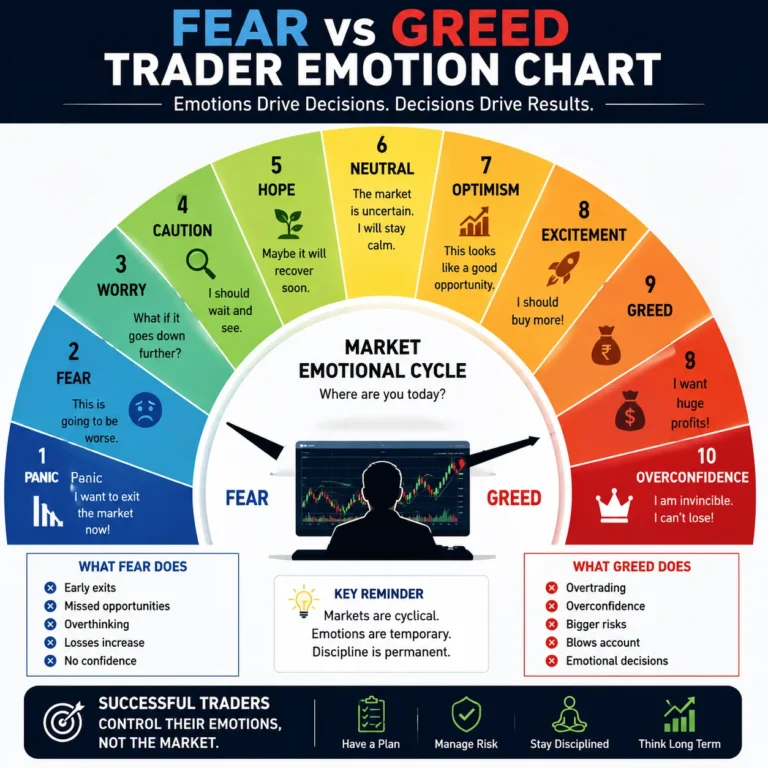
Fear and Greed in Financial Markets
Fear
Fear causes:
Early exits
Hesitation
Missed opportunities
Avoiding valid trades
Example
A trader has a profitable strategy with:
55% win rate
Strong risk-reward
After 3 losses:
Confidence disappears
Strategy abandoned
The problem wasn’t strategy.
It was emotional control.
Greed
Greed causes:
Oversized positions
Ignoring exits
Holding winners too long
Excessive leverage
Common Greed Mistake
A trader doubles capital in options trading.
Instead of protecting profits:
Risk increases aggressively
One volatile expiry destroys gains
This cycle repeats constantly in retail trading.
Revenge Trading Explained
What Is Revenge Trading?
Revenge trading is emotional trading after losses where traders try to recover money quickly through impulsive decisions.
Why Revenge Trading Happens
Trigger | Emotional Response |
Stop-loss hit | Anger |
Missed breakout | Frustration |
Large loss | Panic |
Seeing others profit | Jealousy |
How Professionals Handle Losses
Professional traders:
Stop trading temporarily
Reduce position size
Review trade journal
Protect mental capital
Beginners:
Increase leverage
Trade emotionally
Ignore setups
Blow accounts
The Role of Risk Management Psychology
Risk management is not only mathematical.
It is psychological protection.
Why Risk Management Matters
Without risk management:
Emotions intensify
Fear increases
Discipline breaks
With controlled risk:
Confidence improves
Clarity improves
Consistency improves
The 1% Rule
Many experienced traders risk only 1% of capital per trade.
Why?
Because survival matters more than excitement.
Example
Capital | Risk Per Trade |
₹1,00,000 | ₹1,000 |
₹5,00,000 | ₹5,000 |
₹10,00,000 | ₹10,000 |
Small controlled losses prevent emotional collapse.
Why Strategy Alone Is Not Enough
This is where most beginners misunderstand trading completely.
A Profitable Strategy Can Still Fail
Because traders:
Don’t follow rules
Exit early
Move stop losses
Overtrade
Ignore risk
The best strategy becomes useless with poor emotional discipline.
Professional Trader Mindset Framework
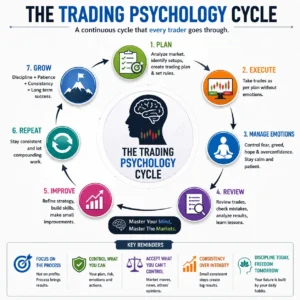
The 7 Core Principles
1. Think in Probabilities
Professional traders know:
No setup is guaranteed
Losses are part of trading
2. Focus on Execution
Good traders focus on:
Following process
Managing risk
Consistency
Not daily profit obsession.
3. Detach Emotionally from Money
Money attachment creates fear.
Professional traders think:
“This is statistical execution.”
Not:
“I must win this trade.”
4. Avoid Market Noise
Too much information destroys clarity.
5. Trade Less, Better
High-quality trades outperform random activity.
6. Accept Uncertainty
Markets are uncertain by nature.
Emotionally mature traders accept this reality.
7. Protect Mental Capital
Mental exhaustion destroys decision-making quality.
Real-World Trading Psychology Examples
Scenario 1: The Impatient Breakout Trader
A trader enters before confirmation.
The breakout fails.
Instead of exiting:
Hope begins
Loss grows
Stop loss removed
This is emotional attachment.
Scenario 2: The Overconfident Options Buyer
A trader makes:
₹50,000 in one week
Confidence explodes.
Next week:
Larger positions
No risk control
Emotional trades
Result:
Entire profits wiped out
Scenario 3: The Disciplined Trader
A disciplined trader:
Takes 2 quality trades weekly
Uses strict risk management
Accepts small losses
Reviews mistakes daily
After 2 years:
Consistency develops
Confidence becomes stable
Trading becomes systematic
This is how professionals survive long term.
Trading Psychology Secrets Used by Experts
Secret #1: Professionals Focus on Capital Protection
Beginners focus on profits.
Experts focus on survival.
Secret #2: Emotional Discipline Beats Intelligence
High IQ does not guarantee trading success.
Emotional stability matters more.
Secret #3: Fewer Trades Often Produce Better Results
Overtrading usually destroys profitability.
Secret #4: Journaling Improves Self-Awareness
Keeping a trading journal reveals:
Emotional patterns
Mistakes
Behavioral weaknesses
Secret #5: Systems Reduce Emotional Damage
Rule-based trading reduces impulsive behavior.
This is why structured mentorship programs emphasize disciplined systems rather than random signals. Mentors like Ruchir Gupta focus heavily on systematic analysis, risk management, and emotional discipline in trading education.
Beginner Mistakes That Destroy Accounts
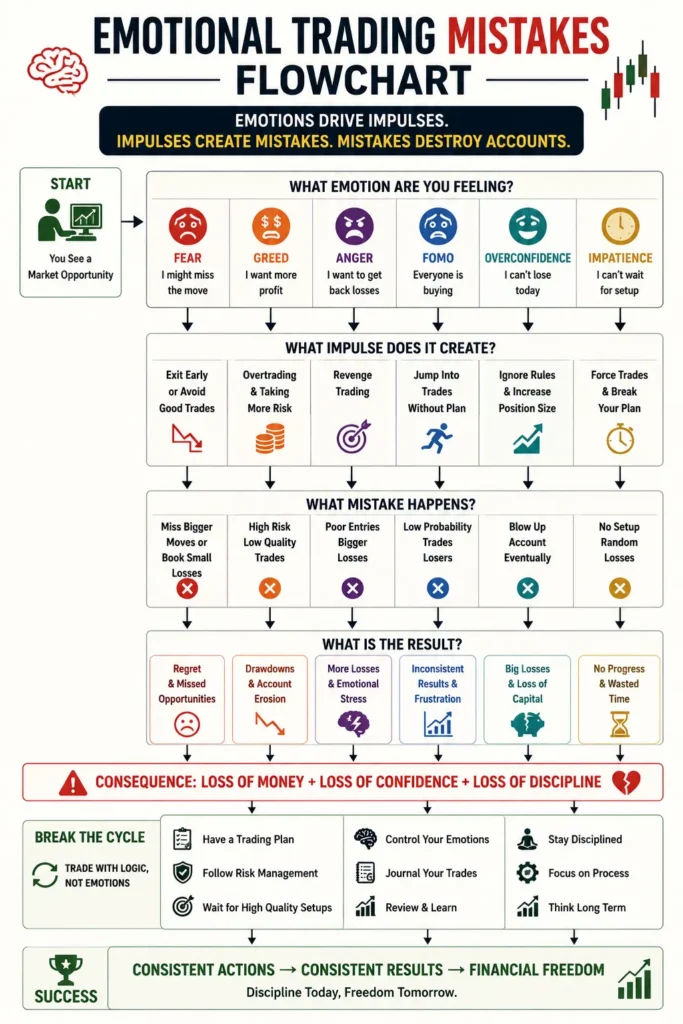
Top Trading Psychology Mistakes
1. Trading Without a Plan
2. Risking Too Much
3. Following Telegram Tips Blindly
4. Switching Strategies Constantly
5. Emotional Options Buying
6. Ignoring Stop Losses
7. Chasing Losses
8. Expecting Fast Riches
Common Beginner Mistakes
1. Using Too Many Indicators
Many traders overload charts.
Instead, focus on:
moving average trading strategy
support and resistance trading
candlestick pattern analysis
2. Ignoring Risk Management
Risk management matters more than prediction accuracy.
3. Trading Emotionally
Emotional trading destroys discipline.
How to Build Emotional Discipline in Trading
Step-by-Step Process
Step 1: Reduce Position Size
Smaller risk reduces emotional pressure.
Step 2: Create Fixed Rules
Define:
Entry
Exit
Stop loss
Risk percentage
Before trading starts.
Step 3: Use a Trading Journal
Track:
Emotions
Mistakes
Patterns
Decision quality
Step 4: Avoid Constant P&L Watching
Obsessing over money increases emotional instability.
Step 5: Accept Losses as Business Expenses
Losses are normal.
Professional traders understand this deeply.
Daily Habits of Consistent Traders
Habit | Purpose |
Morning market preparation | Improves clarity |
Predefined watchlist | Reduces impulsiveness |
Trade journaling | Builds awareness |
Fixed risk management | Protects capital |
Limited daily trades | Prevents overtrading |
Post-market review | Continuous improvement |
AI and Social Media’s Impact on Trading Behavior
In 2026, AI-generated trading content is everywhere.
This creates:
Information overload
Strategy confusion
Unrealistic expectations
Dangerous Modern Trend
Many traders:
Copy AI-generated strategies blindly
Depend on influencers
Ignore personal psychology
Remember:
“No strategy works if your emotions destroy execution.”
Best Ways to Improve Trading Psychology
Proven Methods
Meditation & Mindfulness
Improves emotional control.
Structured Learning
Clear frameworks reduce confusion.
Backtesting
Builds confidence through data.
Mentor Guidance
Avoids years of mistakes.
Risk Reduction
Protects emotional stability.
Why Mentorship Accelerates Trader Growth
Most traders waste years repeating emotional mistakes.
A structured mentor helps:
- Correct behavioral errors
- Improve discipline
- Develop realistic expectations
- Build professional habits
This is why many traders today prefer structured training academies focused on real-world trading psychology rather than only indicators.
Programs like the Best Stock Market Course Online – Ruchir Gupta emphasize:
- Emotional discipline
- Risk management
- Scanner-based trading
- Systematic execution
- Real market understanding
Instead of promoting unrealistic “quick-rich” promises.
The academy’s approach strongly focuses on:
- Discipline over emotion
- System over speculation
- Risk management over overconfidence
Which are core principles behind long-term trading success.
For forex learners, Ruchir Gupta’s structured training also includes time-cycle logic, scanner-based filtering, and professional risk management frameworks designed to reduce emotional trading behavior.
What is emotional discipline in trading?
Emotional discipline in trading is the ability to follow a predefined trading plan without being influenced by fear, greed, excitement, or frustration. It helps traders make rational decisions, manage risk properly, and maintain long-term consistency.
Comparison Table: Emotional Trader vs Disciplined Trader
Emotional Trader | Disciplined Trader |
Chases candles | Waits for confirmation |
Trades daily compulsively | Trades selectively |
Risks too much | Uses fixed risk |
Focuses on profits | Focuses on process |
Reacts emotionally | Thinks statistically |
Uses random tips | Follows a system |
Conclusion
The biggest trading psychology secret in 2026 is simple:
Markets are not defeating traders.
Their emotions are.
Most traders already know enough technical analysis to survive.
What they lack is:
- Emotional control
- Patience
- Discipline
- Risk management
- Consistency
The psychology of trading separates professionals from emotional gamblers.
Winning traders understand:
- Losses are normal
- Risk must stay controlled
- Discipline matters more than excitement
- Long-term consistency beats short-term dopamine
If you truly want to improve as a trader:
- Focus less on indicators
- Focus more on mindset
- Build systems
- Protect capital
- Control emotions
And most importantly:
Treat trading like a professional business, not entertainment.
For traders serious about building structured market understanding, disciplined execution, and long-term consistency, joining a professional mentorship-based program can dramatically shorten the learning curve.
Join stock market course by Ruchir Guptha. Learn intraday, options trading & technical analysis with live training and mentorship designed around disciplined, rule-based trading approaches rather than emotional speculation.
People Also Ask
Why do traders fail psychologically?
Traders fail psychologically because emotions like fear, greed, impatience, and overconfidence override logical decision-making and risk management.
Can trading psychology be improved?
Yes. Trading psychology improves through journaling, discipline, structured learning, risk management, and emotional awareness.
Is trading more psychological than technical?
For long-term success, psychology often matters more than technical analysis because emotional mistakes destroy even profitable strategies.
How do professional traders control emotions?
Professional traders use fixed systems, controlled risk, journaling, and disciplined routines to reduce emotional decision-making.
FAQs
What are trading psychology secrets?
Trading psychology secrets are mental and emotional techniques used by successful traders to maintain discipline, manage risk, and avoid emotional decision-making.
Why is psychology important in trading?
Psychology is important because emotions directly affect trading decisions, risk management, and long-term consistency.
Can beginners improve trading psychology quickly?
Yes, through journaling, disciplined routines, mentorship, and controlled risk management.
What is the biggest psychological mistake traders make?
Revenge trading and emotional overtrading are among the biggest mistakes.
How does fear affect trading?
Fear causes hesitation, early exits, missed opportunities, and poor execution.
How does greed affect traders?
Greed leads to oversized positions, excessive leverage, and ignoring risk management.
Do professional traders still experience emotions?
Yes, but they manage emotions through systems and discipline.
Is overtrading psychological?
Yes. Overtrading often results from dopamine addiction, boredom, or emotional frustration.
How can I become emotionally disciplined in trading?
Use:
- Fixed rules
- Position sizing
- Journaling
- Structured learning
- Consistent routines
Why do traders ignore stop losses?
Because emotions like hope and fear make traders avoid accepting losses.
Is trading psychology more important than strategy?
For long-term consistency, psychology is often more important than strategy alone.
Can mentorship improve trading behavior?
Yes. Experienced mentors help traders identify emotional mistakes and develop disciplined systems.
How long does it take to develop strong trading psychology?
It varies, but most traders improve significantly after consistent journaling, structured practice, and disciplined execution over time.
Does social media negatively affect traders?
Yes. Unrealistic expectations and constant comparison can increase emotional instability and impulsive trading.
What is the best way to learn disciplined trading?
Structured education, real market experience, and mentorship from experienced professionals are among the most effective approaches.