You see a stock breaking out above resistance with rising volume and are poised to go long. However, the wider market moves lower and the breakout doesn’t look as strong. What do you do?
This is where discretionary trading comes in: This uses technical analysis to make decisions based on market conditions, experience and judgement.
However without a clear strategy discretion can lead to emotional decision making. This should be done with discipline and clear risk management.
Quick Answer: What Is Discretionary Trading?
Discretionary trading means that you use your own knowledge, technical analysis and intuition to decide when to open, manage and/or close a trade.
As trades aren’t fully automated you have the opportunity to use your knowledge of how the market is behaving.
However, to be successful some sort of structure and risk management must be in place.
What Is Discretionary Trading?— Human Judgment vs Market Signals
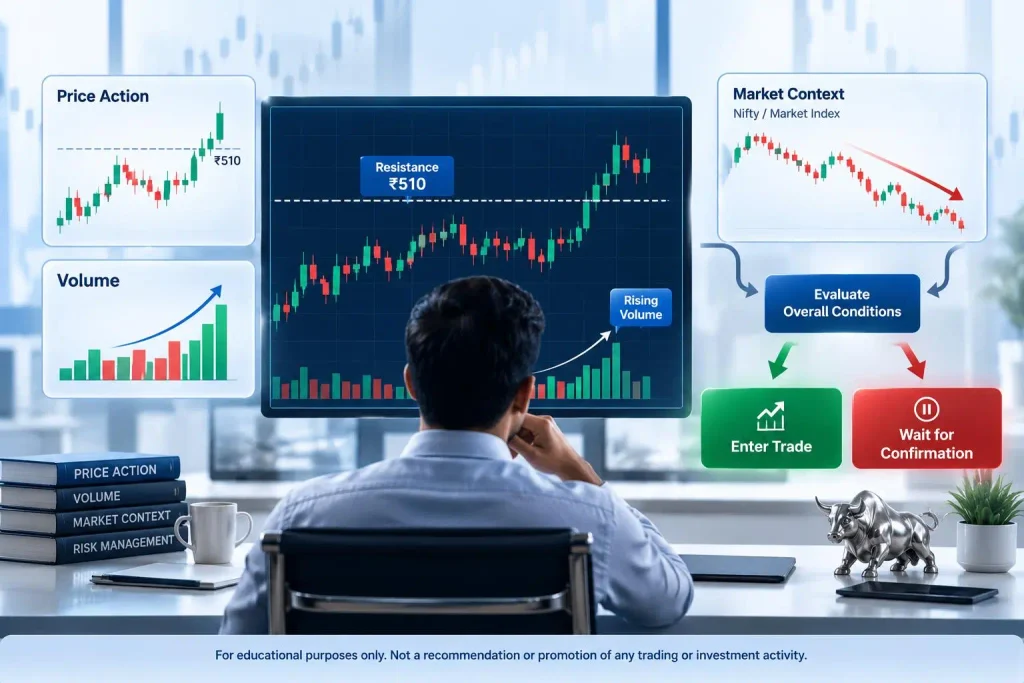
Discretionary trading is when decisions are made based on interpreting:
- Price action
- Support and resistance levels
- Volume
- Sentiment
- News
Simple Definition
If two traders see a bullish breakout, one will buy as soon as the price breaks above resistance whilst the other will wait for the candle to finish.
They will look at the volume, overall market and determine if they fit with their strategy. This is an example of using discretion.
Discretionary trading is not random, it is using your knowledge but with a clear strategy.
Key Features of Discretionary Trading
- Human Judgment
- Market Context
- Technical Analysis
- Flexibility
- Risk Management
How Does Discretionary Trading Work?
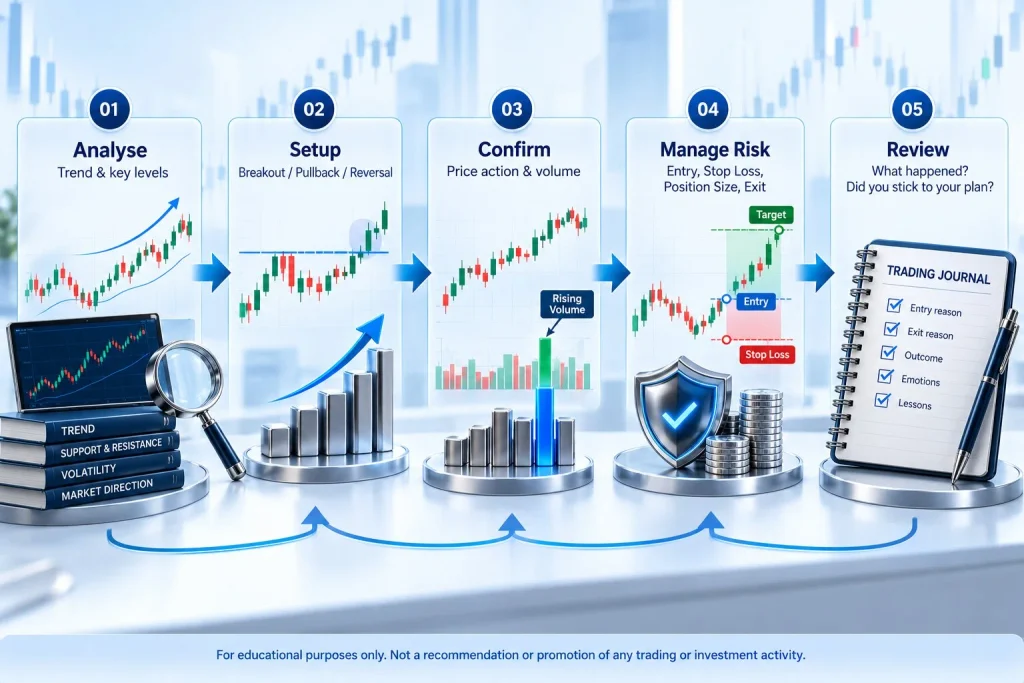
You need to have a system in place so that you don’t make any impulsive decisions.
Steps Involved in Discretionary Trading
- Analyse: What is the trend? Key levels? Volatility? Direction of the market?
- Setup: Is there a breakout/pullback/reversal?
- Confirm: Price action and volume.
- Risk Management: Entry, Stop Loss, Position Size, Exit.
- Review: What happened and did you stick to your plan?
Example: Trading Near a Resistance Level
You might want to wait for confirmation when the stock is near the resistance level (₹510).
If the breakout fails then you can avoid the trade.
Discretionary Trading Example: A Breakout Setup
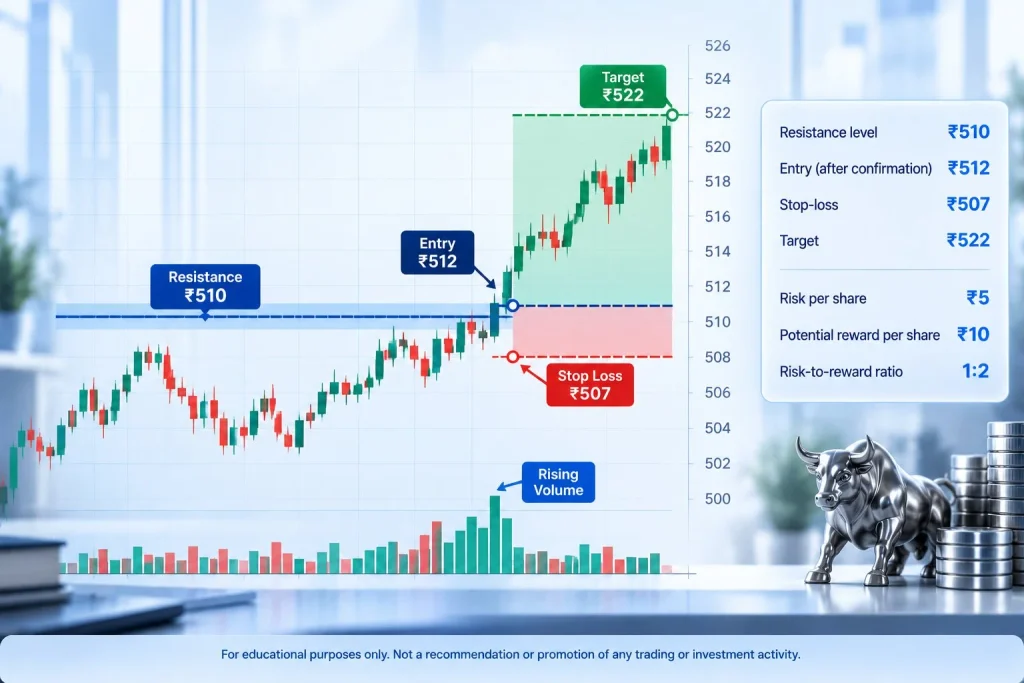
Consider this hypothetical setup:
| Trading parameter | Example |
| Resistance level | ₹510 |
| Entry after confirmation | ₹512 |
| Stop-loss | ₹507 |
| Target | ₹522 |
| Risk per share | ₹5 |
| Potential reward per share | ₹10 |
| Risk-to-reward ratio | 1:2 |
Buying at 512 with a stop-loss order in place at 507 means you’re risking 5 rupees per share. Your target of 522 means each share could give you a 10 rupee profit before costs. This example would mean you are risking 500 rupees on 100 shares whilst having the potential to make 1,000 rupees. This is purely for example purposes.
What If the Breakout Doesn’t Work?
If the stock breaks above ₹510 and re-enters below the level with low volume then you can avoid getting into the trade or take your planned exit.
A good discretionary trader will look at the quality of the setup.
Discretionary Trading vs Algorithmic Trading
Both approaches can use analysis; the key difference is who or what makes the decision.
| Factor | Discretionary trading | Algorithmic trading |
| Decision-making | Human judgement | Programmed rules |
| Adaptation | Trader interprets context | Depends on code and inputs |
| Speed | Depends on trader and platform | Can be very fast |
| Emotional influence | Possible | Reduced in automated execution |
| Flexibility | Human adaptation | Depends on programmed rules |
| Main challenge | Bias | Model or technical errors |
Neither is always better. Discretionary trading suits those who interpret context; algorithmic trading suits those able to maintain systematic strategies. Some traders use alerts and decide manually.
Popular Discretionary Trading Strategies
| Strategy | How it works | What to watch |
| Intraday trading | Positions opened and closed the same day | Volume, volatility, costs |
| Breakout trading | Looks for price to leave a range | Confirmation and false breakouts |
| Pullback trading | Looks for an entry during a temporary retracement | Trend strength and support |
| Options trading | Uses options based on a market view or strategy | Premium decay, volatility, liquidity, and potential loss |
Psychology and Discretionary Trading
Sometimes losses or FOMO can affect your trading.
Ask yourself before entering a trade:
- Why does this set-up match your trading strategy?
- What will cause me to be wrong?
- How much could I lose?
This should help you to move away from impulsive trading.
Pros & Cons of Discretionary Trading
Pros:
- Flexibility
- Price, volume & trend can be taken into account
- Avoid confusing setups.
- Opportunity to learn from reviews.
Cons:
- Emotional
- Inconsistency
- Time consuming to watch multiple stocks.
- Over analysing if indicators do not agree.
Key Takeaway: Flexibility works best with set rules.
Risk Management
Even if you do good research, you must still account for the possibility of failure.
From personal research by SEBI into individual traders within equity derivatives we should be aware of losses, costs and risk within derivatives. View an official list here.
Things to Keep in Mind
- Risk Management: Know what you’re risking.
- Position Sizing: How much you’re risking based on how far your stop loss is from your entry.
- Loss Limit: Only lose so much per day and don’t let your emotions get the better of you.
- Costs: Brokerage, tax, exchange fees and slippage.
- Journal: Know why you entered the trade, what setup you used, why you exited and what the outcome was.
- Know About Derivatives: Futures & Options can have big losses.
Practical Example: Risk Management
Using 0.5% risk of your capital (₹20,000) you’ll be looking to risk ₹100.
This will depend on how far away your stop loss is and what your costs are.
Your stop loss isn’t guaranteed to be hit at the exact point you want to exit especially with large movements or gaps.
View NSE Investor Guidance.
Is Discretionary Trading Right for Beginners?
Start by building your knowledge.
Realistic Beginner Steps
- Know the basics of the market, order types, candles and price action.
- Know about support/resistance, volume and trends.
- Stick to one simple setup.
- Practice using historical charts and demo trading.
- Track some meaningful trades and see what mistakes you make regularly.
- Only start small once you understand the risks.
Common Mistakes Beginners Should Avoid
- Don’t buy just because a stock is going up.
- Don’t use leverage.
- Don’t increase your position size after losses.
- Don’t treat indicators as a guarantee.
- Don’t trade without an exit strategy.
- Don’t assume your strategy works because you’ve won a few times.
Learn Discretionary Trading With Ruchir Gupta Trading Academy
Beyond chart reading you need to have a solid risk management plan and objective decision making.
The Ruchir Gupta Trading Academy provides learners with the knowledge to give them a solid foundation within the stock market. This includes intraday trading, options trading and technical analysis.
What You Can Learn
Look for a course that will teach you when not to trade. The course provided by Ruchir Gupta will include:
- Technical Analysis: Charts, Trends, Support & Resistance.
- Intraday Trading: Planning Your Trades, Market Structure & Execution.
- Options Trading: Premiums, Volatility, Expiry & Risk.
- Live Learning: If available.
- Risk Management & Mentorship: Position Sizing, Stop Loss Planning & Feedback on Analysis.
Take the Next Step in Your Trading Journey
Take a look at the stock market course provided by Ruchir Gupta. This will provide you with knowledge of intraday trading, options trading and technical analysis.
If available there will be live learning. You should contact the academy directly to find out:
- What is included in the curriculum?
- What are the fees?
- What are their credentials?
- What is the format of the course?
Remember that education does not guarantee profits.
Conclusion
Discretionary trading means that you have more freedom when it comes to interpreting the market conditions. However, without discipline, too much freedom can create unnecessary losses.
You should follow a strategy, check your setups, control your risk and make objective decisions.
Take a look at the Ruchir Gupta Trading Academy to improve your knowledge of intraday trading, options and technical analysis.
Be realistic with your expectations.