Ever invested in a stocks for intraday option trading based on it being a volatile stock and lost money?
Just because a stock is volatile does not mean that it will provide a good option trade. You may end up getting flat premiums , big spreads, low volumes and even reversals that will eat into your profits.
By using market data, technical indicators and a stock scanner tool we can identify the best stocks to trade. They ensure the stock has adequate liquidity, volatility and clarity. This article focuses on India.
Quick Answer: How to Select Stocks for Intraday Options Trading?
Take into account F&O eligibility, liquidity, volume, volatility, price movement, news and sector strength. Look for potential opportunities. Think about option strike price, expiry date, option liquidity, bid-ask, volume and open interest.
There is no guarantee of profitability.
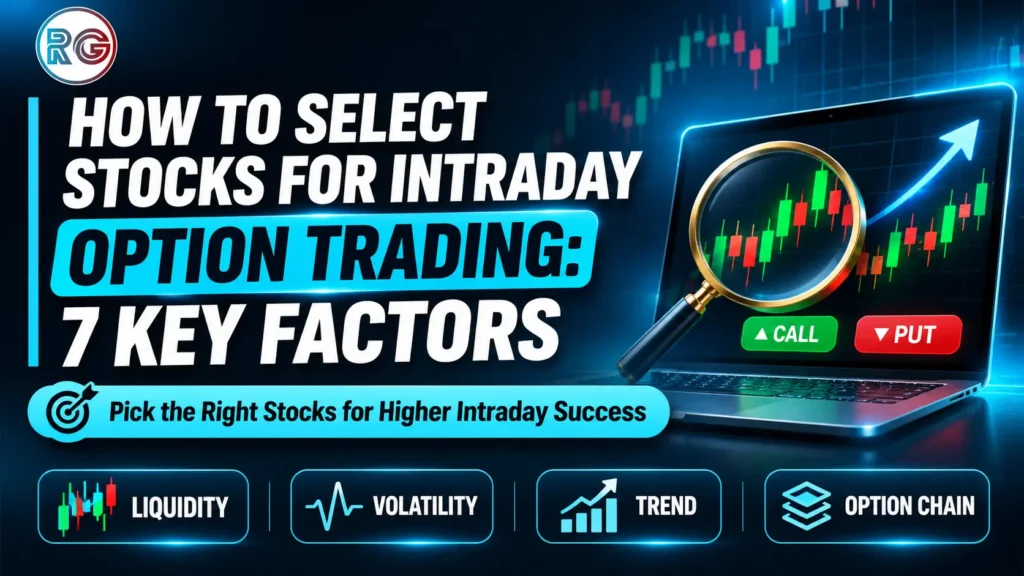
7 Factors To Consider When Trading Options Intraday
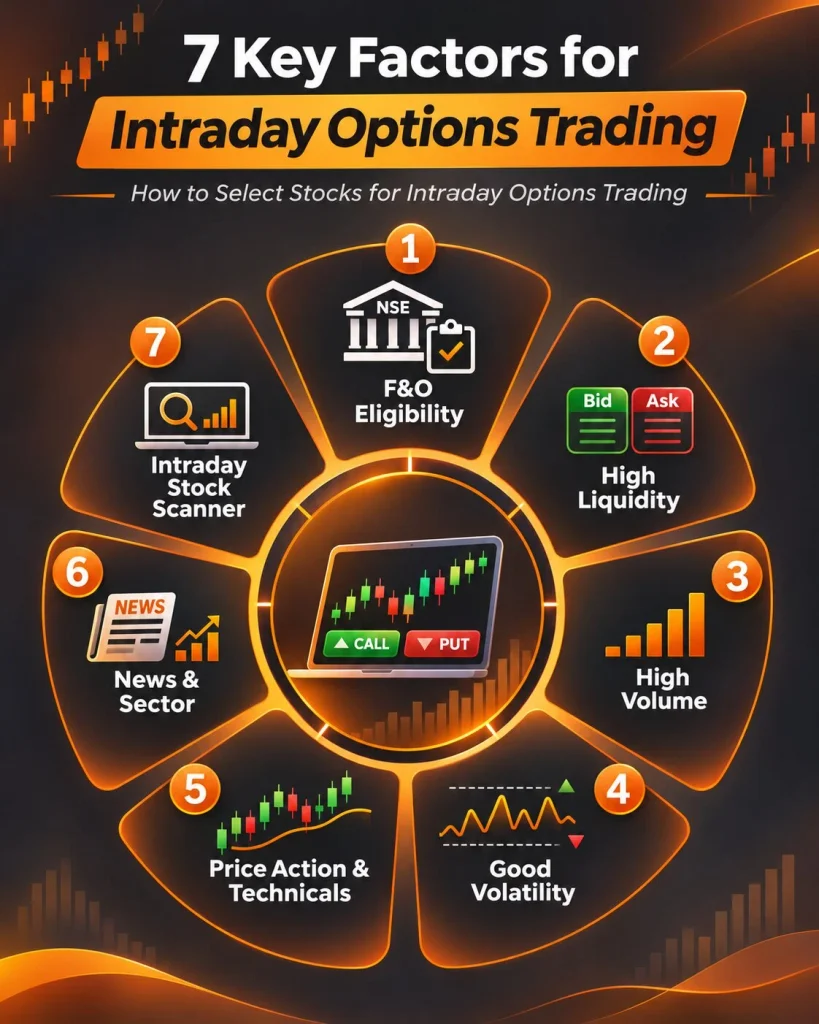
Selecting the right stock to trade options on is very important. Just because a stock is popular doesn’t mean it is a good choice for intraday options trading. Here are some key considerations:
1. Ensure it is an F&O Stock
Make sure that there are options available to trade on the NSE. You should consider:
- Is it in the F&O segment on NSE?
- How many expiries and strike prices are available?
- What is the volume on the contracts?
Try to avoid low volume options. The F&O list and options can change frequently.
2. High Liquidity
You need high liquidity options to ensure you can easily get in and out of a trade without the price suffering too much. Ensure your contract has good liquidity.
Look for:
- Small Bid Ask spreads.
- Good depth.
- Good volume.
- High open interest.
- Avoid high slippage.
Looking for options with a bid of 98 and an ask of 100 will give you a spread of 2. An option with a Bid of 98.50 and ask of 99 will give you a much smaller spread and may provide a better quality.
3. High Volume
Volume will tell you how active the stock/option is. The higher and more consistent the volume, the more activity will be present. This does not guarantee you a good trade though.
Look for:
- High volume (Higher than average).
- Increase in volume during breakouts.
- Consistent volume.
- Confirm using the option contract.
- Increasing volume at key support/resistance levels.
A stock with 1% movement may be more reliable if it has double the volume than a stock with 1.5% movement and lower than average volume. You should look to confirm using price action and options liquidity.
4. Good Volatility
This will tell you how much the stock price is moving. You want your stock to have enough volatility to make the options premium react. Too much volatility can lead to increased risk.
Useful indicators include:
- ATR – Tells you how much the stock moves on average.
- Historical Volatility – Tells you how much the stock has moved.
- Implied Volatility – Tells you how much it is expected to move.
- Bollinger Bands – Can help show increasing/decreasing volatility.
Low volatility won’t give you much chance to trade. Too much can cause erratic reversals and expensive premiums. High implied volatility does not guarantee a good option to buy.
5. Price Action & Technicals
A stock may have high volume and volatility but if the price action is unclear it may be difficult to trade. Look at:
- Support/Resistance.
- VWAP.
- Short term moving averages (9 EMA, 20 EMA).
- Breakouts from opening range.
- Candlestick Patterns & Rejection.
If the stock gaps above previous high, stays above VWAP and breaks out of the opening range with high volume this may indicate bullish strength. However, you should look to confirm. Breakouts can fail after large candles.
6. News & Sector
Company news can cause sudden price movements. Look for:
- Earnings.
- Large orders or company news.
- Regulatory changes.
- M&A.
- Sector News.
- Global Market Trends.
Also look at whether the sector is performing well. If banking stocks are performing well and the general market is bullish, you may have a clear setup to trade a liquid banking stock.
Never trade a stock because it is trending in the news. Ensure the news is already priced in and there is volume to back it up.
7. Intraday Stock Scanner
It can be tricky to manually go through hundreds of stocks. Using a real time stock scanner can help you identify good stocks with good momentum, weird volume, breakouts and changing volatility.
Some common filters are:
| Filter | Reason |
| Above VWAP | Bullish strength. |
| Below VWAP | Bearish weakness. |
| Above Average Volume | More involvement. |
| Above Previous High | Bullish momentum. |
| Below Previous Low | Bearish weakness. |
| RSI > 60 | More momentum. |
| RSI < 40 | Less momentum. |
Tools such as Chartink, TradingView, Zerodha Kite and NSE India can help you identify, chart and confirm contracts.
Remember these tools will only help you identify stocks. They do not guarantee you a buy/sell signal. Always confirm using price action, market conditions and options contract liquidity.
A Practical Checklist Before Selecting Stocks for Intraday Trading
| Selection factor | What should you verify? |
| F&O eligibility | Current exchange-listed contracts |
| Underlying liquidity and volume | Active market and comparable volume |
| Volatility | Sufficient but manageable movement |
| Technical setup | Clear levels and invalidation point |
| News and sector | Relevant announcements and market context |
| Option chain | Chosen strike and expiry; liquidity, spread, volume and open interest |
Consider shortlisting three to five stocks instead of tracking too many at once.
Risk Management: The Factor You Should Never Ignore
No matter how you choose your stocks you will lose money from time to time either from breakouts not working, reversals or being against you on the premium.
- Plan your stop loss.
- Use a risk amount that you are comfortable with.
- Don’t trade too out of the money options as they can be cheaper.
- Use limit orders for larger spreads.
- Don’t average losers intraday.
- Take into account any brokerage or tax.
- If you hit your daily stop loss stop trading.
In August 2026, SEBI published a study on the profitability of individual traders in the equity derivatives segment for FY 2025–26.
A good trader doesn’t have to trade everyday. Sometimes it’s better not to trade in a bad setup.
How to Find Stocks to Trade Intraday:
1. Before the market opens: Look at global hints, news and sector movements.
2. At the market open: Look for active F&O stocks and high volume.
3. Use scanners: Look for high volume, high volatility and price movement.
4. Chart analysis: Look for key levels such as support, resistance, VWAP and range.
5. Options contracts: Compare volumes, OI and spreads between contracts.
6. Wait for confirmation of the trade set-up before entering the trade.
7. Track your trades: Note down when you entered, exited and why. What was the outcome?
This will help take the guess work out of picking stocks to trade.
Learn Market Analysis with Ruchir Gupta Training Academy
Intraday options traders must be aware of market trends as well as have the correct knowledge of market timing, technical analysis and risk management. At Ruchir Gupta Training Academy, traders can develop these skills through structured learning.
After taking structured courses, using real time market examples and advanced tools you will learn how to correctly analyse markets. You will also learn how to use GCD and Time Cycles as well as rule based strategies.
- GCD & Time Cycle Method – Understand market cycles, possible reversal points and price movements. This will help you to make informed decisions when entering, exiting and targeting.
- Advanced Stock Scanners – Learn how to use advanced scanners based on GCD. This includes a BSE scanner to scan 2800 stocks.
- Real Time Market Examples – Learn using real time charts, examples and interactive sessions.
- Technical Analysis – Understand price movements, support and resistance, momentum and how different stocks, indices and commodities perform.
- Risk Management – Understand how to size your positions, place stop loss orders and make disciplined decisions.
This will provide a more analytical approach when picking stocks, making trades and remove guess work
Conclusion: Choosing the right stock.
You will want to look for stocks with high liquidity, volume, volatility, great price action in a strong sector in addition to any news.
Whilst using an intraday stock screener will help reduce the number of stocks to analyse, you will still need to do some technical analysis and also look at the option chains. Everything needs to be kept in order.
The Ruchir Gupta Training Academy will give you structure and knowledge of how to apply intraday strategies, options and technical analysis to analyse the market, identify opportunities and manage risk.