There are many ways you can make money from the stock market. Some people like to actively trade their stock/investments and others prefer to invest in quality companies.
This can get into a debate about which is better.
Trading can be a great way to generate quick profits but can be risky and stressful. As opposed to trading, investing can be a longer term strategy and can take patience, research and discipline.
It really depends on how you want to use your money, how risky you want to be, how much knowledge you have and personal preference.
By understanding the key differences between trading and investing you can make the decision on which is going to be best for you.
Quick Answer – Trading vs Investing
- Trading: Buying and Selling financial securities to gain profit from short-term price movements.
- Investing: Buying assets to grow your overall wealth. This can be through price growth, dividends and compounding.
Traditionally trading will be more active.
What is Trading?
Trading is when you buy and sell stock/instruments to make money from trends, price movements, volumes and technical indicators.
For example buying 100 shares for 500 and then selling for 515. This would give you a gross profit of 1,500.
Types of Trading
- Intraday Trading: Buying and selling in one session.
- Swing Trading: Buying and selling over the course of days/weeks.
- Positional Trading: Buying and selling over the course of weeks/months.
- Scalping: Making frequent, short-duration trades to capture small price movements.
- Options Trading: Trading derivative contracts influenced by underlying price movements, volatility and time decay.
What do you need?
- Technical Analysis, Charts, Trends.
- Easy to get in/out.
- Stop Loss, Position Sizing and Risk Management
- Emotional control.
- Expert knowledge.
Even if you have a great setup you may still lose out due to not having expert knowledge. Entering at the wrong time, using too much leverage and/or exiting for emotional reasons can cause a loss.
What Is Investing?
Investing is buying financial assets in order to reach long term goals. Investors see companies from a value/growth perspective. Investors can invest directly into individual stocks, invest in index funds or use other strategies to invest depending on their goals within investing and level of risk they are willing to take.
For example, if you buy 50 shares for ₹500 each (Total = ₹25,000) and after 5 years the price has risen to ₹800 per share, you will have made a profit of ₹40,000. (Doesn’t include Dividend, Tax, Cost)
You can gain profit from capital gains, dividend, growth and compounding.
How Compounding works in Investing?
Over time, reinvested investment returns can generate additional returns through compounding.
For instance, reinvesting dividend payments or investment profits can assist in increasing investment growth.
As the value of an investment increases, future returns will be based upon a higher investment value potentially allowing wealth to grow over time.
However, Investment returns depend on market performance and other factors and are therefore not guaranteed
Common Investment Strategies
- Value investment – Invest in undervalued stocks.
- Growth investment – Invest in companies with growth potential.
- Dividend investment – Invest in companies that pay dividends.
- Index investment – Invest in funds that track indices such as Nifty 50.
An investor will analyse a company’s financials, management, industry and value.
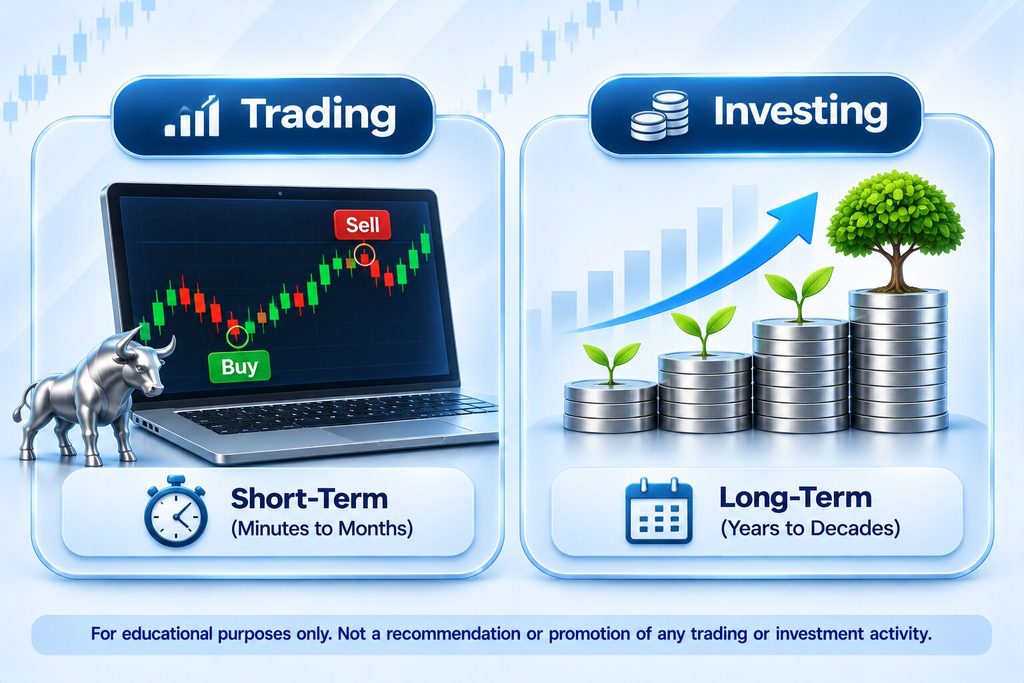
Trading vs Investing: Key Differences
| Factor | Trading | Investing |
| Objective | Profit from price changes | Build long-term wealth |
| Timescale | Very short-term to medium term (minutes/weeks/months) | Long term (years to decades) |
| Analysis | Technical analysis | Fundamental analysis |
| Monitoring | Frequent monitoring | Regular review of portfolio |
| Growth | Profits from price movements | Capital growth, income and other distributions |
| Costs | Potentially higher costs, due to frequent trading | Generally lower costs, due to less frequent trading |
| Risk Management | Stop loss orders, trade management and position sizing | Diversification, asset allocation and time horizon |
| Skills | Technical analysis, discipline | Fundamental analysis and planning |
| Difficulties | Managing emotions in short-term volatility and trading pressure | Maintaining discipline in periods of market decline |
Trading for a Quick Gain or Investing for the Long Term?
A) Trading Scenario
- Buy Price: ₹1,000
- Sell Price: ₹1,030
- Number of Shares: 100
- Initial Investment: ₹1,00,000
- Gross Profit: ₹3,000
In this case, the investor has benefitted from short term gains. Once the investor achieves the target profit, the shares are sold and earn a profit of ₹3000.
B. Investing Scenario
- Buy Price: ₹1,000
- Initial Investment: ₹1,00,000
- Number of Shares: 100
- Holding Period: 5 Years
- Assumed Selling Price: ₹1,600
- Value After 5 Years: ₹1,60,000
- Gross Capital Gain: ₹60,000
- Return on Investment: 60%
As the time period of holding is long (5 years), it is assumed that the business of the company will have grown and hence, the market value would have increased. So, if the price of the shares increases to ₹1600 then the investment becomes ₹1,60,000 which shows a profit of ₹60,000.
Note: This is an example only. Charges such as tax, brokers and other costs are excluded.
Traders look at short term price changes, whilst investors look at a company’s longer term prospects.
Which Is Better: Trading or Investing?
There is no one answer. It depends on your objectives, how much time, experience and risk you have.
| Trading may suit you if you: | Investing may suit you if you: |
| Like to be involved in the markets | Want to build wealth over the long term |
| Are able to keep on top of the markets | Have a longer time frame |
| Know how to use technical analysis | Can analyse fundamentals |
| Stick to strict risk management | Can review your portfolio periodically |
| Can tolerate short term losses | Can tolerate market volatility |
Important thing to Know As a New Trader
However once you start frequently trading you will start to incur costs, feel stressed and risk.
According to a study done by SEBI in FY26 around 87.7% of retail traders lost money on equity derivatives with an overall loss of around ₹91,685 crore.
As an investor there are risks involved. The price of shares can fall due to bad earnings, problems in the industry or the overall economy.
Whilst we cannot avoid risk we can understand and manage it.
Can You Trade and Invest?
Yes you can have money invested in a long term portfolio, but also have a pot for trading.
- Investment Portfolio – Invest in fundamentally sound and diverse companies.
- Trading Capital – Have some money set aside.
- Risk Management – Have a risk management strategy, tracking and target.
Don’t ever use your emergency fund or borrowed money. Only invest money that you can afford to lose.
Common beginner mistakes
| Mistake | Improvement |
| Trading without a plan | Create and test a plan |
| Taking others advice | Do your own research |
| No Stop Loss | Have a clear idea what you’re willing to lose. |
| Investing in hype. | Do your research on fundamentals. |
| Expecting guaranteed profits. | The market can be volatile. |
| Over trading when losing. | Stick within your limits. |
| Putting everything into one stock. | Consider diversifying. |
| Panicking when things go against you. | Refer to your investment thesis. |
Having one winning trade does not necessarily mean your strategy is correct. Having a losing trade does not necessarily mean your research was wrong. Look at your process.
Choosing the right approach
Before you begin trading on the stock market, ask yourself some questions:
1. What is your goal? Are you looking for short-term opportunities or overall wealth?
2. How much time can you invest? Will you want to be actively involved and constantly monitoring, or will you want to check in at certain times?
3. What is your risk tolerance? Can you handle losing money?
4. How much do you know how to analyse technicals and/or fundamentals?
5. Do you have a strategy? Can you identify what your entry/exit strategy is?
Before getting into more complex products such as futures and options ensure that you understand the basics.
Learn To Trade With Ruchir Gupta Training Academy
Now that you know the difference between trading and investing you can put that into practice.
At Ruchir Gupta Training Academy we offer training courses, live market examples, workshops and specific market analysis tools to assist you with a systematic approach.
Key Topics Covered Include:
1. Time Cycle Analysis using GCD
Understand market cycles, key changes within markets and identify entry/exit points and targets of trades.
2. Advanced Scanners
Use advanced tools based on GCD including the BSE scanner (covering 2,800 stocks).
3. Live Learning
Apply knowledge to charts, examples from the market and previous recordings.
4. Technical Analysis
Analyse stock, indices and commodities for price action, key levels of support/resistance, and momentum.
5. Risk Management
Know how to appropriately size your position, apply stop losses, manage capital risk, and be disciplined in trading.
You will learn how to make informed decisions and understand the potential issues but this does not guarantee you will make money.
Conclusion: Trading Vs Investing – Choose The Right One For You
Trading is all about making quick profits whereas investing is all about using the fundamentals of the business and being patient to make long term profits.
Neither will guarantee you will make profits but having an understanding of the markets will help you create the right strategy. Make sure to always make informed decisions.
Start your journey with us at Ruchir Gupta. We offer training on Intraday Trading, Options Trading and Technical Analysis. Improve your knowledge with our hands on and mentoring based training.