The Short Straddle options strategy allows traders to make money from the stock market without guessing if the price will go up or down. The strategy involves selling a Call and Put option of the same strike price as you expect the market to be stable.
However, if the market suddenly moves higher, drops sharply, or any unexpected news occurs, then you could lose a lot of money. Although you receive a premium when selling options, you are taking on a large amount of risk.
Traders need to understand how volatility, time decay, breakeven points and good risk management will affect short straddles. We will look at some examples below.
Quick Answer: What Is a Short Straddle?
A short straddle is created by selling both an ATM Call and Put option of equal strike price and expiry date.
This means the strategy will achieve the greatest profit if the underlying price expires at exactly the strike price.
It also capitalises on time decay and falling implied volatility; however, it is a very risky strategy if there is significant movement in the price of the underlying asset.
How Does the Short Straddle Strategy Work?

A Short Straddle is a Neutral Strategy that you use if it is expected that the market would move in a very limited range.
How to create a Short Straddle:
- Pick an underlying asset – say NIFTY
- Pick an At the Money strike price
- Sell one Call Option (CE)
- Sell one Put Option (PE)
- Make sure that the expiry of both options is the same.
You receive premium income from both the options and you try to keep as much of the premium as possible.
For example,
If NIFTY is trading at 25,000, then you sell:
| Position | Strike Price | Premium |
| 25,000 CE Sell | 25,000 | 150 |
| 25,000 PE Sell | 25,000 | 130 |
| Total premium | 280 |
So here you are receiving 280 per unit. In case NIFTY expires at 25,000, you will end up with a profit of 280 as both options would expire worthless.
But if there is a large movement in the market, you could face losses beyond the premium you received.
This is just for illustration purposes. The actual premium and number of contracts vary.
Short Straddle Payoff: Maximum Profit and Breakeven Points
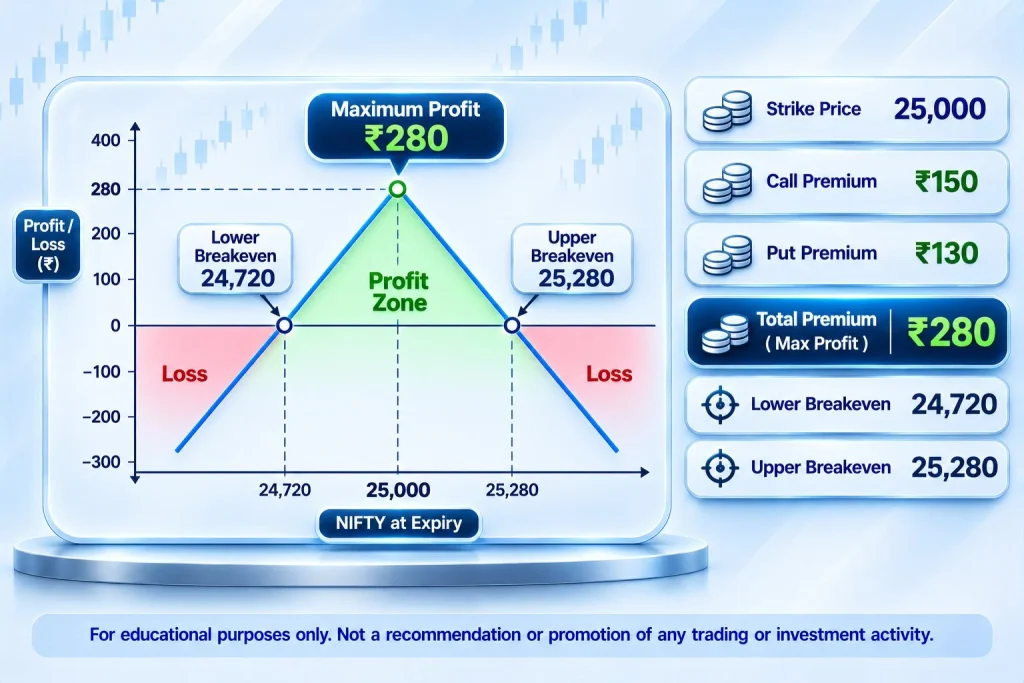
Understanding the payoff structure is essential before placing a short straddle trade.
There are three important calculations:
- Maximum Profit = Total Call Premium + Total Put Premium
- Upper Breakeven = Strike Price + Total Premium Received
- Lower Breakeven = Strike Price − Total Premium Received
Using our NIFTY example:
- Strike price: 25,000
- Call premium: ₹150
- Put premium: ₹130
- Total premium: ₹280
Therefore:
- Maximum profit = ₹280 per unit
- Upper breakeven = 25,280
- Lower breakeven = 24,720
The position makes a profit at expiry when NIFTY remains between 24,720 and 25,280, before transaction costs.
Short Straddle Payoff at Expiry
| NIFTY Expiry Level | Net Profit/Loss per Unit |
| 24,500 | -₹220 |
| 24,720 | ₹0 |
| 24,800 | +₹80 |
| 25,000 | +₹280 |
| 25,200 | +₹80 |
| 25,280 | ₹0 |
| 25,500 | -₹220 |
The closer the expiry price is to the strike price, the greater the potential profit.
What does the payoff chart look like?
A short straddle has an inverted V-shaped payoff:
- The peak represents maximum profit at the strike price.
- The two breakeven points mark the boundaries of profitability.
- Losses increase as the market moves beyond either breakeven point.
Maximum profit is limited to the combined premium received. Upside losses are theoretically unlimited, while downside losses are substantial but technically bounded if the underlying asset cannot fall below zero.
When Does the Short Straddle Work Well?
The short straddle is not always the best option for every market scenario. As previously mentioned, it will only perform well if the underlying assets are behaving in a certain way.
In general, it will work better if:
1. The market is moving sideways: This means that the underlying is trading around your chosen strike price.
2. Implied volatility is relatively high: You may be able to gain more premium income from the options.
3. Volatility is falling: This can cause the options you have sold to fall in value.
4. Time passes with no large movements: This causes theta decay, meaning both options will lose value which is favourable for the seller.
Time Decay
As options reach their expiry date, the value of them will decrease (all other things being equal). This can be very favourable for short straddles as you have sold both options.
However, just because there is time decay doesn’t mean you will make a profit. If volatility suddenly increases or there is a large price move then this can cause problems.
Short Straddle vs Long Straddle: What’s the Difference?
Both strategies use a call and a put at the same strike and expiry, but their market expectations are opposite.
| Feature | Short Straddle | Long Straddle |
| Position | Sell ATM CE and PE | Buy ATM CE and PE |
| Market outlook | Neutral | Expects a large move |
| Maximum profit | Limited | Theoretically unlimited on upside |
| Maximum loss | Substantial | Limited to premiums paid |
| Time decay | Generally benefits | Generally hurts |
| Falling volatility | Generally benefits | Generally hurts |
| Ideal market | Range-bound | Strong breakout or breakdown |
A long straddle benefits from a significant price movement in either direction. A short straddle, on the other hand, benefits when the market remains relatively stable.
What are the biggest risks of trading a short straddle?
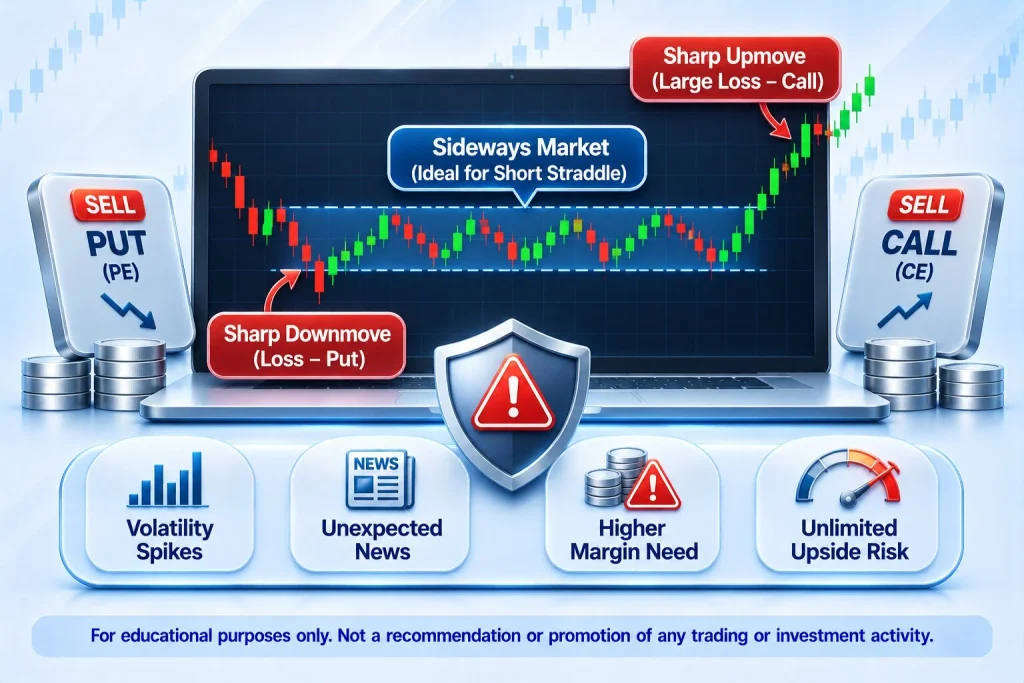
Many people will underestimate the risks involved.
As you receive 2 premiums it can be tempting to feel like you have nothing to worry about. However, there are still some large risks.
The main risks are:
1. Uncapped upside risk – If the underlying goes up substantially, then you can get hit hard by the short call.
2. Large downside risk – If there is a market crash then you could be left with a big loss from your short put. If the underlying goes to 0, your losses could be close to your strike price minus the premium you received.
3. Implied volatility increasing – If IV increases, you may find that when you go to buy back your options they are more expensive.
4. Market shocks – There could be market shocks such as economic news, geopolitical news or company news which causes large movements.
5. Large margin requirements – When you sell options you need large amounts of margin. If your risk increases then you could have increased margin requirements from your broker. This could cause you to run out of margin or get stopped out.
How can traders manage these risks?
- Make sure you look at the economic and company calendar.
- Watch IV levels and key support and resistance levels.
- Have a plan in place for how much you are willing to lose.
- Size your positions appropriately.
- Consider adding wings to turn your position into an iron butterfly.
- Do not hold a losing position just because it is nearing expiry.
- Have sufficient margin.
You need to have a risk management plan in place before you enter the trade.
Common errors made by beginners
Many traders know how to get into a short straddle but fail to manage their trades correctly.
Avoid:
1. Looking for a high premium: This can suggest that the market is expecting a large amount of volatility.
2. Not considering Implied Volatility: Even though you may have a good-looking setup, increasing volatility can cause it to be costly.
3. Too much leverage: If you are over-leveraged your losses will grow quickly.
4. Going to expiry blindly: Sometimes it can make sense to close or adjust your position early.
5. Not considering commission: Broker’s fees, exchange fees, tax and slippage will reduce your profitability.
6. Not having an exit strategy: All short straddles should have specific risk limits.
Good options traders will look at how much premium they can collect but also how much capital they could lose if the market moves against them.
Is the Short Straddle suitable for beginners?
The short straddle is not usually a good starting point for those new to options trading. Although it is easy to set up, you will need to have a grasp of:
- Greeks (Theta, Delta, Gamma & Vega).
- Volatility (Implied and Historical).
- Margin and position sizing.
- Expiry.
- Risk/reward.
Before getting started you should understand what it means to buy/sell options, payoff diagrams and risk management concepts.
You could also get some paper trading experience to give you a better understanding of how markets behave.
Learn Options Trading via Ruchir Gupta Training Academy
While it may be easy to understand what a strategy entails, knowing when to take a trade, stop taking a trade and how to manage when things go against you can be difficult.
The Ruchir Gupta Training Academy is designed to teach you real-world knowledge of trading in the stock market.
Learn:
- Intraday trading concepts and strategies
- Options trading and Option Greeks
- Technical analysis
- Market trends, price and volatility
- Risk management
- Practical market knowledge with mentoring.
Want to learn more about trading the stock market?
Join a course where you will learn Intraday trading, Options trading and Technical Analysis with live training and mentoring.
Develop your knowledge of trading strategies and become a more disciplined trader.
Conclusion
A short straddle could be a good strategy to take if you expect the market to stay relatively flat. By selling ATM calls and puts you are profiting from the premium and trying to profit from time decay and decreasing volatility.
However, there is a major downside to this strategy. You can only make limited profits and stand to lose big if the market moves a lot.
The skill here comes from understanding volatility, risk management and knowing when to take profits.
Before using this strategy in a live environment, it is important to know how the payoff works, breakeven points and how to manage various market situations.
Want to become a more confident and disciplined trader? Take a look at our stock market courses at Ruchir Gupta Training Academy and improve your knowledge on options trading, intraday strategies and technical analysis.