Have you ever purchased a call option on Nifty in anticipation of the market rising but seen the Premium drop despite the index rising?
Or have you ever purchased an Options position ahead of a large news event and still lost money?
The premium of an Option depends on many factors , and not just the direction of the market. Time to expiry, implied volatility and interest rates can all impact the price of an option. This is where the concept of ‘Option Greeks’ comes into play.
Understanding these 5 metrics will help you understand why the prices of the option premiums are changing. Whether you are trading Nifty, Bank Nifty, individual stocks or other derivatives, we will show you how to understand Option Greeks through real examples.
What Is Option Greeks? (Quick Answer)
The Option Greeks are a series of mathematical calculations that show how the premium of options will react to changes in market conditions.
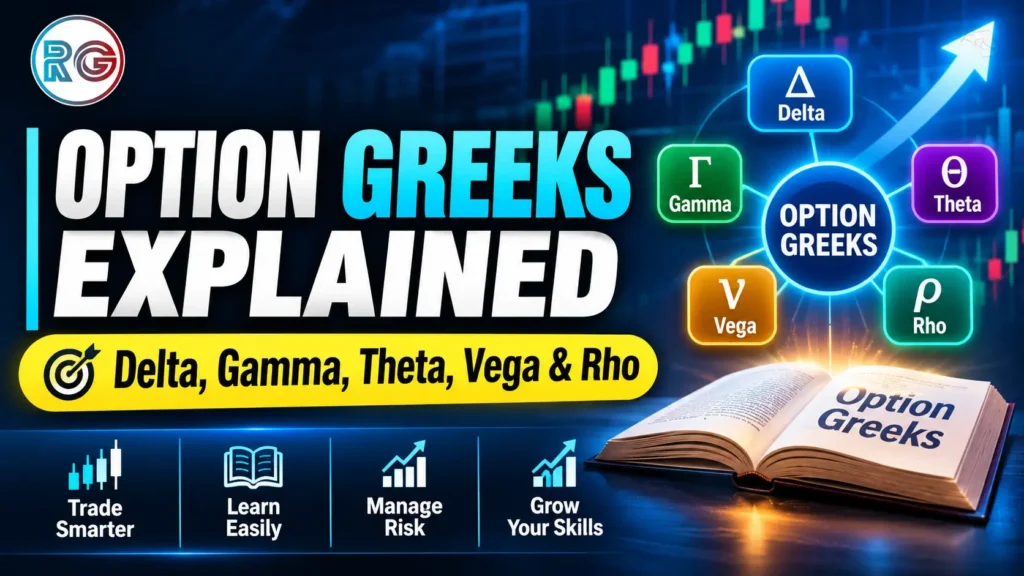
The 5 main Greeks are:
- Delta: Measures price sensitivity to the underlying.
- Gamma: Shows the change in Delta.
- Theta: Shows time decay.
- Vega: Shows sensitivity to implied volatility.
- Rho: Shows sensitivity to interest rates.
Why Are Option Greeks Important in Options Trading?
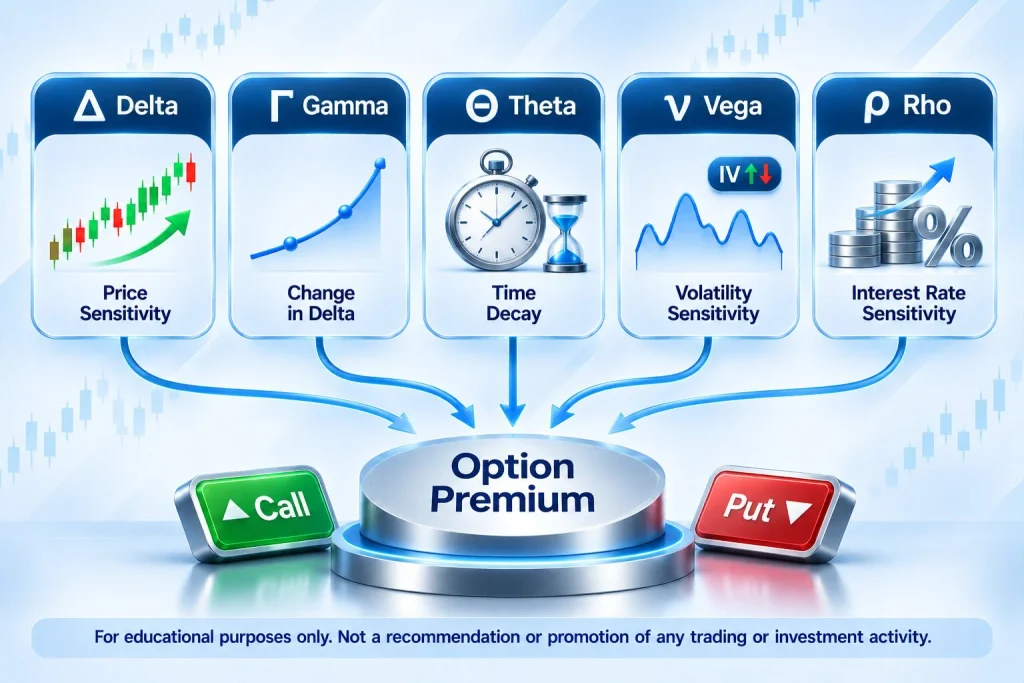
Option premiums are not just affected by movements in the underlying stock/index.
For example, Nifty may increase by 50 points but the change in your call premium may be negligible due to time decay, fall in implied volatility, low Delta and other factors.
Greeks help traders understand:
- How sensitive the premium is
- Time decay
- Volatility
- Strike price and expiry comparisons
- Managing directional risk
Delta (Δ): How much will the premium of my option move?
Delta indicates how much the premium of an option is likely to change, for every 1 point change in the underlying asset, assuming all other variables are constant.
| Type of Option | Typical Range |
| Call | 0 to +1 |
| Put | -1 to 0 |
| ATM Call | Approx +0.50 |
| ATM Put | Approx -0.50 |
Example
For example, if we have a Nifty call option with a premium of ₹200 and a Delta of 0.50 and Nifty rises 20 points, we can estimate the premium will increase by:
20 × 0.50 = ₹10
So the premium could be ₹210, assuming all other variables are constant.
Delta can help us to compare ITM, ATM and OTM options. It can also help understand how directional our position is.
Sometimes Delta can be used as a rough guide to how likely an option is to finish in the money, however it is not completely accurate.
Gamma (Γ): Why is Delta changing?
Gamma indicates how much Delta will change for a movement in the underlying asset.
So if we have a Nifty call option with a Delta of 0.50 and Gamma of 0.02 and Nifty rises 10 points, Delta may increase to ~0.70.
| Market Condition | Typically |
| ATM Options | Higher |
| Deep ITM/OTM Options | Lower |
| ATM Options close to expiry | Very High |
A high Gamma indicates that Delta can change quite quickly. This is important to note for short options close to expiry.
What initially seems like a manageable position could expose you to a large amount of directional risk.
Theta (Θ): How does time decay affect option premiums?
Theta indicates how much the premium of your option is likely to change as time passes.
Generally, as options approach their expiry date, they will lose their time value. This is known as time decay.
Example
If you buy a Nifty call option with a premium of ₹150 and Theta of -₹2 per day, assuming all other variables are constant, after 1 day your premium may reduce by ~₹2.
Theta will depend on factors such as moneyness, volatility and other variables affecting the price.
Theta can help buyers understand the cost of buying options. Sellers can also use it to understand how they may benefit from time decay.
If Nifty is flat after buying a short-term call, the premium may reduce.
Just because you are correct with the direction doesn’t mean you will make money.
Vega (ν): How does volatility affect option prices?
Vega indicates how sensitive the premium of your option is to changes in implied volatility (IV).
Generally, if IV increases, the premium will increase. If IV decreases, the premium will decrease, assuming all other variables are constant.
Example
If we have an option with a premium of ₹100 and Vega of 0.80, and IV increases by 2%, we can estimate the premium will increase by:
0.80 × 2 = ₹1.60
So the premium could be ₹101.60.
Vega can be important around times of Union Budget, RBI policy, company earnings or major economic events.
What is IV Crush?
IV Crush refers to when implied volatility drops significantly and therefore causes option premiums to drop.
If you buy a call before an announcement and expect a large move, once the announcement is made uncertainty will reduce and IV will drop.
Even if the market moves slightly in the expected direction, you may not make any money due to losing value from the drop in volatility.
Pro Tip: When considering buying an option, don’t just look at the direction of the market, look at the IV and Vega.
Rho (ρ): How do interest rates affect option prices?
Rho indicates how sensitive an option premium is to interest rate changes.
Generally Rho isn’t as important for short-term retail traders, however can be more important for longer-dated options.
- Call Options generally have a positive Rho.
- Put Options generally have a negative Rho.
Generally an increase in interest rates will cause call premiums to increase and put premiums to decrease.
Example
For example, if you have a call option with a Rho of +0.10, if interest rates increase by 1%, the option may increase by ~₹0.10 in theoretical value.
Comparison of All Five Option Greeks
Understanding the differences between the five Greeks becomes easier when you compare them together.
| Option Greek | Measures | Main risk |
| Delta | Underlying price movement | Directional risk |
| Gamma | Change in Delta | Changing directional exposure |
| Theta | Passage of time | Time decay |
| Vega | Implied volatility | Volatility risk |
| Rho | Interest rate changes | Interest rate risk |
Which Greek matters most to option buyers and sellers?
| Greek | Option buyer | Option seller |
| Delta | Depends on position direction | Depends on position direction |
| Gamma | Generally positive | Generally negative |
| Theta | Generally negative | Generally positive |
| Vega | Generally positive | Generally negative |
| Rho | Depends on call or put | Opposite of buyer |
The table describes the usual exposure of individual long and short vanilla options. Combined strategies can have different Greek exposures.
How to Use Option Greeks Together Before Taking a Trade
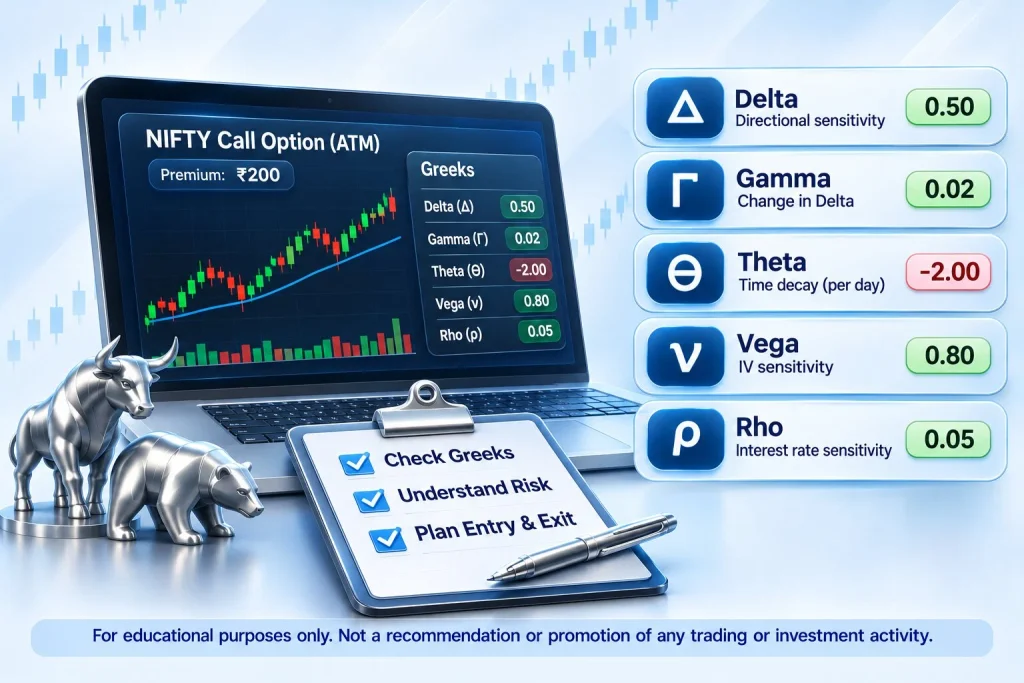
The following Greeks should be checked before placing any trade:
- Delta – Gives you an indication of how sensitive the option is to movements in the underlying asset.
- Gamma – Shows how sensitive the delta is and could change rapidly.
- Theta – Shows how much it will cost to hold the option.
- Vega – Take into consideration how sensitive the price will be to changes in IV.
- Rho – Take note of how sensitive the option is to interest rates (longer-dated options).
Example: Buying an ATM Call Option
If you buy an ATM call option and expect the underlying (Nifty) to increase:
- Delta shows how sensitive the option is to direction.
- Gamma shows how it will change.
- Theta shows how much time decay you will face.
- Vega shows how much the option price could be affected by changes in IV.
Even if you get the underlying prediction right, there are still other factors that could impact the price.
Common Greeks Mistakes to Avoid
1. Not accounting for Theta: Holding short-term options without considering theta decay.
2. Confusion around Delta: Thinking that Delta is a guarantee of profit probability.
3. Not accounting for Gamma: Not considering the acceleration of risk as they approach expiry.
4. Not accounting for implied volatility: Not considering IV when buying options.
5. Focusing on Delta: Not considering the other factors which influence your risk (Theta & Vega).
6. Poor risk management: Taking large positions or not considering that the Greeks may change.
Option Greeks are only an estimate based on pricing models. Large market moves, volatility and liquidity can cause the premiums to behave differently.
Learn Options Trading from Ruchir Gupta Training Academy
While it is important to understand what the different Option Greeks are, it’s also useful to practice and observe how they act in different strike prices, expiry dates and market situations.
Ruchir Gupta Training Academy will help you learn more by providing you with a proper structured education in the Stock Market.
With guidance from experts like Ruchir Gupta, you can develop your understanding of:
- Intraday trading
- Options trading
- Technical analysis
Rather than relying solely on market tips.
Ruchir Gupta provides training and mentorship to help students better understand the application of theory in the market.
Conclusion (Understand the Greeks)
Options trading isn’t just about being able to predict if the market is going up or down but understanding how time decay, volatility, interest rates and sensitivity to price changes impact the premium.
Using the 5 Option Greeks:
- Delta – This shows directional sensitivity.
- Gamma – This shows why delta changes.
- Theta – This shows time decay.
- Vega – This shows sensitivity to volatility.
- Rho – This shows sensitivity to interest rates.
The benefit is not only knowing what each factor does but how they work together.
Want to improve your knowledge on options, intraday strategies and technical analysis? Learn under the guidance of Ruchir Gupta.
Improve your knowledge, practice your market analysis and become a disciplined trader.
Learn the concepts, understand the risks involved and trade with knowledge.