Suppose that you think Nifty is going to go up. You don’t purchase one futures contract, but you consider an alternative: a call option and a put. That’s where synthetic futures come in handy.
It’s possible to have a futures-like payoff with a combination of calls and puts. This is because of the understanding of strike price, premiums and expiry. Synthetic futures can help Nifty traders or traders trading stock derivatives grasp options pricing and options risk in India. Ruchir Gupta Trading Academy is not only about acquiring trading strategies; it is about knowing the “why” behind the trades that traders make and how they react or result.
What Are Synthetic Futures?
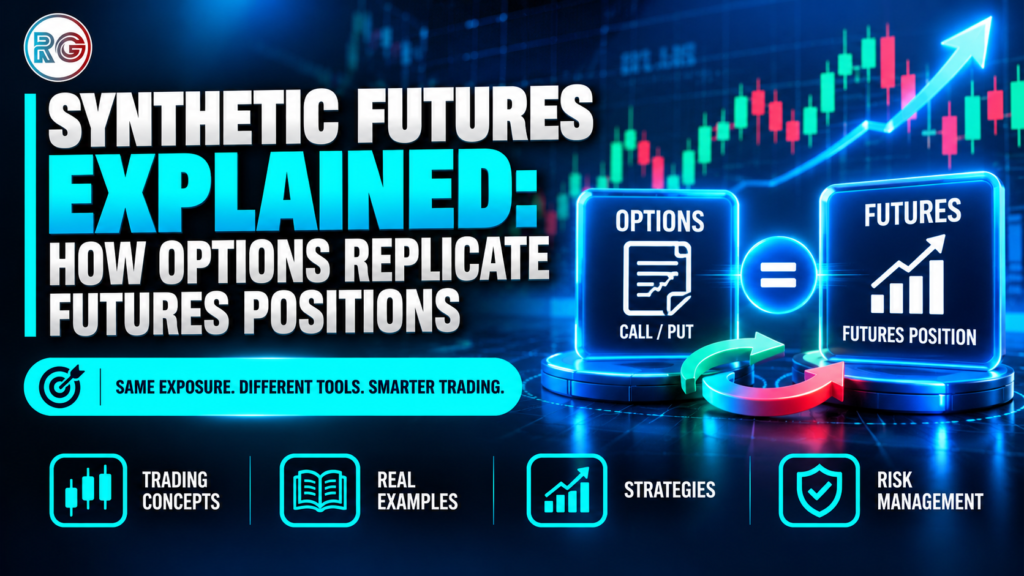
Synthetic futures are options combinations whose payoffs are similar to that of a futures position. A long synthetic future is where a person buys a call and sells a put of the same underlying asset, strike and expiration. The inverse combination is a short synthetic future. The above information is based on estimates and is subject to variation based on premium, margin and execution costs.
A synthetic futures position is created with options that have the same economic payoff as a futures position. It is closely related to put-call parity, which shows the relationship between the price of a call, the price of a put and the price of the underlying asset for the same strike and the same expiration.
Long synthetic futures: Buy a call and sell a put with the same strike and expiration.
Short synthetic futures: Sell a call and buy a put with the same strike and expiration.
They can also be used by traders to gauge directional exposure, hedge or compare prices, but when options are sold, they can cause traders to suffer significant losses.
What Is the Payoff of a Synthetic Future?
Suppose that the price of a share of a stock is ₹1,000 and it has two options with the same strike price of ₹1,000 and the same expiry.
Call buyer: When the value of the underlying rises, the call buyer makes a profit after accounting for the premium paid.
Put seller: Bears the risk when the market drops and has the downside risk of a futures contract.
The intrinsic payoff is the sum of the payoffs: the common strike is subtracted from the underlying price received at expiry.
Long synthetic payoff: S_T − K
Short synthetic payoff: K − S_T
In this case, S_T represents the underlying price at expiry and K is the common strike. Premiums, transaction costs, taxes and financing effects are not included in these formulas.
What Are the Differences Between an Option Strike Price and the Current Price?
The strike price refers to the price of the underlying asset that the option buyer can buy in a call option and sell in a put option. It contributes to intrinsic value.
Let’s assume that the share price is ₹1,000 and the strike price for both options is also ₹1,000:
•At ₹1,100, the call has ₹100 intrinsic value.
•At ₹900, the put has ₹100 intrinsic value.
•Ignoring premiums and transaction costs, the combined expiration payoff of a long call and a short put with a ₹1,000 strike is ₹100 when the underlying closes at ₹1,100, and −₹100 when it closes at ₹900.
| Term | Meaning |
| Strike price | The price at which the option buyer can buy the underlying asset in a call option or sell it in a put option. |
| Strike price option | The strike price for a call or put. |
| What is option strike price? | The price used to calculate intrinsic value and the price at which the stock option can be exercised. |
The list of equity derivatives contract specifications, including strike and expiry dates, is available on the NSE website.
Please note: Do not select an option only because it has a lower premium. Make sure that the underlying, strike and expiry are aligned.
Long Synthetic Futures vs. Short Synthetic Futures
| Feature | Long synthetic | Short synthetic |
| Call | Buy | Sell |
| Put | Sell | Buy |
| Outlook | Bullish | Bearish |
| Gains when | Underlying rises | Underlying falls |
| Main risk | Market decline | Market rally |
Profitability depends not only on direction, but also on entry price, size and cost.
A Real-life Application: Synthetic Future
Suppose the strike price of a stock is ₹1,000 and the expiry date is the same. The call premium is ₹60 and the put premium is ₹50. The net premium outflow is ₹10 per share when buying the call and selling the put.
This is illustrative and not a quote.
| Stock at expiry | Call payoff | Short put payoff | Combined payoff | Net after ₹10 premium |
| ₹900 | ₹0 | −₹100 | −₹100 | −₹110 |
| ₹950 | ₹0 | −₹50 | −₹50 | −₹60 |
| ₹1,000 | ₹0 | ₹0 | ₹0 | −₹10 |
| ₹1,050 | ₹50 | ₹0 | ₹50 | ₹40 |
| ₹1,100 | ₹100 | ₹0 | ₹100 | ₹90 |
Results exclude charges. This is an example of linear directional exposure at expiry. With the net premium, you can make or lose money; a correct forecast does not mean that you will make money.
Difference Between Synthetic Futures and Actual Futures
| Comparison | Synthetic futures | Actual futures |
| Construction | Two option positions | One futures position |
| Exposure | Replicates futures payoff | Direct futures exposure |
| Premium | Net option premium received or paid | No option premium |
| Margin | Options margin requirements and regulations apply | Futures margin applies |
| Main concern | Liquidity and price risk | Margins and mark-to-market losses |
There is no guarantee of savings with synthetic futures. Prices may differ due to financing costs, dividends, spreads and charges, and may not necessarily be an arbitrage opportunity.
Make a Decision Based on the Facts
Risk of a short put: If the underlying price falls, the short put can incur substantial losses. For a standard physically settled stock option whose underlying price cannot fall below zero, the maximum loss per share is generally the strike price minus the premium received, before transaction costs. The actual settlement and risk exposure depend on the contract specifications.
Note that if the contract is not exactly the same (with different strikes, expiries, etc.) then the payoff will differ.
- Liquidity: When the bid/ask spread is wide, it can lead to poor execution.
- Margin requirements may fluctuate: When there is inadequate margin, this can result in forced closure.
- Expiry rules: Keep up to date with current exchange settlement rules.
- Psychological trap: Two options may be not necessarily safer. Synthetic futures provide futures exposure and can lead to great losses.
Prior to trading, make sure the contracts are similar, understand the potential losses, confirm the liquidity and margin, and add in charges and slippage, as well as the position size and exit criteria.
Expert Tips
- Practice using paper trading before playing with real money, and simulate up, down and flat markets.
- Once you have calculated the cost of futures you should compare prices; premiums are influenced by volatility and time.
- Learn what are the active contracts on NSE and what is the margin requirement for NSE broker.
Understand the Concept of Synthetic Futures at Ruchir Gupta Trading Academy
One should work through synthetic futures in order to make a step towards better derivatives knowledge. Understand the relationship between premium, strike, technical analysis and risk management in actual markets.
Ruchir Gupta Trading Academy focuses on systematic teaching of the stock-market concepts, Options trading, Day Trading and Technical analysis. Check the curriculum and practical training, as well as the qualities of mentors and risk-management coverage before applying. The goal is to develop analytical skills and not a dependence on signals or a guarantee of a steady income.
When trading off stocks, Consult the Structure Before Placing the Trade page.
A synthetic futures position uses two options on the same underlying, strike price, and expiry. A long synthetic future involves buying a call and selling a put, while a short synthetic future involves selling a call and buying a put, with matching contract quantities and specifications.
Know put-call parity, strike prices and premiums and the risks involved in owning a short option. Analyze the profit/loss positions, check the execution prices and understand margin trading before trading.
Have a strategy for risk management, practice and understand it, before investing. Education and practice can help provide a more disciplined approach.
Note: The contents of this article are intended to provide information only and are not an investment or trading recommendation. Derivatives are not necessarily for everyone and can be associated with risk.