Two traders are looking at the same stock. Trader A uses a fully automated system so they can respond to slight price changes in a matter of milliseconds. Trader B uses a rule-based strategy for example, buying when a stock hits a certain price.
Both traders use technology, but their strategies differ in speed, objectives, and the opportunities they target.
Faster execution doesn’t always mean increased profit. It is more useful to understand how the technology works, what it costs and the risk involved.
Quick Answer: HFT vs Algo Trading
High-frequency trading (HFT) is a specialised form of algorithmic trading that takes advantage of short term opportunities using high-speed technology.
Algorithmic trading automates trading or execution rules across different timeframes.
Key Takeaway: Not all algorithmic trading uses HFT infrastructure however all HFT does use algorithms.
There are risks, costs and potential losses associated with both methods of execution.
What Is Algo Trading?
Algorithmic trading, or algo trading, uses computer programmes and rule-based strategies. This could be based on indicators, price, volume or statistical relationships.
Example: Moving Average Crossover Strategy
- Calculate 20 day and 50 day moving averages.
- Buy when the shorter moving average crosses above the longer moving average.
- When it crosses below sell.
- Use position sizing and risk controls.
- Test strategy with backtesting and paper trading.
Common Strategies
- Trend Following: Attempting to follow trends in price.
- Mean Reversion: Looking for price to revert to its average.
- Arbitrage: Looking for price gaps between correlated instruments.
- Market Making: Providing bids and offers. Managing inventory and spread risk.
What Is HFT Trading?
High-frequency trading (HFT) uses powerful computers, advanced algorithms, and low-latency infrastructure to identify and act on short-term market opportunities.
HFT firms often process large amounts of market data and compete on execution speed. Their strategies may involve market making, arbitrage, or short-term price movements.
How Does HFT Trading Work?
A typical HFT system follows these steps:
- Data Acquisition: Continuous price, order book, and market data stream is captured.
- Opportunity Identification: Price or liquidity anomalies are identified.
- Order Calculations: Orders are generated with exact price, quantity and condition.
- Pre-Trade Risk & Order Management: Orders sent through low latency infrastructure after pre-trade risk checks.
- Execution Monitoring: Executions, positions and changing market conditions monitored.
Example
Let’s say there are two related instruments that are temporarily mis-priced.
The algorithm of an HFT trader may try to:
- Buy the under-valued asset.
- Short the over-valued asset.
But this may not happen in time. Transaction costs, latency, liquidity and competition can cause the opportunity to be lost and turn profit into loss.
HFT Trading vs Algo Trading: Key Differences
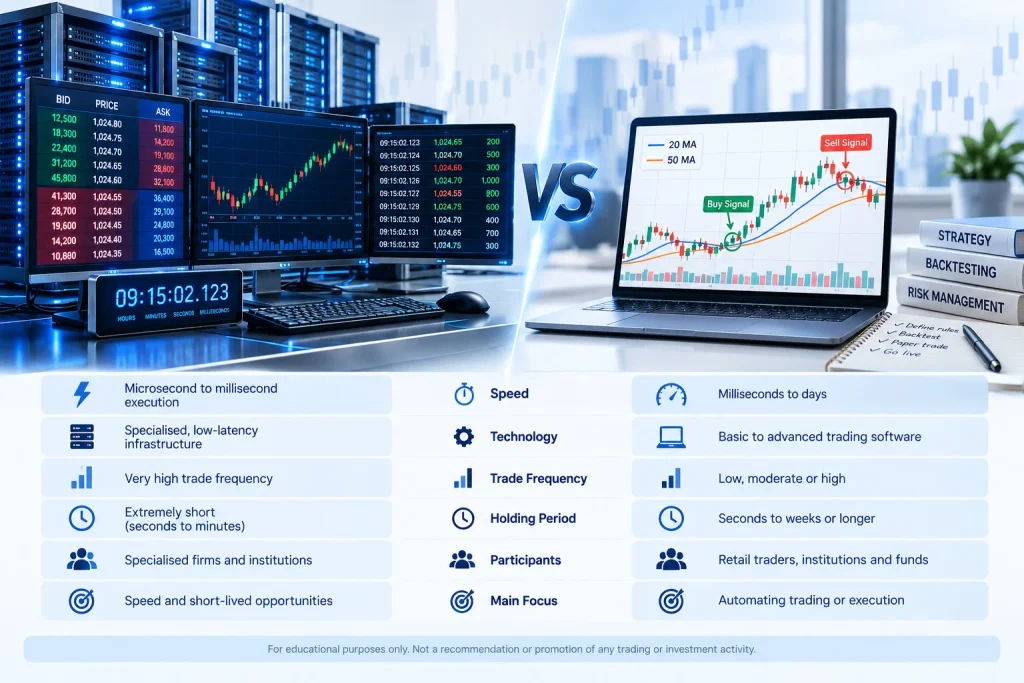
HFT is a specialised category within algorithmic trading.
| Feature | HFT Trading | Algo Trading |
| Meaning | High Frequency Trading | Rule based automated trading |
| Speed | Often microseconds or milliseconds | Milliseconds to days |
| Trading Frequency | Often very high | Low, medium or high |
| Technology | Specialist low latency systems | Simple software to complex systems |
| Holding Time | Normally extremely short | Seconds to weeks or longer |
| Trading Participants | Specialist companies and institutions | Retail traders, institutions, funds |
| Focus | Fast and short term trading | Automated trading/execution |
| Accessibility for Beginners | Hard to compete | Some strategies available |
Practical Example: How These Strategies Differ
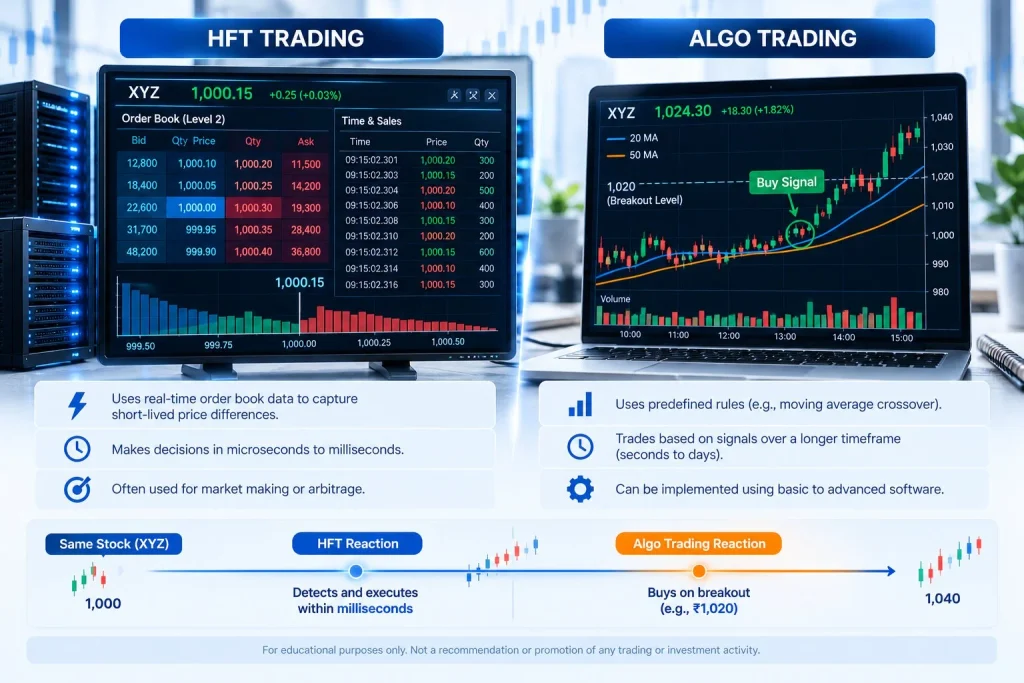
Let us say we have a stock which is trading at ₹1,000. Here we can see how each system can interact with the stock, however with different objectives.
| Scenario | HFT approach | Retail algo approach |
| Observation | Continuously processes order-book changes | Checks prices or indicators against rules |
| Signal | Temporary pricing or liquidity opportunity | Moving-average crossover or breakout |
| Execution | Extremely latency-sensitive | Depends on strategy and broker |
| Holding period | Milliseconds or seconds | Minutes, hours or days |
Retail Algorithmic Trading: An algorithm on the retail side may want to see the stock break above ₹1,020 with confirmation of volume.
High-Frequency Trading (HFT): An HFT system may want to analyse changes in the order book.
This is just an example. Both systems can make losses.
Is Algorithmic Trading Profitable?
Yes, algorithmic trading can be profitable, but profits are never guaranteed. Even well-designed strategies can fail due to market volatility, trading costs, and changing market conditions.
Factors Affecting Profitability
| Factor | Reason |
| Quality of the Strategy | Rules should have a logical reason behind them. |
| Brokerage and Costs | Transaction costs reduce gross trading profits. |
| Slippage | Prices may differ from what is expected. |
| Market Conditions | Strategies will perform differently depending on market conditions. |
| Risk Management | Position sizing and stop-losses can help manage drawdowns. |
| Overfitting | Even if a strategy has performed well historically there is no guarantee that it will perform well in live trading. |
| Reliability | Technical issues can cause unintended orders. |
Basic Example
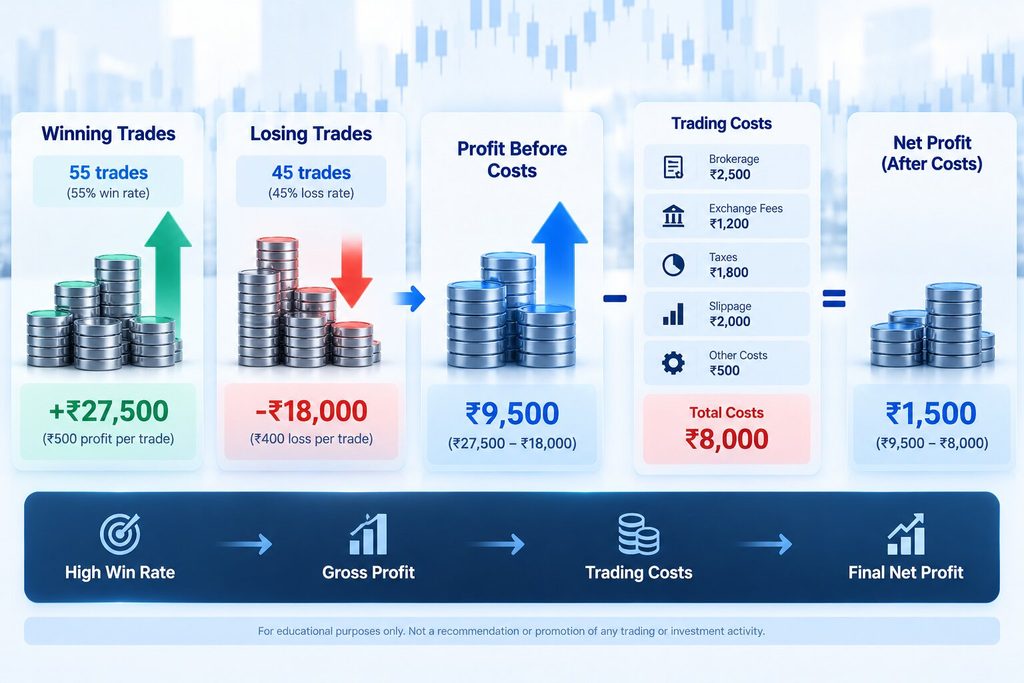
If you make 100 trades using your strategy:
- 55 winning trades: ₹500 profit each = ₹27,500
- 45 losing trades: ₹400 loss each = ₹18,000
This gives you a net profit of ₹9,500 before any costs are applied.
You will have to pay costs like brokerages, taxes, exchange fees and slippage. If your costs are more than ₹9,500 then your strategy will be losing money.
So simply having a high win rate does not guarantee that your strategy will be profitable.
Preparation Before Going Live
- Use realistic costs when backtesting.
- Don’t get ahead of yourself by only using the information available.
- Test on out of sample data.
- Paper trade your strategy.
- Keep an eye on your drawdowns and ensure that your actual results match your assumptions.
Backtesting doesn’t guarantee any future returns.
Risks Involved
Automated trading comes with several risks:
- Technical Issues: Bugs, server issues or connectivity issues can cause issues.
- Volatility: Sudden price movements can trigger unexpected executions and losses.
- Over Optimisation: Overfitted strategies may perform poorly in live markets.
- Too Much Trading: Trading too much will incur costs.
- Uncontrolled Exposure: Poor position sizing can increase losses.
- Operational Risk: Controls should be in place to ensure you do not place unexpected orders.
A common mistake made is to overlook costs, out of sample testing, maximum drawdown and third party verification when looking at impressive returns within backtests.
SEBI Regulations for Algorithmic Trading in India
On 4 February 2025, SEBI issued a framework aimed at making retail participation in algorithmic trading safer. Following implementation extensions, the framework became applicable to all stockbrokers from 1 April 2026.
Key Requirements for Retail Traders
Retail traders using automated trading strategies should be aware of requirements for:
- Broker APIs
- Exchange processes
- Order tagging
- Risk controls
The requirements will vary depending on how your algorithm is built and used.
Important Note: Please always refer to the latest SEBI circulars and NSE operational guidelines.
What Is Better for Beginners?
It makes more sense to begin learning about algo trading rather than compete in HFT.
| Goal | Learning Approach |
| Understand Automation | Simple rule-based strategies |
| Understand Technical Analysis | Use indicators and manually test |
| Quantitative Techniques | Statistics and backtesting |
| Institutional Systems | HFT and market structure |
| Improving Execution | Execution algorithms and transaction costs |
Although you don’t need high cost infrastructure to learn, you need to understand why your strategy might work, when it might fail and how much you are willing to lose.
Learn to Trade the Right Way (Ruchir Gupta Trading Academy)
Start with the basics of price action, technical analysis, market structure and risk management.
Ruchir Gupta Trading Academy provides training on intraday trading, options trading and technical analysis. They also provide live training and mentoring.
Beginners can learn the fundamentals of the markets.
Intermediate traders can practice their entry/exit rules, position sizing and discipline.
If you want to improve your knowledge of the stock market take a look at the courses provided. Choose a path to follow based on your experience.
This is to improve your knowledge and discipline not guarantee fast profits.
Conclusion: Know Your Strategy
High frequency trading revolves around speed and special infrastructure. Algo trading is a broader term referring to various rule based strategies.
Neither will make you money but having a good strategy along with testing, cost and risk management will help.
Ensure that you have a good fundamental knowledge before getting into something complicated
Take the Next Step With Ruchir Gupta Trading Academy
If you’re ready to take the next step, look no further than Ruchir Gupta Trading Academy who can train you on:
- Intraday Trading
- Options Trading
- Technical Analysis
They also offer live training and mentoring.
Disclaimer: This article is for educational purposes only. This article should not be taken as investment advice or a recommendation to buy/sell a security. Trading carries financial risk and past performance is not indicative of future performance.