Sometimes, you identify a great potential breakout opportunity but can’t get out at the right price. This is because there might be an issue with liquidity.
For Intraday Trading strategies, it is important to look at liquidity. At market open and during news events, volatility increases and may cause your orders to get filled at different prices.
Good trading looks at how easily you can get into and out of positions. This is part of our Ruchir Gupta Trading Academy’s disciplined learning.
Quick Answer: What Is the Impact of Liquidity on Intraday Trading?
Liquidity refers to how easily you can buy/sell without affecting the price much.
Stocks with high liquidity generally have narrow bid/ask spreads and low slippage. Stocks with low liquidity can cause increased costs, unexpected price movements and issues getting stop losses filled.
Volume, depth, spreads and volatility should be considered when trading intraday strategies.
What Is Liquidity in the Stock Market?
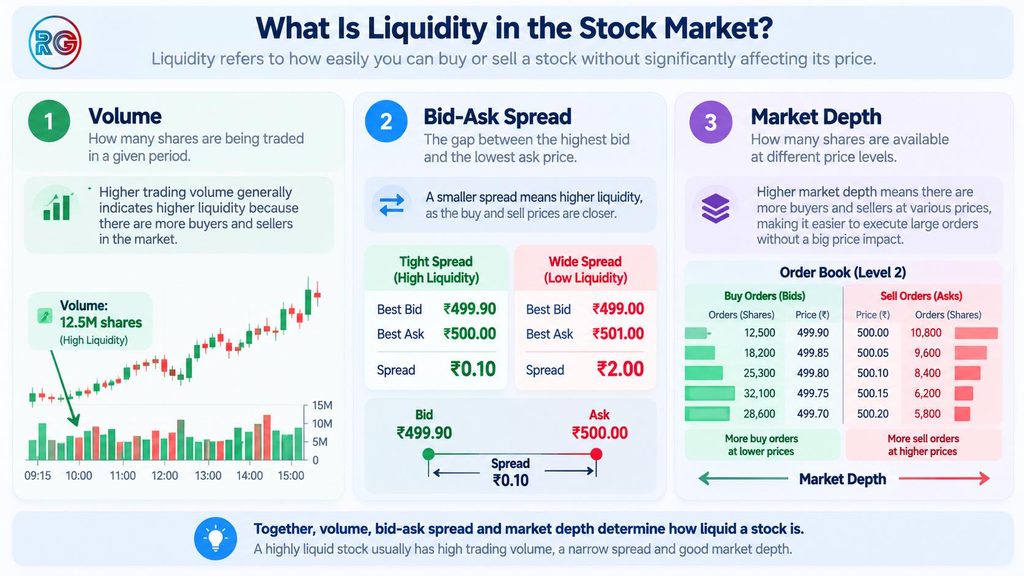
This refers to how easily you can buy/sell a stock in line with the current market price. This will depend on the market depth and buyers/sellers.
Three Factors to Look At
- Volume – How many stocks/contracts are being traded.
- Bid/Ask Spread – The gap between the highest bid price and lowest ask price.
- Market Depth – How many people are buying/selling at different prices.
Whilst high volumes may indicate that a stock is highly liquid, it is also important to look at the spread and depth.
Impact of Liquidity on Intraday Strategies
A) Bid/Ask Spread
If the bid price is 499.90 and the ask price is 500 then there’s a 0.10 spread.
But if the bid price is 499 and the ask price is 501 then there’s a 2 spread.
This can have an impact on your profitability if you’re trying to make small profits using your strategies.
B) Slippage
This is the difference between the price you expect to pay and the actual price you pay.
If the stock is trading at around 500 and there are no more sell orders then you might end up paying a large amount more for your market buy.
This can impact your breakout/momentum based intraday strategies.
C) Stop Losses
Stop Losses help but you aren’t guaranteed to get filled at this price.
If there’s a big movement in the market you may not get filled at the price you wanted.
They help to control risk.
D) Position Sizes
Large orders can eat through many price points meaning your average price will get worse.
The NSE have impact costs to show you what you’d pay for a certain order size.
High Liquidity vs. Low Liquidity: Which Is Better?
| Factor | High Liquidity | Low Liquidity |
| Bid-Ask Spread | Typically smaller | Often larger |
| Execution | Typically smooth | Can be delayed or incomplete |
| Slippage | Often less | Can be more |
| Market Depth | Typically better | Can be poor |
| Breakouts | Need confirmation | Spikes may cause confusion |
| Stop-Loss Risk | Can still be gapped | Risk of poor execution is increased |
High liquidity does not eliminate risk, especially after major news.
Which intraday trading strategies suit different conditions?
| Strategy | Liquidity consideration |
| Breakouts | Confirmation of breakout with volume and depth |
| Momentum Trading | Can momentum be maintained? |
| Scalping | Spreads should be tight since your target is small |
| Pullbacks | Is it an orderly pullback or thin market? |
| Range Trading | Support/resistance may not be as reliable |
A Practical Trading Example
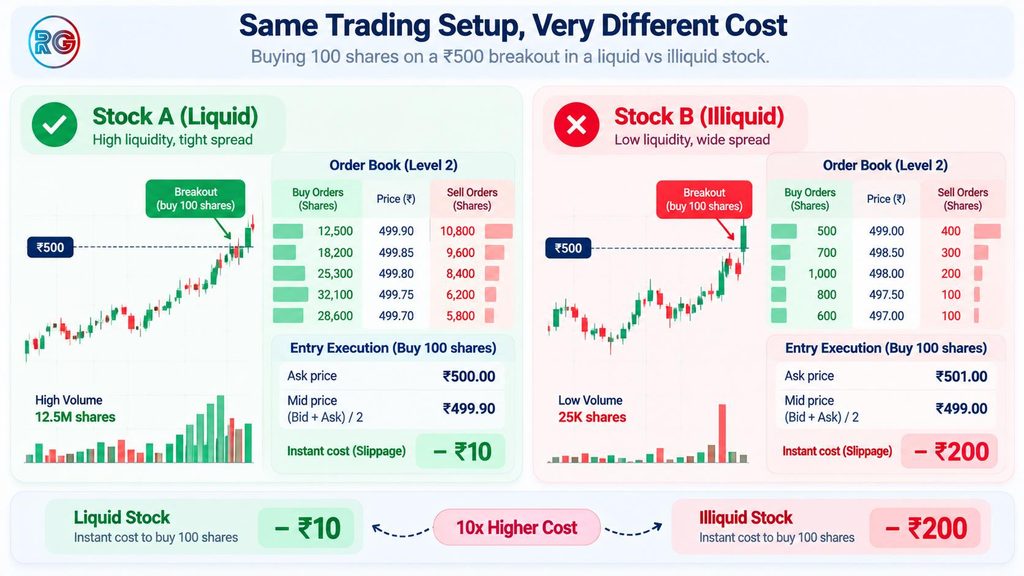
Imagine two stocks that look like they could break out at around ₹500. Price and size are the same.
| Calculation | Stock A (Liquid) | Stock B (Illiquid) |
| Best Buy | ₹499.90 | ₹499.00 |
| Best Sell | ₹500.00 | ₹501.00 |
| Spread | ₹0.10 | ₹2.00 |
| Cost to Buy 100 Shares | ₹50,000 | ₹50,100 |
| Profit on Immediate Sale | ₹49,990 | ₹49,900 |
| Difference | -₹10 | -₹200 |
These don’t include any fees, taxes or charges. As you can see the larger the spread the higher the cost of the trade will be.
So whilst having a good looking chart is just one part of the equation, execution costs should make sense too.
How to Determine Liquidity
Before entering into a trade, you can do a quick checklist:
- Volume – Is it normal?
- Spread – How big is the spread?
- Depth – Is there enough depth?
- News and Volatility – These can impact liquidity quickly.
- Exit Strategy and Costs – How much will it cost you to enter the trade?
Quick Checklist
- Are the spreads reasonable?
- Is there enough volume to support your trade?
- Is there reasonable depth?
- Have you set an exit and stop loss?
- Have you checked for news and volatility?
Note: This will not guarantee that you will make a profit.
Common Mistakes When Trading Intraday
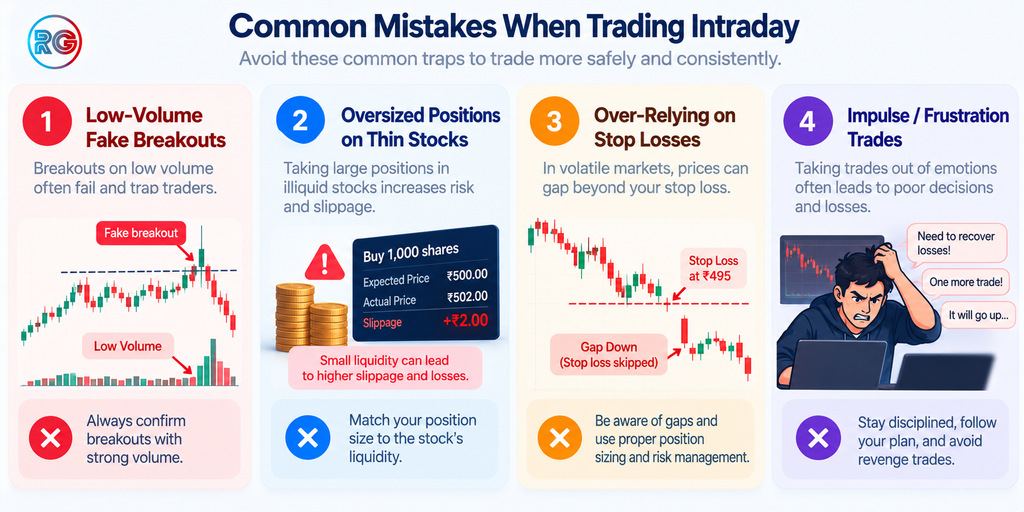
- Breakout – Low volume can make trades hard to execute.
- Choosing a Stock Based on Movement – Just because there is movement doesn’t mean it’s liquid.
- Not Checking the Spread – If you’re looking at small targets, it may not be worth it.
- Large Positions – Big positions can have a large impact on thin stocks.
- Over-Relying on Stop Loss – High volatility can cause slippage.
- Frustration Trades – You’re trying to get back into profit and may make decisions on impulse.
Keeping track of what you expect to pay vs. what you actually paid can help determine whether your trade is being impacted by low liquidity.
Trading Psychology
If you don’t get good fills, you may enter trades on impulse or give up on your stop loss.
You can adjust your position size, wait for better conditions, or just not trade. Sometimes it’s better to not trade.
Learn From Ruchir Gupta Trading Academy
There’s more to becoming a disciplined trader than just liquidity. You need to have knowledge of reading charts, understanding price action, selecting setups and managing risk.
Ruchir Gupta Trading Academy offer courses in:
- Intraday Trading
- Options Trading
- Technical Analysis
As a beginner you want to have a good understanding of the basics. As an experienced trader you will want to know how liquidity will affect your trading such as spreads, slippage and position sizing.
Increase your knowledge of the stock market by taking courses and mentoring from Ruchir Gupta Trading Academy. They offer courses and mentoring on intraday setups, technical analysis, options trading and risk management.
This will help you make informed decisions.
Conclusion
Liquidity will impact how effective you are at executing your chart set up. If you have low spreads, good depth and slippage then you are going to incur low costs. However if there is low liquidity, it can be difficult to get into and out of positions and stop losses.
Look at volume, spreads and depth. Think about slippage, cost, position size and exit strategy. Look at your performance.
Expand your knowledge of the stock market with our intraday trading, options trading and technical analysis courses from Ruchir Gupta Trading Academy. We provide practical knowledge to help make your decisions disciplined and aware of the risks involved.
Disclaimer: The information within this article is for educational purposes only and should not be considered as investment advice. Intraday trading carries a high risk of losing money.