How to Trade Futures Contracts in 2026: A Practical Beginner-to-Advanced Guide
Quick takeaway: Futures contracts are standardized, exchange-traded agreements to buy or sell an underlying asset at a predetermined price for a specified future expiry. In India, traders can access index, stock, currency, commodity and other derivative markets through regulated exchanges. The opportunity is significant—but so is leverage-related risk.
Introduction: Futures Trading in 2026 Is Not Just About Predicting Price
A trader sees the Nifty moving sharply and thinks, “If I can capture even 100 points, I can make good money.”
That sounds simple.
The problem begins when the trader discovers that futures don’t behave like buying shares in the cash market.
A relatively small margin can control a much larger notional position. A profitable move can therefore produce a meaningful return on the capital deployed—but an adverse move can hurt just as quickly.
This is why learning futures contracts should start with understanding the contract itself, not with finding a “winning strategy.”
The Indian derivatives market is also evolving. NSE’s current specifications include index futures and futures on individual securities, with three consecutive monthly contracts available in the relevant equity-futures segments. NSE’s specifications were updated in August 2026, so traders should always verify the latest contract specifications before trading.
More importantly, the risk is real. SEBI published fresh studies on individual traders’ profitability and behaviour in the equity derivatives segment on August 20, 2026.
So the right question isn’t:
“How much can I make from futures?”
It is:
“How do I use futures contracts without allowing leverage, poor risk management and emotions to control my account?”
That is the approach this guide takes.
What Are Futures Contracts?
A futures contract is a standardized agreement to buy or sell an underlying asset at a specified price for a specified future date or expiry period.
Unlike a privately negotiated forward, futures are standardized and traded through an exchange. The exchange specifies important characteristics such as contract size, expiry, tick size and other trading parameters.
In simple words
Think of a futures contract as:
Underlying asset + contract quantity + futures price + expiry + exchange rules
For example, a stock futures contract may represent a predetermined number of shares of an eligible stock.
You are not simply buying one share.
You are taking exposure to the entire contract value, while posting the margin required by the broker/exchange framework.
Definition box
Futures contracts: Standardized, exchange-traded derivative contracts that create an obligation to buy or sell an underlying asset according to predefined contract specifications.
How Do Futures Contracts Work?
The mechanics are easier to understand with an example.
Suppose a hypothetical stock is trading at ₹1,000.
Assume its futures contract has a lot size of 500 shares.
The notional value is:
₹1,000 × 500 = ₹5,00,000
You don’t necessarily pay ₹5 lakh as if you were purchasing 500 shares outright. Instead, futures positions require margin according to applicable risk-management requirements.
Now imagine the futures price rises from ₹1,000 to ₹1,020.
Your theoretical gross change is:
₹20 × 500 = ₹10,000
If the price falls to ₹980:
₹20 × 500 = ₹10,000 loss
This is the part beginners often underestimate.
The important lesson
The percentage movement in the underlying may look small, but the rupee impact on the full contract can be substantial.
That is the power—and danger—of futures.
What Is Futures Trading?
Futures trading means taking a long or short position in a futures contract with the objective of managing risk, hedging exposure or attempting to profit from changes in the underlying price.
There are two basic directions:
Position | Your market view | You benefit if |
Long futures | Bullish | Futures price rises |
Short futures | Bearish | Futures price falls |
One of the most important differences from traditional cash-market investing is that futures make it possible to take a short position directly.
Example
Suppose an index futures contract is trading at 25,000.
You believe the market is likely to decline.
You sell the futures contract.
If it falls to 24,900, the decline can generate a profit based on the contract’s lot size.
If it rises instead, you lose.
That sounds straightforward.
In practice, the difficult part is determining:
When to enter
Where to exit
How much capital to risk
How much adverse movement you can tolerate
Whether the trade is worth taking at all
Types of Futures Contracts
Futures aren’t limited to stock-market indices.
Broadly, futures contracts can be categorized according to their underlying asset.
Type | Underlying | Typical purpose |
Index futures | Stock-market index | Directional trading, hedging |
Stock futures | Individual security | Trading/hedging |
Currency futures | Currency pair | Currency exposure/hedging |
Commodity futures | Gold, crude oil, metals, agriculture etc. | Hedging/speculation |
Interest-rate futures | Interest-rate instruments | Interest-rate exposure |
NSE currently lists equity, commodity, currency and interest-rate derivatives as separate product areas. Its equity derivatives section includes index futures and futures on individual securities.
Futures Contracts Examples
Here are practical examples to understand the concept.
Example 1: Long Futures
Assume:
Futures price = ₹2,000
Lot size = 250
Entry = ₹2,000
Exit = ₹2,040
Price gain:
₹40
Gross contract gain:
₹40 × 250 = ₹10,000
Example 2: Short Futures
Assume:
Entry price = ₹1,500
Exit price = ₹1,450
Lot size = 300
Price decline:
₹50
Gross gain:
₹50 × 300 = ₹15,000
The trader benefits because the futures position was short.
Example 3: The Same Trade Goes Wrong
Suppose instead the futures price rises from ₹1,500 to ₹1,550.
Loss:
₹50 × 300 = ₹15,000
This is why a futures strategy without a predefined exit plan is dangerous.
Futures Contracts vs Forward Contracts
A common beginner question is:
What is the difference between futures and forwards?
The easiest answer is standardization.
A forward contract is generally privately negotiated between parties and can be customized. Futures are standardized and exchange-traded.
Feature | Futures | Forward |
Trading venue | Exchange | OTC/private |
Standardization | Standardized | Customized |
Contract size | Exchange-defined | Negotiated |
Expiry | Defined by contract | Negotiated |
Counterparty structure | Central clearing | Bilateral |
Transparency | Generally higher | Generally lower |
Liquidity | Usually better in active contracts | Depends on counterparties |
Typical use | Trading + hedging | Customized hedging |
Forward contracts meaning
A forward contract is an agreement between two parties to buy or sell an asset at a predetermined price on a future date, with terms negotiated privately.
Futures essentially take the concept of a forward and place it into a standardized, exchange-traded framework.
How to Trade Futures Contracts in 2026: Step-by-Step
If you are a beginner, don’t start by placing a trade.
Start with a process.
Step 1: Understand the underlying
Before trading a futures contract, know what you are trading.
Ask:
Is it an index?
An individual stock?
A commodity?
A currency?
What drives its price?
How volatile is it?
Step 2: Check the contract specifications
Never assume the lot size or expiry.
Check:
Contract symbol
Lot size
Expiry
Tick size
Trading hours
Settlement mechanism
Margin requirements
Position limits
NSE’s current equity derivatives specifications show, for example, three consecutive monthly contracts for several index-futures products and a three-month trading cycle for individual-security futures.
Step 3: Calculate the notional exposure
Use:
Contract Value = Futures Price × Lot Size
This calculation should become automatic.
A trader who doesn’t know the notional exposure is effectively trading blind.
Step 4: Decide your trading timeframe
Futures can be used for different approaches:
Intraday trading
Short-term swing trading
Hedging
Positional trading
Spread strategies
Don’t mix them randomly.
A trader who enters an intraday trade and suddenly decides to “hold until it recovers” has changed the strategy after the trade has already gone wrong.
Step 5: Define your entry
Your entry should have a reason.
Possible reasons include:
Breakout
Pullback
Trend continuation
Support/resistance reaction
Price-action setup
Volatility expansion
System-generated signal
Avoid entering simply because the market “looks strong.”
Step 6: Define the stop-loss before entering
This is one of the most important habits in futures trading.
For example:
Entry = ₹1,000
Stop = ₹985
Risk per unit = ₹15
If lot size is 500:
Maximum planned trade risk = ₹7,500
This allows you to evaluate whether the trade fits your capital and risk limits.
Step 7: Calculate the reward-to-risk ratio
Suppose:
Entry = ₹1,000
Stop = ₹985
Target = ₹1,045
Risk = ₹15
Potential reward = ₹45
Reward:risk = 3:1
That doesn’t mean the trade will win.
It simply means the potential payoff is three times the predefined risk.
Step 8: Execute without improvising
Once the position is active, emotions become louder.
You may think:
“Let me give it another ₹5.”
Then another ₹5.
Then ₹10.
This is how a ₹7,500 planned loss can become a ₹20,000 or ₹30,000 loss.
A trading plan must therefore define what happens before emotions arrive.
Futures Margin: The Concept Every Beginner Must Understand
Margin is one of the most misunderstood parts of futures trading.
You don’t generally need to fund the entire notional value like a cash-market purchase. Instead, the applicable margin framework determines the funds/collateral required to carry the futures position.
That creates leverage.
Why leverage is attractive
A trader can control a large exposure with comparatively less capital.
Why leverage is dangerous
Losses are calculated against the contract exposure, not merely the amount of margin you initially think of as “investment.”
SEBI explicitly warns that derivatives can multiply profits and losses because the amount payable for the derivative may be relatively small compared with the underlying market value.
A useful mental model
Don’t think:
“I only invested ₹X.”
Think:
“I have exposure to ₹Y of market value.”
That difference in thinking can prevent serious mistakes.
Mark-to-Market: Why Futures Losses Feel Immediate
Futures positions are subject to settlement and margining mechanisms.
The practical implication is simple:
Your losses cannot be ignored until expiry.
If the market moves against you, your account reflects that adverse movement through the applicable settlement and margin process.
This is fundamentally different from telling yourself:
“The stock will eventually recover.”
A futures contract has an expiry and a defined settlement framework.
How to Choose a Futures Contract
Don’t choose the contract merely because its price looks attractive.
Evaluate:
1. Liquidity
Prefer contracts where you can enter and exit efficiently.
2. Open interest
Look at open interest alongside volume and price behaviour.
3. Bid-ask spread
A wide spread can increase execution costs.
4. Volatility
Higher volatility can create opportunities, but also larger adverse moves.
5. Expiry
Know exactly when the contract expires.
6. Contract size
A seemingly small price movement can become a large rupee gain or loss when multiplied by the lot size.
NSE Futures Contracts in 2026
For Indian traders, NSE’s current equity derivatives specifications are particularly important.
As of the latest specifications available in August 2026:
- NSE lists Index Futures and Futures on Individual Securities.
- Equity futures include products linked to specified indices and eligible securities.
- Several index futures have a three-month consecutive trading cycle.
- Individual-security futures have a three-month trading cycle.
- NSE specifies expiry rules for these contracts.
- Contract specifications can change, so traders should verify the current exchange information rather than rely on an old blog or YouTube video.
This last point matters more than it sounds.
A strategy may remain valid while its contract specifications change.
Therefore, always check the latest exchange documentation before placing a trade.
There is no single “best futures strategy.”
Instead, traders typically build strategies around market behaviour.
1. Trend-Following Strategy
The basic idea:
Identify the dominant trend
Wait for confirmation
Enter in the direction of the trend
Place a logical stop
Trail or exit according to predefined rules
The mistake is buying every green candle.
2. Breakout Strategy
A trader identifies a defined range.
For example:
Resistance = 25,000
A sustained move above resistance may create a breakout setup.
But experienced traders know:
Breakout ≠ guaranteed continuation.
False breakouts are common.
3. Pullback Strategy
Instead of chasing a strong move, the trader waits for price to retrace toward an area of interest.
The objective is to improve entry quality rather than simply enter because momentum is visible.
4. Support/Resistance Strategy
The trader identifies important price zones and waits for price behaviour around those zones.
The key is not drawing dozens of lines.
It is identifying levels that actually matter.
The Psychology of Futures Trading
This is where many technically knowledgeable traders fail.
The market doesn’t need to defeat your strategy.
Sometimes it only needs to trigger your emotions.
Common emotional reactions
Fear after entering
Greed after a quick profit
Revenge after a loss
FOMO after a breakout
Hope when a trade moves against you
Overconfidence after a winning streak
A trader may have a perfectly reasonable setup at 10:15 AM and completely abandon discipline at 2:30 PM after three losses.
That’s not a technical-analysis problem.
It’s a process problem.
My strongest practical rule
Never increase your position size simply because you lost money.
The market doesn’t owe you a recovery trade.
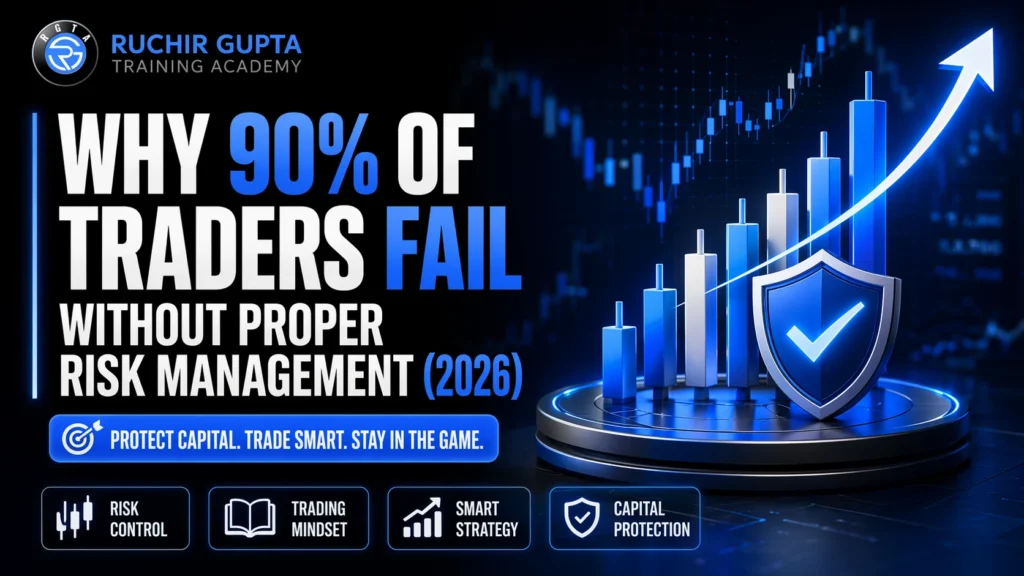
Risk Management Rules for Futures Trading
If you remember only one section from this article, remember this one.
Before every trade, know:
Entry price
Stop-loss
Target
Lot size
Maximum rupee loss
Maximum daily loss
Trading timeframe
Reason for entry
Exit condition
What invalidates the trade
A simple risk framework
Suppose your trading capital is ₹5 lakh.
If you decide to risk 1% per trade:
Maximum planned risk = ₹5,000
Now calculate position size based on the stop distance.
Don’t calculate the stop based on the lot size you already decided to trade.
That’s backward.
Why Most New Futures Traders Struggle
SEBI’s research provides an important reality check.
Its earlier studies found that a very high proportion of individual equity-F&O traders incurred losses, including 93% during FY22-FY24 in the study published in September 2024.
SEBI has now published updated FY25-FY26 research on both profitability and trading behaviour, dated August 20, 2026.
The lesson isn’t that futures should never be traded.
The lesson is that futures should not be approached as easy money.
Common reasons beginners lose
Excessive leverage
Oversizing positions
No stop-loss
Revenge trading
Overtrading
Trading based on tips
Ignoring contract specifications
Holding losing positions because of hope
Increasing size after losses
Trading during emotionally difficult periods
No trading journal
Futures Trading vs Cash Trading
Factor | Cash Equity | Futures |
Ownership | Yes, for shares purchased | No direct ownership from the futures position |
Leverage | Generally lower | Higher exposure through margin |
Expiry | No expiry for shares | Contract has expiry |
Short selling | Subject to market rules | Futures allow direct short positioning |
Risk | Capital can decline | Leverage can amplify losses |
Contract size | Individual shares | Fixed lot |
Best suited for | Investing/trading | Trading, hedging, tactical exposure |
Who Should Trade Futures?
Futures may be appropriate for traders who:
- Understand derivatives
- Have defined risk limits
- Can tolerate volatility
- Understand margin requirements
- Know contract specifications
- Have a tested trading process
- Can follow rules under pressure
They may not be appropriate for someone who:
- Is looking for guaranteed income
- Has no emergency fund
- Is borrowing money to trade
- Doesn’t understand leverage
- Cannot accept losses
- Trades based on WhatsApp/Telegram tips
- Has no predefined stop-loss
A Beginner's Futures Trading Checklist
Before placing your first futures trade:
- Understand what the underlying asset is
- Verify the current contract specifications
- Check the lot size
- Check expiry
- Calculate notional exposure
- Understand margin requirements
- Identify the trading setup
- Define entry
- Define stop-loss
- Define target
- Calculate maximum rupee loss
- Check liquidity
- Avoid emotional position sizing
- Record the trade in a journal
How to Learn Futures Trading Properly
The biggest mistake beginners make is learning strategies before learning market structure and risk management.
A better learning sequence is:
Stage 1: Market fundamentals
Learn:
Stocks
Indices
Derivatives
Futures
Options
Margin
Expiry
Settlement
Stage 2: Technical analysis
Study:
Trends
Support/resistance
Price action
Volume
Market structure
Stage 3: Risk management
Learn:
Position sizing
Stop-loss
Risk/reward
Maximum daily loss
Capital protection
Stage 4: Trading psychology
Understand:
FOMO
Revenge trading
Overconfidence
Fear
Discipline
Stage 5: Practical execution
Only then should you move toward:
Paper trading
Small-size live trading
Journaling
Reviewing performance
Learning Futures With Ruchir Gupta Trading Academy
For learners who want structured rather than random market education, Ruchir Gupta Training Academy positions its programs around practical market learning, technical analysis, risk management, trading psychology and live-market examples. The supplied academy material states that Ruchir Gupta has 20+ years of market experience, has trained 3 lakh+ students, and provides live and recorded learning formats.
The academy’s stated teaching approach emphasizes:
- Practical market application
- Technical analysis
- Trading strategies
- Risk management
- Trading psychology
- Live market exposure
- Structured learning
- Mentor support
The academy material also describes Ruchir Gupta as a stock market mentor and trading educator with a research background and a focus on disciplined, rule-based trading rather than shortcuts.
For someone specifically trying to learn intraday trading, options and technical analysis, joining a structured stock market course can be more useful than jumping between disconnected social-media strategies.
The objective should not be to find someone who tells you what to buy tomorrow.
The objective should be to learn why a trade exists, how much to risk, when the setup is invalid and how to evaluate the result afterward.
Expert Tips for Trading Futures Contracts in 2026
Tip 1: Don’t confuse margin with affordability
Just because your broker allows you to enter a position doesn’t mean your account can safely handle it.
Tip 2: Calculate risk in rupees
Percentages are useful, but actual rupee risk makes the trade emotionally tangible.
Tip 3: Don’t chase volatility
Volatility creates opportunity and danger simultaneously.
Tip 4: Watch the expiry
A futures contract is not an indefinite position.
Tip 5: Don’t use yesterday’s contract information blindly
NSE specifications can change. Check current exchange documentation.
Tip 6: Keep a trading journal
Record:
Setup
Entry
Stop
Target
Exit
Result
Mistake
Emotional state
Tip 7: Measure process, not just profit
A losing trade can be a good trade if it followed your system.
A profitable trade can be a bad trade if it violated your rules.
That distinction is critical for long-term improvement.
Final Takeaway
The most important thing to understand about futures contracts in 2026 is that the contract itself isn’t the difficult part.
The difficult part is controlling the trader behind the contract.
You can understand:
- Futures
- Technical analysis
- Market structure
- Indicators
- Price action
- Breakouts
- Trends
…and still lose money if you repeatedly take oversized positions or refuse to exit when your setup fails.
A more sustainable approach is:
Understand → Plan → Calculate risk → Execute → Record → Review → Improve
For Indian traders, always verify the latest exchange specifications because contract parameters, expiry structures and other market rules can change. NSE’s current specifications were updated in August 2026.
And the latest SEBI research is a useful reminder that derivatives should be treated as a serious financial product—not as a shortcut to quick income.
If your goal is to learn intraday trading, options trading and technical analysis systematically, a structured program such as the learning approach offered by Ruchir Gupta Training Academy can provide a more organized path than trying to assemble a strategy from random market tips. The academy’s supplied material emphasizes practical education, live-market learning, risk management and mentorship.
The goal of futures trading should not be to predict every market move. It should be to build a process that survives the moves you predict incorrectly.
Frequently Asked Questions
What are futures contracts?
Futures contracts are standardized agreements traded on an exchange to buy or sell an underlying asset under predetermined contract terms.
How do futures contracts work?
A trader takes a long or short position, and the position’s value changes as the futures price moves. Margin and settlement mechanisms manage the leveraged exposure.
What are futures contracts examples?
Examples include index futures, stock futures, currency futures and commodity futures.
What is the meaning of forward contracts?
A forward is a privately negotiated agreement between two parties to buy or sell an asset at a future date at an agreed price.
What are the types of futures contracts?
The major categories are index, stock, currency, commodity and interest-rate futures.
Is futures trading good for beginners?
It can be studied by beginners, but trading with real capital should come only after understanding leverage, risk, margin, expiry and execution.
Can futures trading make you rich quickly?
There is no reliable shortcut. Leverage can increase profits, but it can also accelerate losses.
Do futures contracts have expiry dates?
Yes. Each futures contract has defined expiry or last-trading rules.
What should I check before buying a futures contract?
Check the underlying, lot size, expiry, liquidity, margin, volatility, entry, stop-loss, target and maximum rupee risk.
Is futures trading the same as investing?
No. Futures are derivative instruments and generally have a defined expiry, while buying shares represents ownership in the underlying company.
Why is risk management so important in futures?
Because leveraged exposure can make relatively small underlying price movements produce significant gains or losses.