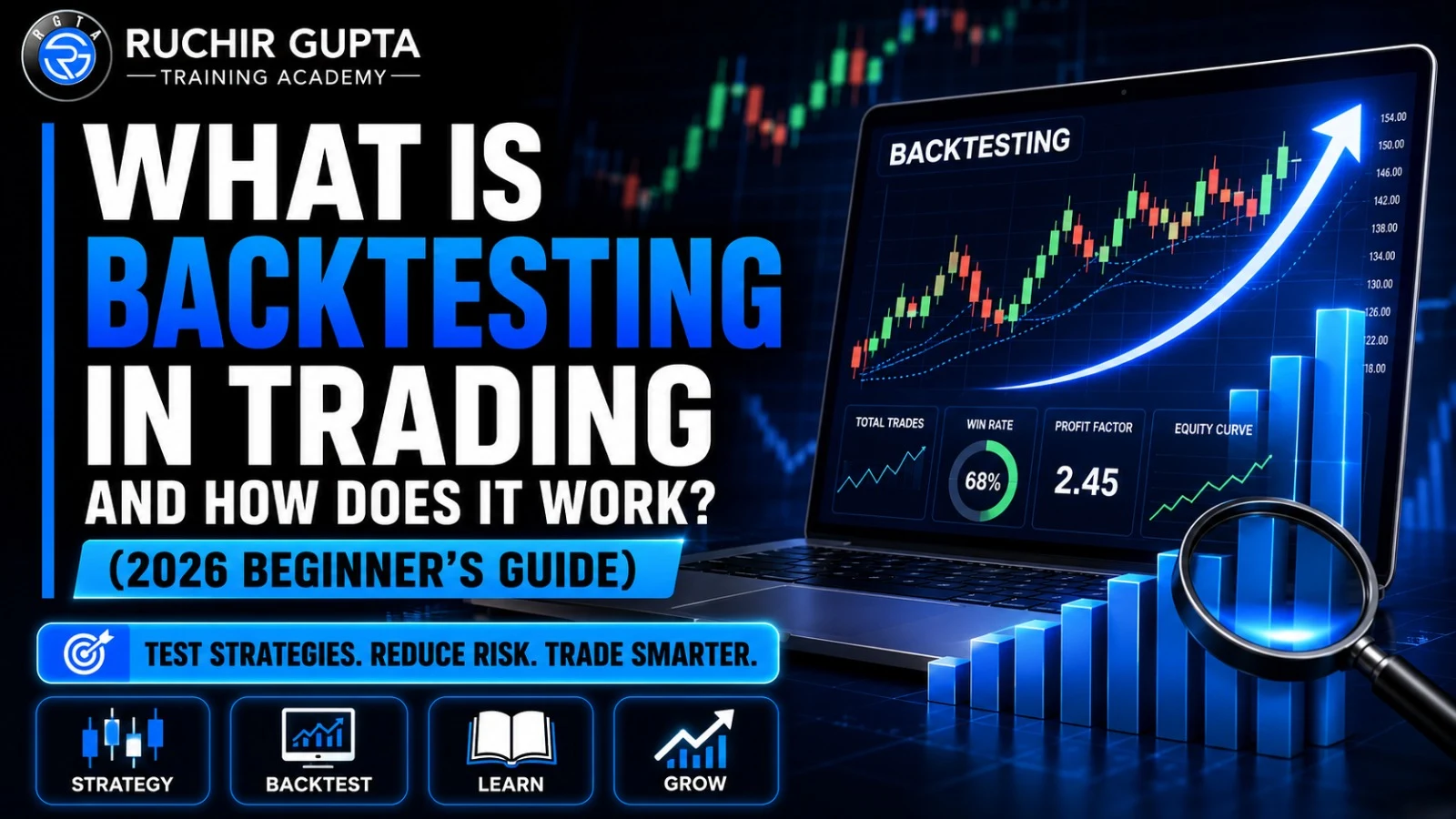
What Is Backtesting in Trading and How Does It Work? (2026 Beginner's Guide)
What if you create a trading strategy that takes months to develop and then after you risk some money on it, you find out it doesn’t have a statistical advantage?What if you spent months developing a trading strategy and then after you risked some money on it you find out that it didn’t have a statistical advantage? Unfortunately, this is one of the biggest reasons for why new traders lose money.
Traders who are professionals wouldn’t ever trade a strategy without testing it first to the market history. This is referred to as backtesting in trading, and it’s one of the most crucial skills required in today’s data-driven markets.
Whether you’re trading stocks, futures, forex, or options, learning what is backtesting in trading can significantly improve your decision-making and confidence. Rather than making an educated guess, back-testing can help you determine if a trading strategy was successful over a range of market conditions.
The world of algorithmic trading, AI-driven analysis, and sophisticated charting tools has made backtesting more accessible and easily accessible for even novice traders in 2026.
Quick Answer
In trading, backtesting involves testing a trading strategy with historical data and analyzing its performance over a specific time period. It assists traders to assess profit, risk, win rate, drawdown and consistency before implementing the strategy in the markets.
What Is Backtesting in Trading?
Definition
Backtesting is a trading strategy that is applied to historical price data to see how the strategy would have worked for a specific period in the past.
Historical backtesting is performed on past market activity; it is not a paper trading system, but a system that utilizes live markets without real money.
Think of it like this:
A pilot practices in a simulator before flying passengers.
Similarly, traders test strategies through strategy backtesting before risking real capital.
Example
Suppose your strategy says:
Buy when the 50 EMA crosses above the 200 EMA.
Sell when the opposite crossover occurs.
Risk 2% per trade.
Instead of immediately trading this strategy, you apply it to five years of historical NIFTY or Bank NIFTY data.
The results may reveal:
Metric | Result |
Total Trades | 420 |
Winning Trades | 252 |
Win Rate | 60% |
Average Reward | 2.1R |
Maximum Drawdown | 8.4% |
Net Return | 47% |
This gives you statistical confidence before entering live markets.
Why Is Backtesting Important?
Many traders jump into the market after watching YouTube videos or following social media tips. The result?
Emotional trading
Inconsistent profits
Strategy hopping
Capital erosion
Backtesting solves these problems by replacing opinions with evidence.
Key Benefits
✔ Validates your trading idea
✔ Measures profitability
✔ Identifies weaknesses
✔ Improves confidence
✔ Reduces emotional decision-making
✔ Helps optimize risk management
✔ Builds discipline
Professional traders rarely trust a strategy without historical testing.
How Does Backtesting Work?
The process is straightforward but requires discipline.
Step 1: Create Trading Rules
Your strategy must be objective.
Example:
Entry Rules
RSI below 30
Price above 200 EMA
Bullish engulfing candle
Exit Rules
2:1 Risk-Reward
RSI reaches 70
Stop-loss below swing low
Every rule must be measurable.
Step 2: Collect Historical Data
Reliable historical data is the backbone of successful historical backtesting.
Data may include:
Daily charts
Hourly charts
5-minute charts
Tick data
Volume
Open Interest
Options chain data
Poor-quality data leads to poor-quality results.
Step 3: Apply Rules
Now apply the exact rules to every historical chart without changing them midway.
Record:
Entry price
Exit price
Stop loss
Target
Profit/Loss
Trade duration
Consistency is essential.
Step 4: Analyze Results
Evaluate:
Win rate
Profit factor
Maximum drawdown
Sharpe ratio
Average trade
Annual returns
A strategy with a 45% win rate can still be highly profitable if winners are significantly larger than losers.
Types of Backtesting
1. Manual Backtesting
The trader reviews historical charts manually.
Advantages
Improves chart reading
Enhances pattern recognition
Great for beginners
Disadvantages
Time-consuming
Human bias
Slower
2. Automated Backtesting
Software executes trades automatically based on coded rules.
Popular among:
Quantitative traders
Algorithmic traders
Professional institutions
Advantages:
Faster
Eliminates emotions
Tests thousands of trades
Handles multiple markets
3. Walk-Forward Testing
After historical testing, traders validate the strategy on unseen data.
This helps reduce overfitting.
Step-by-Step Backtesting Process
Here’s a practical workflow used by experienced traders.
Step | Action |
1 | Define strategy |
2 | Select market |
3 | Choose timeframe |
4 | Gather historical data |
5 | Apply trading rules |
6 | Record every trade |
7 | Calculate statistics |
8 | Optimize carefully |
9 | Retest |
10 | Forward test |
Skipping any of these steps reduces reliability.
Practical Backtesting Example
Suppose you trade Bank NIFTY.
Your strategy:
Buy when:
- Price closes above VWAP
- RSI above 60
- Volume higher than average
Exit:
- 1.5:1 Risk Reward
- Trailing Stop
You test the strategy on two years of historical data.
Results:
Parameter | Result |
Trades | 385 |
Win Rate | 57% |
Average Winner | ₹3,200 |
Average Loser | ₹1,600 |
Profit Factor | 1.92 |
Drawdown | 9% |
Although not every trade wins, the positive expectancy makes the strategy statistically favorable.
Benefits of Backtesting Trading Strategies
1. Builds Confidence
Confidence comes from data—not hope.
When you’ve seen your strategy succeed over hundreds of historical trades, it’s easier to follow during inevitable losing streaks.
2. Improves Risk Management
Backtesting reveals:
Average losing streak
Worst drawdown
Position sizing requirements
Capital needed
This helps traders avoid excessive risk.
3. Removes Emotional Trading
Without testing, traders often:
Exit winners too early
Hold losing positions
Chase momentum
Revenge trade
Historical evidence creates discipline.
4. Helps Optimize Strategies
Testing allows traders to compare variables such as:
Different moving averages
Various stop-loss methods
Risk-reward ratios
Market sessions
The goal isn’t to find a “perfect” strategy but one that performs consistently across different market environments.
5. Identifies Market Suitability
Some strategies work best in trending markets, while others excel in sideways conditions. Backtesting helps you understand where your approach has a statistical advantage.
Common Beginner Mistakes in Backtesting
Avoid these pitfalls to get reliable results:
- Changing rules during testing.
- Ignoring transaction costs and slippage.
- Using only a small sample size.
- Over-optimizing parameters to fit historical data.
- Testing only during bullish markets.
- Ignoring risk-adjusted returns.
- Assuming past performance guarantees future profits.
A robust strategy should perform reasonably well across different market cycles rather than delivering perfect historical results.
Expert Tips for Better Backtesting
After years of observing traders refine their systems, several best practices consistently stand out:
- Test at least 200–500 trades before drawing conclusions.
- Include brokerage charges, taxes, and slippage in your calculations.
- Validate the strategy across bullish, bearish, and sideways markets.
- Keep a detailed trading journal alongside your test results.
- Focus on expectancy and consistency rather than just win rate.
- After historical testing, move to paper trading before committing real capital.
Remember, the objective of backtesting trading strategies is not to predict the future but to understand whether your trading edge has been statistically reliable over time.
Expert Learning Perspective
With structured learning, it’s much easier to learn about learning backtesting than it is by trial and error. Ruchir Gupta Training Academy teaches traders practical concepts like Technical Analysis, Risk Management, Market Psychology and Systematic Approach Development using live and recorded sessions with a mentor who has more than 20 years of experience in the financial markets. The academy focuses on rule-based and disciplined trading, and not on shortcuts, hence a lot of confidence before going live in the market.
Key Takeaways
- Backtesting is the foundation of professional trading.
- It evaluates strategies using historical market data before risking capital.
- Reliable backtesting measures profitability, drawdown, consistency, and risk.
- Manual and automated approaches each have their advantages depending on your experience level.
- Combine historical testing with forward testing and sound risk management for better long-term results.
By mastering what is backtesting in trading, you shift from making decisions based on emotions to making decisions backed by evidence—an essential step toward becoming a disciplined and consistently improving trader.
FAQs
What is backtesting in trading?
Backtesting in trading is the process of testing a trading strategy using historical market data to evaluate how it would have performed before using it in live markets. It helps traders identify the profitability, risk, and consistency of a strategy.
Why is backtesting important for traders?
Backtesting helps traders validate their strategies, improve confidence, minimize emotional trading, optimize risk management, and identify weaknesses before investing real money.
How does backtesting trading strategies work?
Backtesting trading strategies involves creating predefined entry and exit rules, applying them to historical market data, recording trade results, and analyzing metrics such as win rate, profit factor, drawdown, and overall returns.
What is the difference between backtesting and paper trading?
Backtesting uses historical market data to evaluate a strategy’s past performance, while paper trading tests the strategy in live market conditions using virtual money. Both methods are useful, but paper trading reflects real-time market behavior.
Backtesting | Paper Trading |
Uses historical data | Uses live market data |
Tests past performance | Tests current market conditions |
Faster to evaluate | Takes real-time execution |
Ideal for strategy validation | Ideal before live trading |
Can beginners learn backtesting in trading?
Yes. Beginners can start with manual backtesting using charting platforms like TradingView and gradually move to automated strategy testing as they gain experience.
Which markets can be backtested?
You can perform backtesting on various financial markets, including:
- Stock market
- Options trading
- Futures trading
- Forex trading
- Commodities
- Cryptocurrencies
- ETFs
- Indices
What is options backtesting?
Options backtesting is the process of testing options trading strategies using historical options data to evaluate profitability, risk, implied volatility impact, and strategy performance before live execution.
What is algorithmic trading backtesting?
Algorithmic trading backtesting involves testing automated trading algorithms using historical market data. It allows traders to verify whether an algorithm would have generated profitable trades under past market conditions.
Which software is best for backtesting trading strategies?
Some of the most popular backtesting platforms include:
- TradingView
- MetaTrader 4 (MT4)
- MetaTrader 5 (MT5)
- AmiBroker
- NinjaTrader
- QuantConnect
- Python (Backtrader, Zipline)
- TradeStation
The best platform depends on your trading style and market.
How much historical data is needed for accurate backtesting?
Most experts recommend testing at least 2–5 years of historical data or 200–500 trades across different market conditions to obtain statistically reliable results.