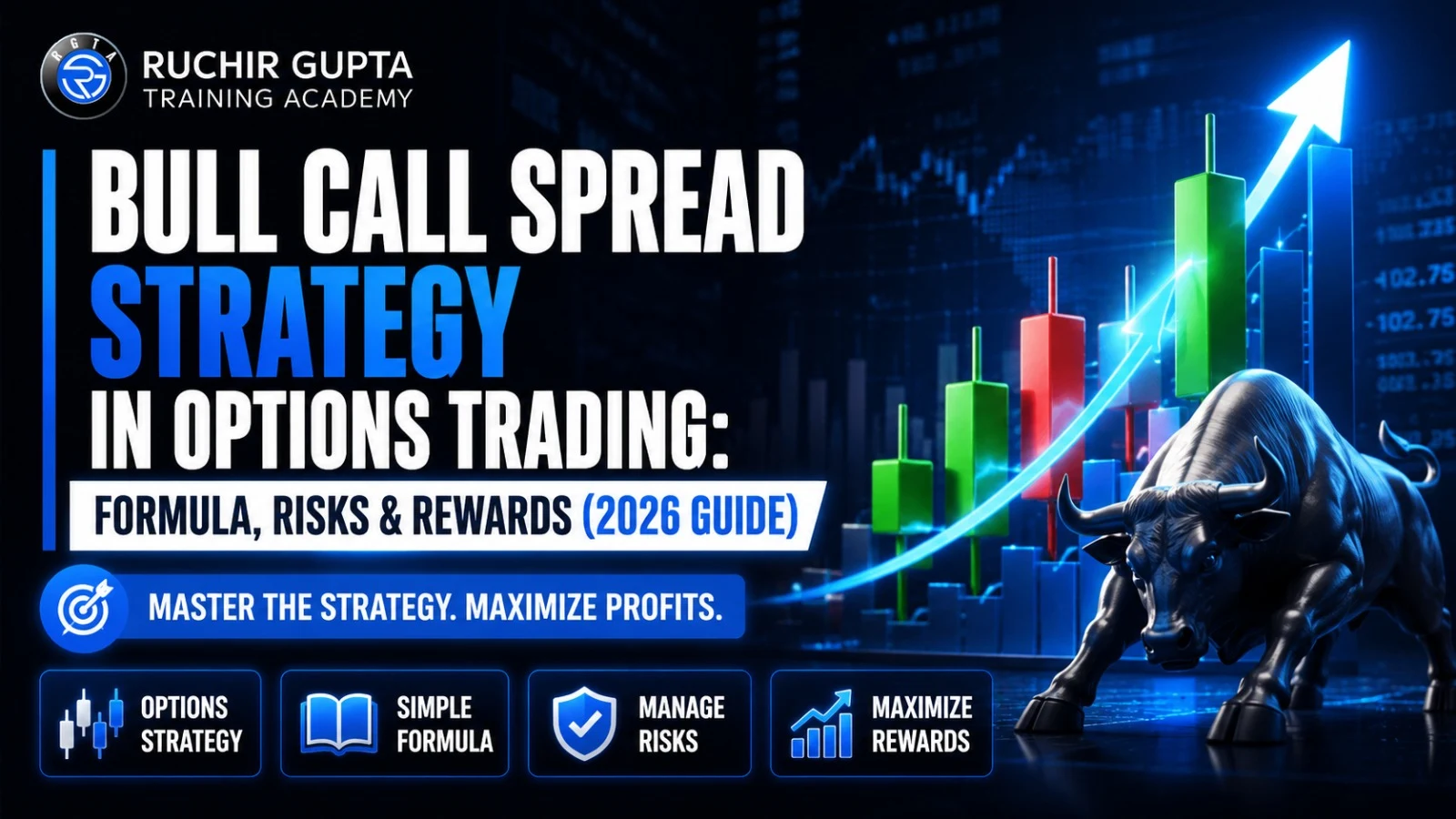
Bull Call Spread Strategy in Options Trading: Formula, Risks & Rewards (2026 Guide)
At any point in time, have you ever thought, “I’m sure this stock/ index will go up… but not by that much that I should pay for a call option?
That’s where the bull call spread option trading strategy can be one of the shrewdest option trading strategies.
Professional traders will buy a call option and sell another call option with a higher strike price to lower the cost of the trade as opposed to paying a high premium for a single call option. This produces a strategy that has a limited risk, limited reward, and better capital efficiency.
This strategy works well when you are trading Nifty, Bank Nifty or stock options and you believe that the price is going to move up in the medium range as opposed to a huge surge.
In this comprehensive guide, you’ll learn everything about the bull call spread option strategy, including its formula, payoff, breakeven calculation, practical examples, advantages, disadvantages, and expert tips for Indian traders.
Quick Answer
A bull call spread option strategy is a bull market options strategy in which the trader purchases a lower strike call option and short sells a higher strike call option, both with the same expiration. It caps the premium cost, while limiting your maximum profit and loss.
What is Bull Call Spread?
Bull call spread options are strategies that are used by traders that believe that prices will move up moderately, also referred to as a debit call spread, vertical call spread or bullish debit spread.
The strategy consists of two trades:
- Buy one ITM or ATM Call Option
- Sell one OTM Call Option
- Same expiry date
- Same underlying asset
Since the premium received from selling the higher strike call offsets part of the premium paid for buying the lower strike call, the overall trade becomes cheaper than buying a single call.
Why Traders Use Bull Call Spread
Professional traders prefer this strategy because it offers:
- Lower premium cost
- Limited downside risk
- Defined profit potential
- Better capital efficiency
- Less impact from time decay compared to naked calls
It is particularly effective during:
- Moderate bullish markets
- Pre-budget rallies
- Earnings season
- Strong technical breakouts
How Bull Call Spread Works
Imagine Nifty is trading at 25,000.
You expect Nifty to rise toward 25,400, but you don’t think it will cross 26,000.
Instead of buying a single call option, you:
Buy 25,000 Call
Sell 25,400 Call
Both have the same expiry.
The premium received from selling the second option reduces your total investment.
If Nifty rises as expected, your profit increases until the higher strike price, after which profits become capped.
Bull Call Spread Formula
The formula is straightforward.
Net Premium Paid = Premium Paid for Bought Call − Premium Received from Sold Call
Maximum Profit
Higher Strike − Lower Strike − Net Premium
Maximum Loss
Net Premium Paid
Breakeven
Lower Strike + Net Premium
Bull Call Spread Example
Let’s understand using a realistic example.
Suppose:
Position | Strike | Premium |
Buy Call | 25,000 | ₹220 |
Sell Call | 25,400 | ₹90 |
Net Premium
220 − 90 = ₹130
Lot Size = 75
Investment
₹130 × 75 = ₹9,750
Scenario 1
Nifty expires below 25,000
Both options expire worthless.
Loss = ₹130
This is your maximum loss.
Scenario 2
Nifty expires at 25,250
Bought Call gains value.
Sold Call remains worthless.
You earn partial profits.
Scenario 3
Nifty expires above 25,400
Both options become profitable.
However, gains stop increasing beyond 25,400 because of the sold call.
Maximum profit is achieved.
Bull Call Spread Payoff
Nifty Expiry | Profit/Loss |
Below 25,000 | Maximum Loss |
25,130 | Breakeven |
25,250 | Profit |
Above 25,400 | Maximum Profit |
The payoff graph resembles a staircase:
- Flat loss initially
- Rising profit zone
- Flat maximum profit after higher strike
Bull Call Spread Maximum Profit
Maximum Profit
(Higher Strike − Lower Strike) − Net Premium
Example
Difference = 400 points
Net Premium = 130
Maximum Profit
400 −130
=270 points
For 75 quantity
270 ×75
= ₹20,250
Bull Call Spread Maximum Loss
Unlike naked call buying, losses remain limited.
Maximum Loss = Net Premium Paid
Example
₹130 ×75
=₹9,750
No matter how much the market falls, losses cannot exceed this amount.
Bull Call Spread Breakeven
Breakeven tells you where profits start.
Formula
Lower Strike + Net Premium
Example
25,000 +130
=25,130
Above this level, profits begin.
Why This Strategy is Popular
Compared to buying calls alone:
✅ Lower premium
✅ Better probability
✅ Controlled risk
✅ Suitable for beginners
✅ Less emotional trading
Bull Call Spread vs Bull Put Spread
Feature | Bull Call Spread | Bull Put Spread |
Market View | Moderately Bullish | Moderately Bullish |
Premium | Debit | Credit |
Initial Cash Flow | Pay | Receive |
Risk | Limited | Limited |
Reward | Limited | Limited |
Suitable For | Beginners | Experienced traders |
Bull Call Spread Strategy for Nifty
Nifty traders commonly use this during:
- RBI Policy
- Budget
- Quarterly Results
- Breakout above resistance
- Strong bullish trend
Choose strikes close to important support and resistance levels.
Bull Call Spread Strategy for Bank Nifty
Bank Nifty is more volatile than Nifty.
Many experienced traders:
Buy ATM Call
Sell OTM Call
The strategy helps reduce premium erosion caused by sudden volatility drops.
Option Greeks Impact
Delta
Positive.
Profits increase as the market rises.
Theta
Negative.
Time decay hurts.
However, selling one call reduces theta impact.
Vega
If implied volatility falls sharply, gains may reduce.
This strategy performs best when volatility remains stable or increases slightly.
Strike Price Selection
A common professional approach is:
Buy
ATM or slightly ITM Call
Sell
OTM Call near resistance.
Avoid selling strikes that are too close.
Otherwise, profits become capped too early.
Trading Psychology
Many beginners become greedy.
They buy expensive call options hoping for huge returns.
Professional traders think differently.
They ask:
“How much am I willing to risk?”
rather than
“How much can I make?”
The bull call spread strategy encourages disciplined trading because both risk and reward are predefined. This removes emotional decision-making and prevents impulsive trades.
Common Beginner Mistakes
Avoid these errors:
- Buying far OTM calls
- Ignoring implied volatility
- Holding till expiry without a plan
- Choosing illiquid option contracts
- Risking too much capital on one trade
- Not calculating breakeven
- Ignoring option Greeks
Risk Management Tips
Professional traders often follow these rules:
- Risk only 1–2% of trading capital per trade.
- Use liquid option contracts with high open interest.
- Avoid entering after a sharp rally.
- Exit early if the market view changes.
- Do not overtrade around expiry unless experienced.
When Should You Use a Bull Call Spread?
This strategy works best when:
- You expect a moderate rise in price.
- Option premiums are relatively high.
- You want lower capital outlay than buying a naked call.
- You prefer a defined-risk trade.
- Technical indicators show a bullish breakout with nearby resistance.
Avoid using it in highly bearish markets or when you expect a massive rally, as the profit potential is capped.
Expert Insight
This strategy works best when:
- You expect a moderate rise in price.
- Option premiums are relatively high.
- You want lower capital outlay than buying a naked call.
- You prefer a defined-risk trade.
- Technical indicators show a bullish breakout with nearby resistance.
Avoid using it in highly bearish markets or when you expect a massive rally, as the profit potential is capped.
Learn Bull Call Spread with Live Market Examples
Reading about options strategies is only the first step. The real learning happens when you see these strategies applied in live market conditions.
If you want to understand intraday trading, options strategies, technical analysis, risk management, and trading psychology, structured mentorship can significantly shorten your learning curve.
Ruchir Gupta Training Academy offers comprehensive online stock market courses designed for beginners and intermediate traders. The academy focuses on practical learning through live market sessions, technical analysis, risk management, and disciplined trading rather than speculative tips. With over 20 years of market experience and 3 lakh+ students trained, the programs aim to help learners build confidence and consistency in the markets.
Conclusion
The bull call spread option strategy is one of the simplest and most systematic options strategies. To eliminate the premium costs while maintaining the risk clearly defined, traders will combine purchase of a lower strike call with the sale of a higher strike call.
The approach may restrict the amount of money that can be gained but it also helps to prevent overtrading and can be particularly beneficial for traders with a moderately bullish approach. Before placing any trade, it’s important to grasp concepts such as strike price selection, breakeven, payoff, and option Greeks, whether you’re trading Nifty, Bank Nifty, or stock options.
As said, the intent of trading isn’t to find a “perfect” trade, but to continually be successful with applying strategies. Understand the mechanics, paper trade, and slowly gain confidence before trading with real money.
FAQs
What is a bull call spread strategy?
A bull call spread is a bullish options strategy where a trader buys a lower strike call option and sells a higher strike call option with the same expiry to reduce cost and limit risk.
Is bull call spread suitable for beginners?
Yes. It is one of the most beginner-friendly options strategies because the maximum loss is predefined.
What is the maximum profit?
The maximum profit equals the difference between strike prices minus the net premium paid.
What is the maximum loss?
The maximum loss is limited to the net premium paid for entering the strategy.
What is the breakeven point?
Breakeven = Lower Strike Price + Net Premium Paid.
When should I use a bull call spread?
No. Beginners can start from the basics and gradually build advanced trading skills.
Use it when you expect a moderate rise in the underlying asset but want to reduce premium costs and control risk.
No. Practical market examples, live analysis, and real-world trading scenarios form a significant part of the learning experience.
Can I use this strategy for Nifty and Bank Nifty?
Yes. The bull call spread is widely used in Nifty and Bank Nifty options trading.
Is a bull call spread better than buying a call option?
If you expect a moderate price increase and want to reduce premium costs, a bull call spread is often a more capital-efficient choice. However, buying a single call offers unlimited upside if the market rallies sharply.