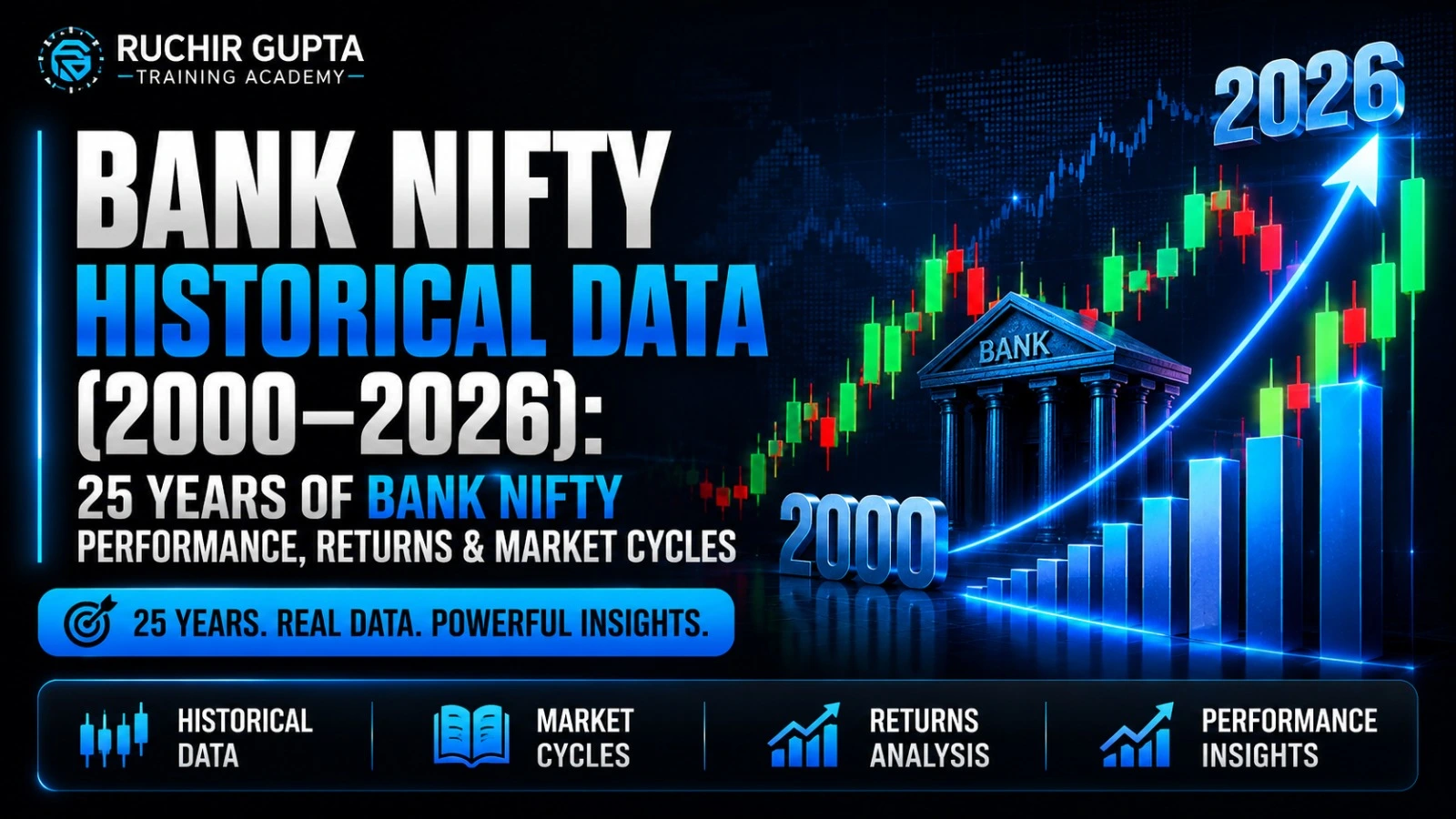
Bank Nifty Historical Data (2000–2026): 25 Years of Bank Nifty Performance, Returns & Market Cycles
The typical trader spends hours looking around for the next big breakout.
Very few take the time to learn from past experience.
Over a decade of studying Indian markets, one thing becomes clear: history does not repeat itself but market behavior rhymes.
Therefore, one of the best things a trader can do is to study the Bank Nifty historical data.
The preceding 25 years of Bank Nifty tells stories that indicators do not tell; these can be of great use to intraday traders, option buyers, option sellers, swing traders, investors, and anyone learning about technical analysis.
The banking industry is the foundation of Indian economy. A healthy bank will see a market rally. A downturn in banks tends to impact general indices.
Quick Answer
Bank Nifty historical data reflects that the index has consistently created significant long-term wealth despite a number of market crashes, such as the Financial Crisis of 2008, COVID-19 crash, and other periods of economic slowdown. Historical returns, volatility, and price movements of Bank Nifty can be analysed to identify trends and patterns, which can help traders develop their strategies, manage their risks, and make better informed decisions on market timing.
What is Bank Nifty?
Definition
Bank nifty, which is also called ‘Nifty bank index,’ is a group of the top Indian bank stocks traded on the National Stock Exchange (NSE).
The index consists of major banking institutions including:
HDFC Bank
ICICI Bank
Axis Bank
Kotak Mahindra Bank
Bank Nifty is among one of the most significant indices in India, as banks play a crucial role in impacting lending, economic growth, and liquidity.
History of Bank Nifty Index
The Nifty Bank Index was launched in 2000 to represent India’s banking sector.
Since then, India has witnessed:
- Dot-com crash
- Global Financial Crisis
- Demonetization
- COVID-19 pandemic
- Digital banking revolution
- Fintech boom
- AI-driven banking transformation
Every event left a footprint on Bank Nifty’s historical chart.
Bank Nifty Historical Data: 25-Year Overview
Period | Market Phase | Key Observation |
2000–2003 | Bear Market | Slow growth phase |
2003–2008 | Mega Bull Run | Explosive banking growth |
2008–2009 | Financial Crisis | Sharp crash |
2009–2014 | Recovery Cycle | Strong rebound |
2014–2020 | Expansion Phase | Private banks dominated |
2020 | COVID Crash | Historic volatility |
2021–2024 | Recovery Rally | New highs achieved |
2025–2026 | Mature Growth | Increased institutional participation |
Bank Nifty Historical Returns Analysis
Why Historical Returns Matter
Historical returns help traders:
Understand long-term trends
Estimate risk-reward ratios
Build realistic expectations
Improve portfolio allocation
Example
Many beginners assume Bank Nifty moves only upward.
Reality is different.
The index has experienced:
50%+ drawdowns
Multi-year consolidations
Sudden rallies
Extreme volatility periods
Understanding these phases improves trading discipline.
Estimated Bank Nifty Yearly Return Trends
Period | Market Character |
Early 2000s | Low Growth |
2003–2007 | High Growth |
2008 | Severe Decline |
2009–2010 | Strong Recovery |
2011–2013 | Range Bound |
2014–2017 | Bull Market |
2018–2019 | Selective Growth |
2020 | Extreme Volatility |
2021–2024 | Strong Expansion |
2025–2026 | Moderate Growth |
The 2008 Financial Crisis: A Historic Lesson
One of the most important periods in Bank Nifty historical records was the Global Financial Crisis.
Many traders believed banking stocks would continue rising forever.
Then the crisis struck.
What Happened?
Banking stocks collapsed
Liquidity dried up
Fear dominated markets
Volatility surged
Lesson
The biggest risk in trading is not being wrong.
The biggest risk is assuming you cannot be wrong.
COVID-19 Crash: The Fastest Recovery in History
March 2020 created panic across global markets.
Bank Nifty experienced one of its most volatile periods ever.
Trader Psychology During COVID
Most traders:
Sold at lows
Panicked during declines
Missed the recovery
Experienced traders:
Focused on risk management
Preserved capital
Waited for confirmation
This period remains one of the best case studies in Bank Nifty historical analysis.
Bank Nifty Historical Chart Analysis
Key Long-Term Patterns
When analyzing Bank Nifty historical charts, several recurring structures appear:
1. Breakout-Retest-Rally
A common pattern where:
Resistance breaks
Price retests support
Trend resumes
2. Panic Selling Events
Common characteristics:
High volume
Large candles
Media negativity
Retail panic
3. Institutional Accumulation
Usually visible through:
Gradual price increases
Strong support zones
Lower volatility
Bank Nifty Futures Historical Data
What is Bank Nifty Futures Historical Data?
Bank Nifty futures historical data includes:
Open price
High price
Low price
Close price
Volume
Open Interest
Professional traders use futures data to:
Backtest strategies
Analyze trends
Study institutional participation
Identify market sentiment
Why Futures Historical Data Matters
Example
Suppose a trader wants to test:
“Buy when Bank Nifty closes above the 20-day high.”
Without historical futures data:
No verification
No confidence
No statistical edge
With historical data:
Thousands of trades can be analyzed
Win rate becomes measurable
Risk can be quantified
Bank Nifty Options Historical Data
Why Option Traders Need Historical Data
Options traders face challenges beyond direction.
They must consider:
Implied Volatility
Time Decay
Gamma
Vega
Open Interest
Bank Nifty options historical data helps traders understand:
How premiums react
IV expansion phases
IV crush periods
Expiry behavior
Bank Nifty Historical Volatility Analysis
Definition
Historical Volatility measures the degree of price fluctuations over a specific period.
High Volatility Periods
2008 Financial Crisis
Brexit Vote
Demonetization
COVID Crash
Low Volatility Periods
Stable economic growth phases
Institutional accumulation cycles
Why Volatility Matters
Many beginners focus only on direction.
Professionals focus on:
Volatility
Position sizing
Risk exposure
Because volatility often determines profitability more than direction.
Bank Nifty Backtesting Data: Why Smart Traders Use It
Backtesting allows traders to test strategies using historical data.
Example Process
Step 1
Collect Bank Nifty historical prices.
Step 2
Create entry rules.
Step 3
Create exit rules.
Step 4
Analyze:
Win rate
Drawdown
Profit factor
Risk-adjusted returns
Common Beginner Mistakes While Studying Historical Data
Mistake #1: Looking Only at Winning Trades
Focus on:
Losing streaks
Drawdowns
Recovery periods
Mistake #2: Ignoring Volatility
A strategy that works in low volatility may fail during market crashes.
Mistake #3: Overfitting
Many traders optimize historical results until they look perfect.
Real markets rarely behave perfectly.
Mistake #4: Using Too Little Data
Testing a strategy over:
One month
One quarter
is not enough.
Serious traders examine years of Bank Nifty historical data.
Expert Insights From 25 Years of Bank Nifty History
After studying banking-sector trends for years, several conclusions stand out:
Insight 1
Risk management beats prediction.
Insight 2
Every major crash eventually created opportunity.
Insight 3
Volatility creates both danger and profit potential.
Insight 4
Most traders fail because of emotions, not strategy.
Insight 5
Historical analysis builds confidence during uncertainty.
How Professional Traders Use Historical Data
Professional traders often analyze:
Market Cycles
Expansion
Contraction
Recovery
Seasonal Trends
Budget periods
RBI policy announcements
Quarterly earnings
Statistical Probabilities
Instead of predicting:
“Market will definitely rise.”
Professionals think:
“Market historically had a 65% probability of rising in this setup.”
That mindset changes everything.
Learn to Analyze Bank Nifty Like a Professional
History is important and studying it is useful.
However, one needs to structure their learning in order to be able to turn the knowledge into actual trades.
The information provided by Ruchir Gupta Training Academy indicates that their courses are structured to cover various aspects of trading, such as technical analysis, risk management, market psychology, live market exposure, and hands-on trading skills, tailored to appeal to both novice and seasoned traders. The academy has successfully educated a significant community of traders and strongly promotes the importance of making informed trading decisions based on a disciplined approach to trading and not speculation.
Ruchir Gupta is a seasoned stock market mentor who has over 20 years of trading experience and stresses on discipline, managing risk, and systematic trading strategies. His approach to training emphasizes eliminating the need for traders to take advice from people or follow market rumors; instead, he concentrates on making traders independent decision makers.
If you’re serious about learning:
- Bank Nifty trading
- Options strategies
- Technical analysis
- Intraday trading
- Risk management
- Market psychology
then structured mentorship can significantly reduce the learning curve.
Conclusion
Bank Nifty historical data is more than just numbers—the story behind it.
It is the story of India’s economic growth, banking changes, investor’s mindset and market’s strength.
In the past 25 years, Bank Nifty has withstood its storm:
- Global financial crises
- Economic slowdowns
- Regulatory changes
- Pandemics
- Political uncertainty
But it didn’t stop this from affording opportunities to those who are more “disciplined”.
The most important lesson learnt after analysing Bank Nifty returns is that:
It is the market that is rewarding those who have made themselves ready for it but not the ones that predicted it.
Investors who seek to become consistently profitable should pay more attention to the knowledge of market history, risk management and structured trading systems, and less time to tips.
They can help them learn from the best traders such as Ruchir Gupta, and learn to understand various aspects of trading, including technical analysis and options trading, as well as the psychology behind trading, which can help them learn more quickly and avoid making the common mistakes that many new traders make.
Keep in mind that the future is unknown, but historical data gives the trader the roadmap to help navigate the future with confidence.
People Also Ask (PAA)
How can I download Bank Nifty historical data?
You can access Bank Nifty historical data through NSE-approved data providers, brokerage platforms, charting software, and professional market-data services.
What is Bank Nifty historical volatility?
Historical volatility measures past price fluctuations and helps traders estimate risk levels and option pricing behavior.
Is Bank Nifty good for backtesting?
Yes. Bank Nifty is one of the most actively traded indices in India, making it highly suitable for strategy development and backtesting.
Why do traders use Bank Nifty futures historical data?
To analyze trends, volume behavior, open interest changes, and institutional participation patterns.
Can Bank Nifty historical data predict future prices?
No. Historical data cannot predict the future with certainty. However, it helps traders identify probabilities, recurring patterns, and risk scenarios.
FAQs
What is Bank Nifty historical data?
Bank Nifty historical data refers to past price records of the Nifty Bank Index, including open, high, low, close, volume, and other market metrics.
How far back does Bank Nifty historical data go?
The Nifty Bank Index was launched in 2000, providing over 25 years of historical market information.
What is Bank Nifty historical return?
It refers to the percentage gain or loss generated by the index over a specific period.
Why is Bank Nifty important?
Because banking stocks significantly influence the Indian economy and stock market.
What is Bank Nifty futures historical data?
It includes historical futures contracts data such as price, volume, and open interest.
What is Bank Nifty options historical data?
It contains historical option-chain information including premiums, implied volatility, and open interest.
How can traders use historical data?
For strategy development, backtesting, volatility analysis, and risk management.
Is historical data enough to become profitable?
No. Data is valuable, but successful trading also requires discipline, psychology, and risk management.
What is Bank Nifty historical volatility?
A measurement of how much Bank Nifty prices fluctuated during a given period.
Which traders benefit most from historical data?
Intraday traders, swing traders, positional traders, option traders, and quantitative analysts.
Does Bank Nifty outperform during economic growth?
Historically, banking stocks tend to perform strongly during economic expansion phases.