Now, suppose you see that Nifty is going to go up, you make an educated guess, go long a call and the market moves in your favor, but the call option doesn’t go up much. Frustrating, isn’t it?
This occurs when traders fail to account for the strike price, premium, time to expiry and implied volatility. An accurate prediction doesn’t mean a profitable trade.
Ruchir Gupta Trading Academy emphasizes the importance of comprehending the logic behind the trades, not just blindly following tips.
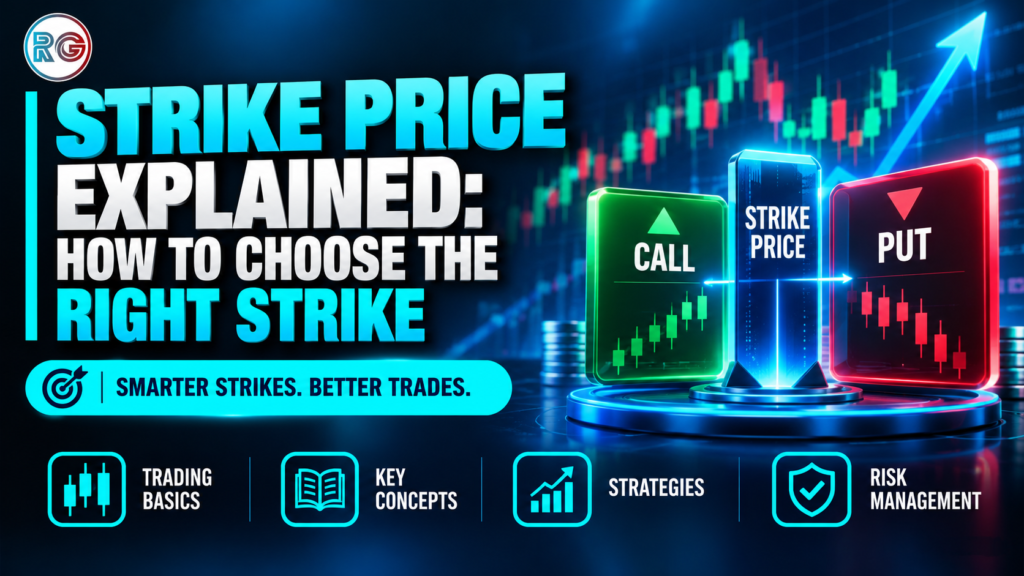
What is a Strike Price?
The strike price is the fixed agreed price at which an options contract allows the person purchasing the option to buy or sell the underlying asset.
For instance, if the price of a stock is ₹1,000 and you purchase a call option that specifies a strike price of ₹950 at which you can acquire the stock, then you can do so at ₹950 under the terms of the call option.
Important terms include:
- Underlying asset: The stock or index that the option is based on.
- Premium: The price that the option buyer pays.
- Expiry Date: When the contract expires.
- Put option: Allows the option buyer to sell the underlying asset.
- Put option: Option to sell the underlying asset to the seller.
The strike price is not a forecast of the direction of the market, but rather a reference point in the contract.
How does a Strike Price Work?
Assume the price of a share is ₹1000.Let, if a stock is trading at ₹1000. The strike price will indicate if a call or put option is in the money (ITM), at the money (ATM), or out of the money (OTM).
| Option type | Strike price | Status |
| Call | ₹950 | ITM |
| Call | ₹1,000 | ATM |
| Call | ₹1,050 | OTM |
| Put | ₹1,050 | ITM |
| Put | ₹1,000 | ATM |
| Put | ₹950 | OTM |
An option’s intrinsic value is the amount by which it is in the money. It can also have some extra value, such as the implied volatility and time value added to its premium.
Keep in mind: Correcting the direction of the market is not the only thing that matters. The option needs to have a good rate of return against the premium and the life of the option.
There are several types of strike prices, such as. ITM, ATM and OTM.
| Factor | ITM | ATM | OTM |
| Typical premium | Higher | Moderate to high | Lower |
| Intrinsic value | Positive | Usually zero | Zero |
| Main consideration | Higher upfront cost | Cost and sensitivity | Needs a good pass |
- In the Money (ITM): A call strike price that is lower than the market price; a put strike price that is higher than the market price.
- At The Money (ATM): Strike is close to the market price.
- Out of the Money (OTM): call strike is above the market price, put strike is below the market price.
There is no best strike. A lower OTM option may be appealing, but could be a no-brainer. This will be dependent on market conditions, trading goals, premium, and risk-taking capacity.
How to pick the correct strike price?
A trading plan should determine which strike to select; not the one that appears to be the lowest-cost option.
Do these six steps:
- Study underlying: Trend, support, resistance and events.
- Establish your market perspective: understand bull, bear or range market.
- Decide the expiry: Decide the length of the time to build your market view.
- Compare strikes: analyse ITM, ATM and OTM positions.
- Analyse liquidity: Liquidity includes premiums, bid-ask spread, volume and open interest.
- Estimate breakeven and potential loss points, and time decay.
If using Indian derivatives, check out the available strikes, lot sizes and expiry dates on the exchange (for instance, the National Stock Exchange of India (NSE).
Guru tip: To trade in the direction of the market, consider delta, premium and expected market price movement. When considering hedging, think about the protection needed and not the most economical. Paper trading is a great way for beginners to practice before using their real cash.
Practical Example: Decision on two call options
Assume that a stock is currently priced at ₹1,000 and you believe that its price will increase before the expiration.
| Detail | Option A | Option B |
| Strike price | ₹1,000 | ₹1,050 |
| Premium per share | ₹30 | ₹12 |
| Breakeven at expiry | ₹1,030 | ₹1,062 |
| The maximum loss a buyer can experience per share | ₹30 | ₹12 |
Illustrative figures; transaction costs not included.
When the stock closes at ₹1040:
- Option A: The intrinsic value is ₹40. Profit = ₹40 − ₹30 = ₹10 per share.
- If the option B is used, it will be the intrinsic value to be ₹0. Loss = ₹12 per share.
Option B was less costly but still out of the money. Option A made a profit at maturity.
A long call is when the breakeven is strike price + premium. In the case of a long put, it is the strike minus premium.
The next time you trade, avoid these common strike price mistakes.
Here are some of the typical pitfalls to steer clear of when trading options:
- Using cheap OTM options: There is a risk that you could lose all of the premium.
- Failure to account for time decay: Options can decrease in value even when the market is moving in their favour.
- Following sharp movements: You could be charged too much.
- Ignoring volatility: Volatility can fall and decrease premiums.
- Addressing liquidity issues: The execution cost is high due to wide bid-ask spreads.
- Trading without a loss limit: Making sure you have a risk that you won’t exceed before you begin a trade.
- Mixing probability and profitability up: The higher the probability of completing the ITM the greater the returns doesn’t necessarily mean.
Know market and liquidity risks before engaging in derivative trading.
Options trading with Ruchir Gupta trading academy.
However, comprehending strike prices is not a complete guide to a disciplined trader. In addition to that, chart analysis, volatility, entry and exit planning and risk management are also crucial.
Ruchir Gupta Trading Academy offers students the opportunity to learn about:
- The Concept of Options and option pricing.
- ITM, ATM, and OTM make comparisons.
- Technical analysis and support and resistance.
- Intraday trading and position sizing.
- Business reviews and risk management.
Looking to improve your trading skills? Explore a stock market course by Ruchir Gupta and enquire about available training and mentorship options. Assess the curriculum and the way it will be practically taught, not on the promise of profits.
Conclusion: Select a Strike With a Plan
The class finishes by selecting a Strike With a Plan.
The strike price affects an option’s intrinsic value, premium, breakeven and eventual profit or loss when the option expires. Compare strikes, make realistic price estimates, consider time decay and volatility and establish a maximum acceptable loss prior to entering a trade.
To learn these skills, check the Ruchir Gupta Trading Academy that provides stock market education, technical analysis, and options trading. Prioritise risk management, learning, and practicing over expanding levels of exposure.
Disclaimer: This article is provided for informational purposes only and should not be considered a recommendation for investment. Options trading is a risky and risky business that can lead to a complete loss of the premium paid for the option. Check up-to-date exchange regulations and contract conditions.